The Philippines could avoid 1.7 billion pesos in coal and gas import costs by meeting its 2030 solar target
May 3, 2026
- The Philippine Energy Plan sets a course for at least 9.5 GW of solar capacity by 2030.
- If the Philippines meets this target, it could potentially avoid spending approximately PHP 1.7 billion (USD 28 million) on coal and gas imports, the prices of which fluctuate depending on geopolitical conflicts.
- Savings on this scale could help deliver critical national policy. PHP 1.7 billion would more than cover, for example, the full cost of the Cancer Assistance Fund planned for vulnerable citizens in 2026.
- The Philippines’ response to the current energy crisis includes fast-tracking over 1.4 GW of renewable energy and storage by the end of April. If the country acts as swiftly to meet its 2030 solar target, it could both ensure long-term energy security and surpass national climate goals.
As the Iran war reaches its tenth week, major supply cuts caused by the conflict have led to soaring energy prices in Asia. Asian countries account for most of the oil and gas flows passing through the Strait of Hormuz, which is now effectively closed.
Asian liquefied natural gas (LNG) prices hit USD 16.55 per million British thermal units (mmBtu) as of 24 April 2026, up about 54.3% from 27 February (one day before the war broke out). The price of Newcastle Coal, Asia’s coal benchmark, was reported to have reached USD 150 per tonne on 9 March, the highest price since November 2024, and was still as high as USD 133.7 per tonne as of 24 April.
In 2022, the Russian invasion of Ukraine also led to an energy crisis that caused historical price spikes in Asian LNG. The same crisis contributed to high inflation, slower economic growth, and increased levels of poverty for many citizens around the world.
Today, geopolitical tensions stemming from the Iran war continue to create uncertainty in coal and LNG markets.
Higher global fossil fuel prices increase the cost of generating power, including the cost of producing electricity. For Asian countries with highly regulated markets, the government will have to absorb these extra costs, putting pressure on reserves and public services. But in countries where generation costs are directly passed on to consumers through power bills, including the Philippines, this could mean higher electricity bills for the population.
According to documents from the Manila Electric Company, Meralco, generation costs accounted for 60% of electricity bills for non-lifeline consumers (those who do not qualify for a subsidised rate for low-income households) using between 200 and 300 kWh in March 2026. This means that when conflict pushes up coal and gas import prices, consumers’ power bills in the Philippines are also likely to rise.
Filipino citizens are already subject to one of the highest power bills in Asia: the country had the third-highest average electricity price in the region from 2023 to 2026, behind only Singapore and Japan.
There are many reasons for the country’s high power prices, including inefficient coal plants, poorly connected grid infrastructure, and a lack of government subsidies for fossil fuel-based electricity generation. However, one major reason is its heavy reliance on expensive coal and gas imports. The Philippines is a net coal importer, and is planning on expanding gas imports by 8.3% per year until 2050, as domestic gas supplies dwindle.
According to the Philippine Energy Plan’s most conservative reference scenario, the country aims to reach 9.5 GW of installed solar capacity1 by 2030. This means adding about 5.8 GW between 2025 and 2030; as of 2025, the Philippines’ solar capacity stood at around 3.7 GW.
Zero Carbon Analytics estimated how much the Philippines could avoid spending on fossil fuel imports by using domestically generated solar power, which will be available if the 2030 solar target is achieved.
To do this, we calculated how much it would cost the country to replace 13.34 TWh of solar generation2 with coal and gas imported at forecasted 2030 prices.3
We found that meeting the existing 2030 solar target could help the Philippines avoid approximately PHP 1.7 billion (USD 28 million) in coal and gas import costs.5 These savings comprise approximately PHP 1.4 billion (USD 23.6 million) from avoided gas imports and approximately PHP 269.6 million (USD 4.5 million) from avoided coal imports.6
In other words, prioritising clean energy in its power mix would help the Philippines avoid the impacts of fluctuating global energy prices. The avoided costs could instead help fund policies which support the national development plan; PHP 1.7 billion would, for example, be more than enough to deliver the Cancer Assistance Fund for vulnerable people that is promised in the Philippines’ budget for 2026.7
In response to the current national energy emergency, the Philippines has taken immediate measures to promote renewables.
On 30 March, the Philippine government reported the activation of 250 MW of solar capacity and 450 megawatt-hour (MWh) of battery storage. On 1 April 2026, the Department of Energy announced it would fast-track the completion of 22 power projects to bring an additional 1,471 megawatts (MW) of renewable energy and storage online by the end of the month.
These measures are in line with a range of clean energy policy announcements made across Asia, especially ASEAN, since the start of the Iran war (see Table 1 and Figure 1). For example, on 11 April, the Thai government approved THB 5 billion in soft loans to support the public’s energy transition efforts, such as rooftop solar installations and EV purchases. On 13 April, Indonesia’s state-owned electricity company, PLN, shared plans to replace more than 2,000 diesel-powered plants (with a total capacity of 1.07 GW) with new renewable energy-based power plants, citing the need to reduce reliance on expensive imported fuels.
(28 February 2026-date of publication)
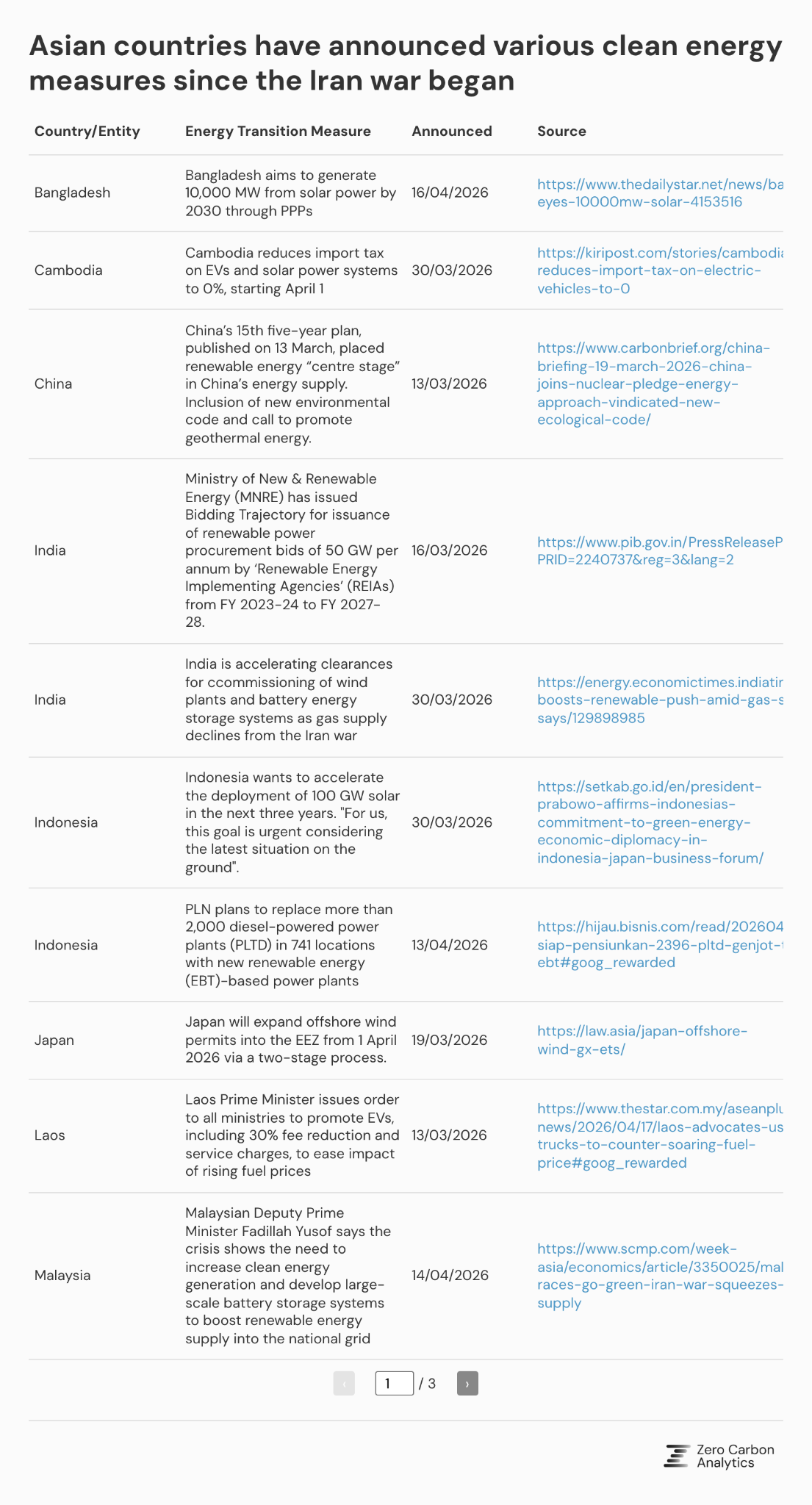
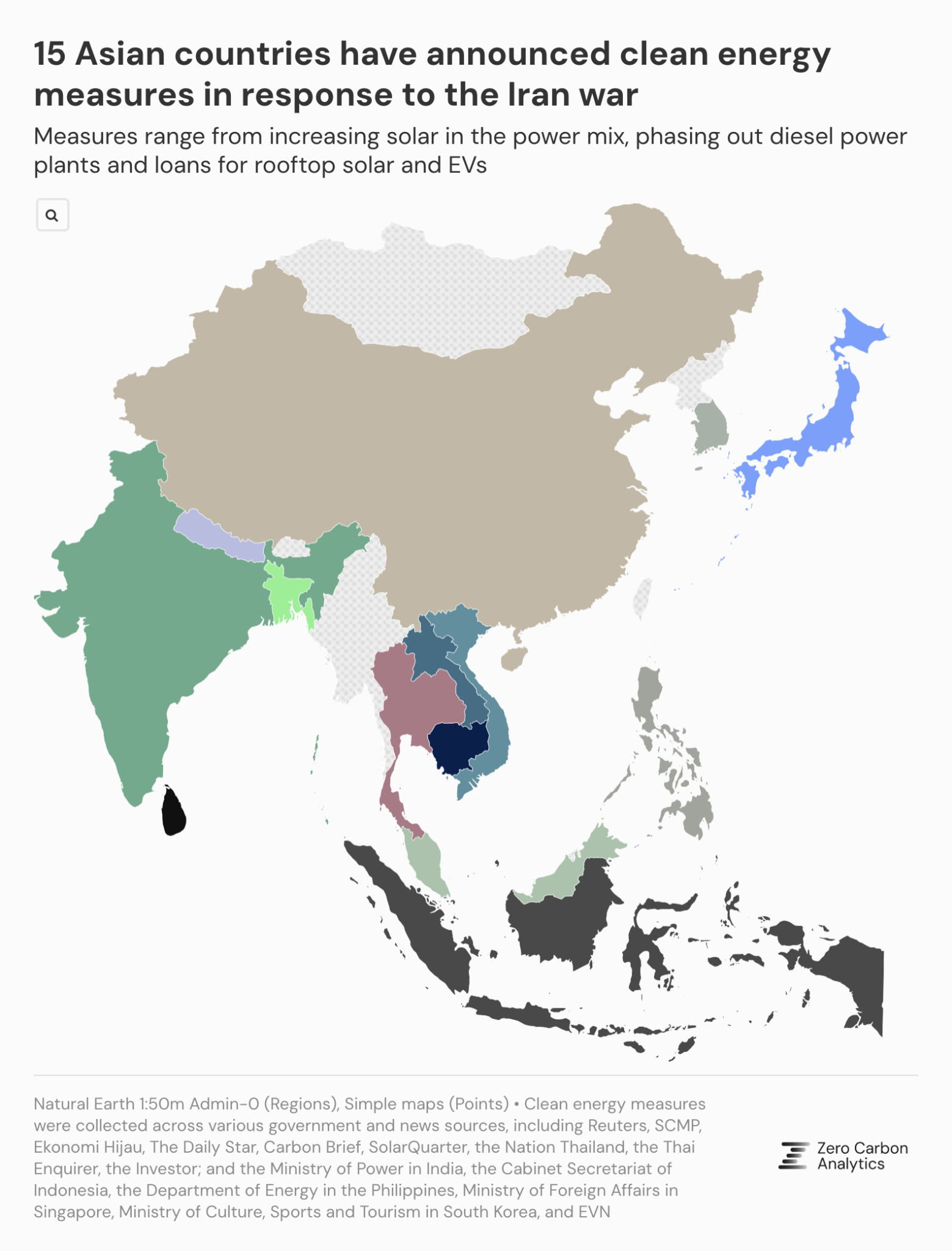
It is difficult to rank these responses in terms of overall effectiveness, as many of the clean energy measures are only just being implemented or are still in the planning stages. However, some measures are more robust than others in terms of specific metrics.
For example, in terms of the greatest renewable capacity commitment made in response to the war, Indonesia leads ASEAN, having promised to deploy 100 GW of solar within the next three years. In terms of overall financing for renewables, Thailand takes the lead in the region, with a THB 5 billion (approximately USD 154 million) commitment to various clean energy measures.
Among the countries that are improving storage and grids to accommodate new renewable capacity, the Philippines is showing the greatest ambition, having already connected 450 MWh of battery storage to the grid. In mid-April, the country also announced a new round of green energy auctions focused on initiatives such as battery energy storage systems (BESS). While Malaysia’s Deputy Prime Minister said the crisis showed the need to develop large-scale battery storage systems to boost renewable energy into the grid, the country has not yet made specific commitments to develop the grid as a response to the war.
Meanwhile, Vietnam leads ASEAN in terms of committing to the greatest number of plans to phase out existing fossil fuels, both in the recent update to its Just Energy Transition Partnership (JETP) plan to phase out coal plants and Vingroup’s request that the government scrap plans to build an LNG-to-power plant.
Beyond energy security, shifting to solar also makes economic sense: solar power is already the cheapest source of power generation, especially compared to gas, in the Philippines, Malaysia, and Thailand. An analysis by the Center for Energy, Ecology and Development (CEED) estimates that the deployment of one million 500-watt solar grids in the Philippines could potentially save households up to PHP 373.14 million per month, based on Meralco’s March 2026 electricity rates.
Solar saves costs in other ASEAN countries as well: previous Zero Carbon Analytics research has shown that solar helped save hundreds of millions of dollars in fossil fuel import costs for Vietnam, and cut power bills by almost 80% for solar users compared to non-solar users in Thailand.
Therefore, if the Philippines’ reactive pro-solar measures become permanent policy decisions, it could not only lead to long-term energy security even in the face of global disruptions, but also ensure that the country hits or even surpasses its national target for 35% renewable energy by 2030. This is related to the country’s NDC commitment to cut emissions up to 75% between 2020 and 2030. However, Climate Action Tracker notes that coal and gas generation are also expected to increase 20% and 75%, respectively, above 2023 levels by 2030. As coal and gas prices continue to fluctuate due to the war, the Philippine government should consider both the economic and climate benefits of solar in the long run.
- This figure was calculated by adding the new solar capacity figures for Luzon, Visayas and Mindanao for 2030 from the Philippines Energy Plan’s (PEP) reference scenario, with the 2025 figure for installed solar capacity from TransitionZero. ↩︎
- This figure was calculated by multiplying the installed solar capacity for 2030, which is 9518 megawatts, according to the PEP, by the Philippines’ capacity factor for solar, and 8760, the number of hours in a year. ↩︎
- Calculations were based on an average for Newcastle Coal futures and Japan/Korea Marker (JKM) futures prices for 2030.
↩︎ - This figure does not account for capital costs recovery, operation and maintenance, grid balancing, or storage costs required to integrate this level of solar capacity. ↩︎
- We assumed that coal and gas could replace solar in proportion to their respective shares of total generation, as they make up more than 99% of fossil fuels in the Philippines’ energy mix. We assumed the ratio of coal imports in power generation will take up about 12%, first by calculating the amount of coal used in power generation by dividing the amount of coal used for power consumption by the likely total amount of coal used in 2024 (we assume this ratio will hold for 2030), then multiplying this by the total coal imports and total power generation from coal in 2030. For gas, we assume the ratio of gas imports in power generation will take up about 85%, by dividing the total figure of imported gas consumed by the total figure of imported gas supply in 2024 (we also assume this ratio will hold for 2030). ↩︎
- We compared the estimated savings from avoided coal and gas imports (approximately PHP 1.7 billion) with deliverables in the Enacted FY 2026 National Budget to find a programme of similar value; the Cancer Assistance Fund is a social health protection programme budgeted at PHP 1.5 billion. ↩︎
Search
RECENT PRESS RELEASES
Related Post