The price of Bitcoin has fallen to its lowest level since the tariff shock last year, once
January 31, 2026
The price of Bitcoin has fallen to its lowest level since last year’s tariff shock, moving in tandem with precious metal prices, which has further undermined market confidence in cryptocurrencies.
In the early hours of February 1st, Bitcoin experienced a sharp decline, briefly dropping below $76,000 per unit before rebounding somewhat. As of this writing, Bitcoin is trading at approximately $78,500, with a staggering 24-hour drop of 6.6%, and its losses since the start of the year have widened to 10%.
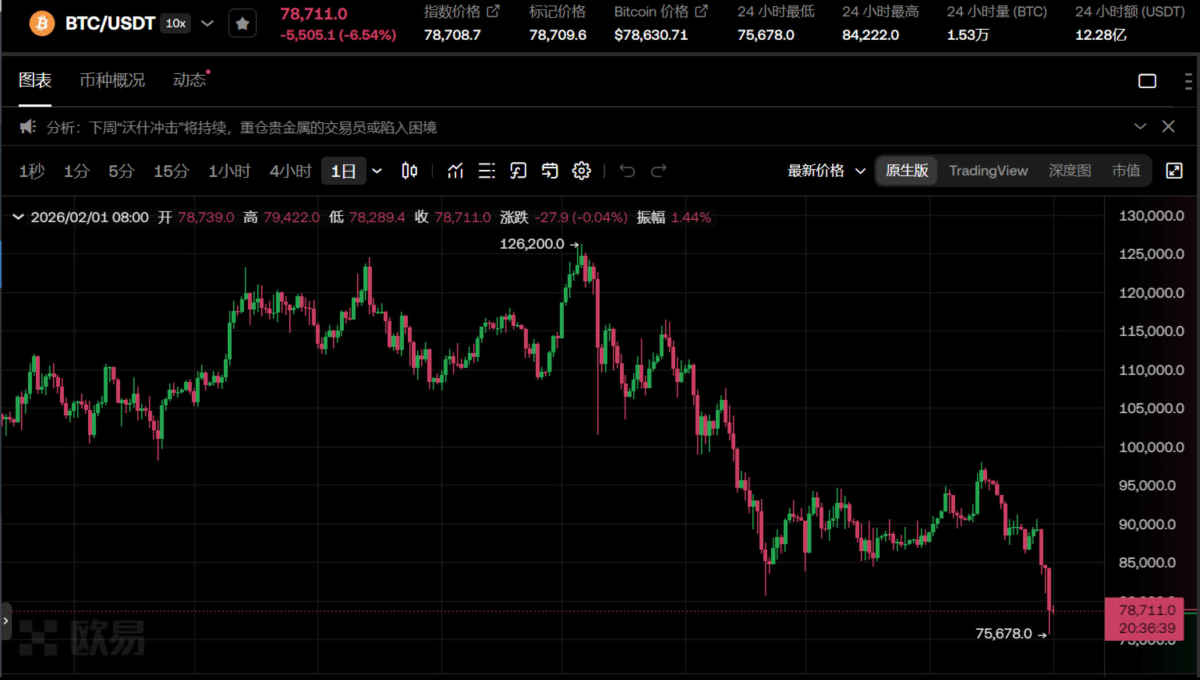
 Ethereum and Solana also recorded declines, with Ethereum plummeting by 9.4% in the past 24 hours, and Solana dropping more than 11%.
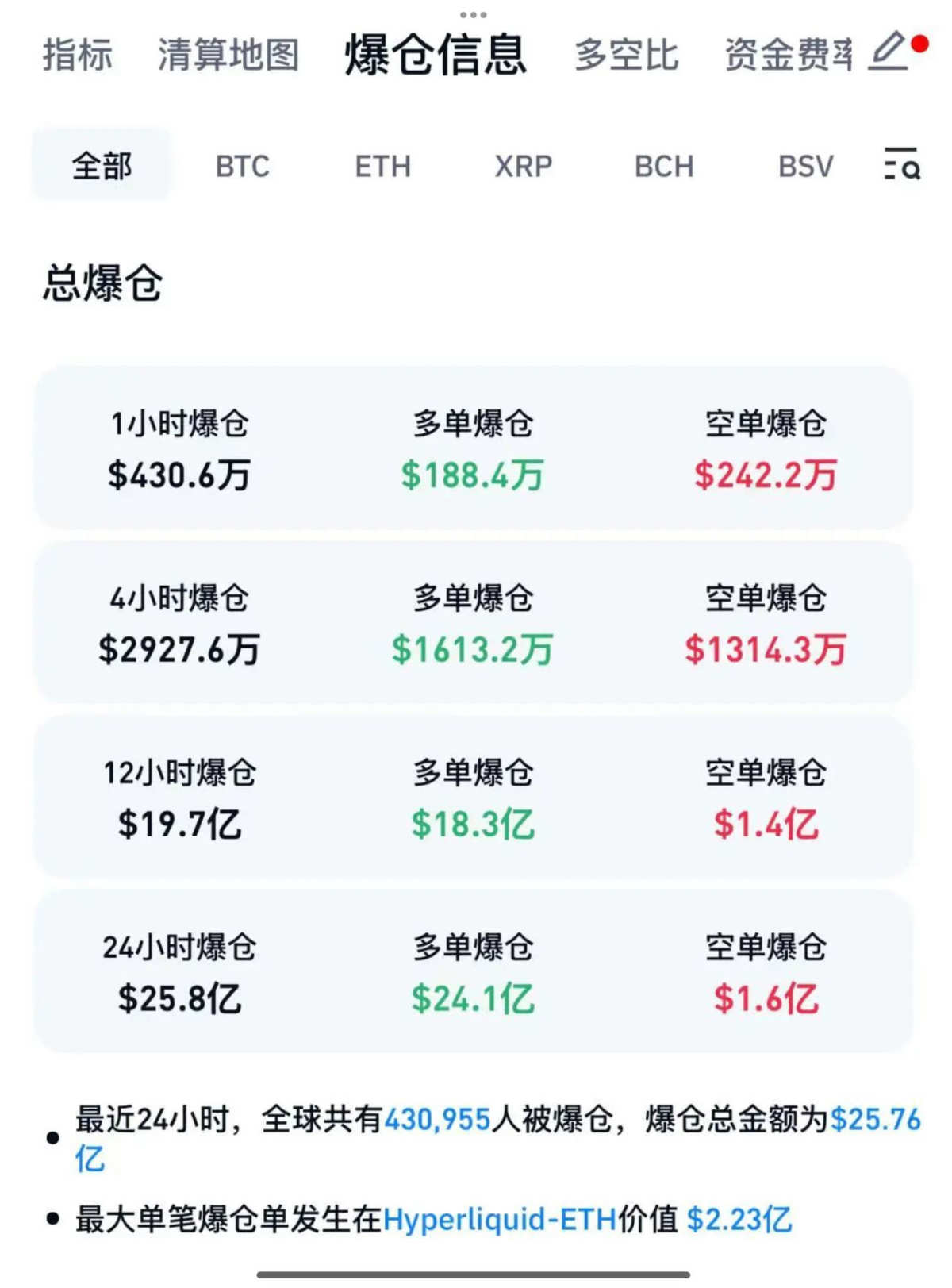
According to data from Coinglass, in the past 24 hours, a total of $2.58 billion worth of cryptocurrency contracts were liquidated across all networks, affecting over 430,000 traders. Among these, long position liquidations accounted for $2.41 billion, while short position liquidations totaled $160 million. The largest single liquidation order occurred on Hyperliquid-ETH, valued at $223 million.
Meanwhile, gold, which recently broke through $5,600 per ounce, retreated sharply on Friday to $4,800. Silver prices plummeted even more drastically, with spot prices falling 26.3% on Friday to $85.15 per ounce, down more than 30% from Thursday’s record high.
The decline in gold, silver, and cryptocurrency prices occurred after U.S. President Trump appointed Kevin Warsh as the Federal Reserve Chairman, a move that boosted the U.S. dollar and alleviated concerns about the Federal Reserve’s independence. However, a stronger dollar could reduce the attractiveness of gold, silver, and Bitcoin as alternative currencies for investors.
Identity Crisis
Although cryptocurrencies followed gold and silver prices lower this week, the previous rapid rise in gold and silver prices reflected investor preference for safe-haven assets amid escalating geopolitical conflicts. At that time, however, Bitcoin prices remained weak, as the market increasingly viewed cryptocurrencies as a risky asset.
Ilan Solot, Senior Global Market Strategist at Marex Solutions, stated that Bitcoin is an asset searching for a valuation model, and the market currently lacks a clear consensus on what factors drive its price fluctuations.
Pramol Dhawan, Managing Director at Pimco, argued that the notion of Bitcoin as digital gold no longer holds, and its price decline indicates that it is “not a monetary revolution.”
A senior insider in the crypto industry emphasized that Bitcoin is becoming associated with the current U.S. administration and is paying a price for this association.
At the end of last year, due to investor confidence in the crypto-friendly measures of the Trump administration, the price of Bitcoin once hit a historic high of nearly $125,000. However, Trump’s ongoing tariff threats, statements demanding the annexation of Greenland, and tensions with Iran and Venezuela severely dampened investment enthusiasm in cryptocurrencies.
Analysts at crypto research firm Kaiko wrote that the correlation between Bitcoin and gold is inherently unstable, oscillating between strong positive and negative correlations depending on the prevailing macro narrative. Fluctuations related to tariffs have exposed Bitcoin’s ongoing identity crisis.
This article is reprinted from the ‘Cailian Press’ app, authored by Ma Lan, and edited by Song Zhiying of Zhitong Finance.
Search
RECENT PRESS RELEASES
Related Post