The rise of humanoid robots to catalyse labour relations
March 26, 2026
Growing use of smart robots on the factory floor could revolutionise the way vehicles are made, improving workplace safety and efficiency. While manufacturing automation is nothing new to the automotive industry, physical AI is, and it is opening the door to all sorts of advanced applications. Of late, big name players are showing particular interest in AI-powered humanoid robots, with the likes of BMW, Tesla, Hyundai and Nvidia leading the push. But from some corners, workers have started to push back.
Unrest at Hyundai
Hyundai has particularly bullish plans for humanoid robots. Not only does it intend to widely deploy Boston Dynamics’ Atlas model within its car factories, but it has also taken a controlling stake in the robotics specialist and plans to make physical AI a core pillar of its strategy. Hyundai production workers are worried about the impact these robots will have on the existing labour system and job prospects.
In a January 2026 newsletter, Hyundai’s South Korean union warned that the Atlas plans would be met with resistance: “Under no circumstances will workers welcome the plan, as the robot deployment will bring a huge employment shock.” The statement went on to claim that “not a single robot can be accepted without labour-management agreement.”

How this plays out at Hyundai remains to be seen, but it’s an issue that stretches far beyond this single automaker. “As deployment increases, debate around robotics and labour agreements is understandable,” says Burkhard Boecken, Chief Technology Officer at Hexagon. The company’s global Robot Generation study found that among adults, the biggest concern with robots was around hacking (51%), followed by replacing humans at work (41%) and trust (26%). Of the nine countries included in the study, South Korea had the lowest level of worry about robots (29%), with the UK showing the highest (52%). Given the pushback that’s already emerged from Hyundai’s union in South Korea, it would be reasonable to expect even greater concerns in other key automotive markets.
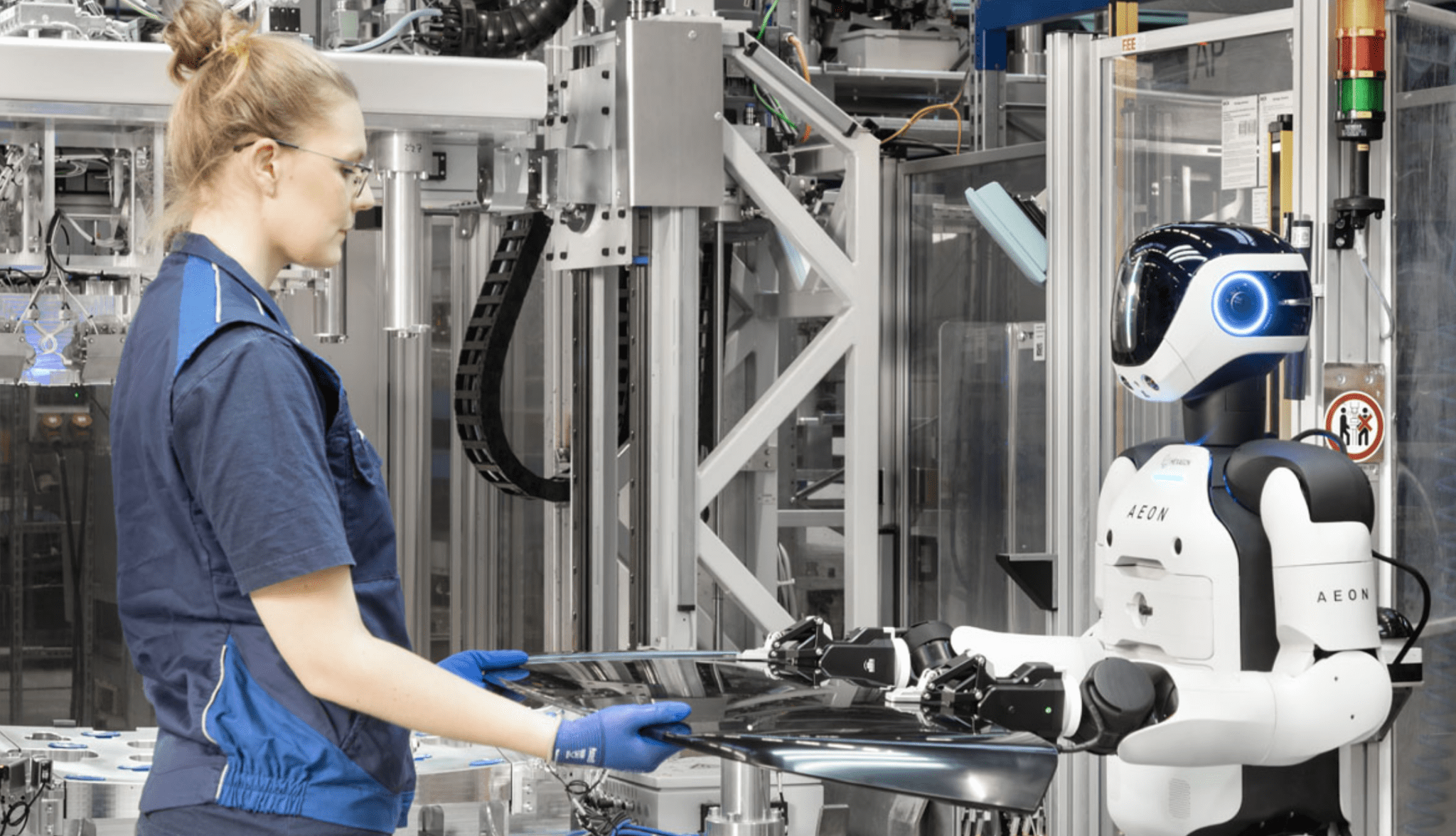
Hexagon’s researchers concluded that anxiety about robots is highest where exposure to them is lowest. Boeckhem believes that “when people see robots operating safely on the factory floor and understand the role they play in production, confidence can increase quickly.” But Hexagon is far from disinterested in the subject; its Robotics Division developed the humanoid robot AEON, which is now in a pilot deployment at the BMW Group’s Leipzig plant. “Ultimately, the conversation around robotics is less about replacement and more about collaboration,” insists Boeckem. “As automation takes on repetitive or physically demanding tasks, it allows skilled workers to focus on higher-value roles while supporting safer and more productive manufacturing environments.”
Rewriting labour policy
In one way or another, growing use of advanced robotics will indeed impact the labour force. Despite the assertions by Hyundai workers, unions have not historically had the power to veto robotic deployments by citing existing labour agreements. “As a rule, collective agreements do not allow unions to directly have a say on technological change,” explains Frido Wenten, Assistant Professor of Management at the Department of Management, London School of Economics and Political Sciences. “Even far-reaching agreements only allow unions to negotiate implementation and impact, not the deployment of technology per se.”
However, each technology brings unique challenges to labour relations. Taking data protection and algorithmic management as an example, Wenten notes: “Privacy laws could empower unions to restrict the use of robots, AI, and machine learning on the shop floor, as has been seen in Spain. If Atlas robots are deployed alongside human workers, questions of control may arise regarding workers’ ability to stop or alter the robots’ operations. As human-robot interactions become closer, the role of health and safety in regulating the use of robots will become more important, and careful negotiation will be required.”
Many unions, particularly in Europe, have been signalling a cooperative stance on technological change in the wake of industry headwinds and the transition to electrified vehicles. “Automotive unions, whose strength lies with the global OEMs, are likely to accept robotisation but bargain hard for beneficial conditions for their members,” Wenten tells Automotive World. “Where industrial bargaining exists, this could reach further than individual enterprises. However, even in those cases, employers will likely offset the associated increase in labour costs by expanding contingent employment or production in lower-wage locations at the expense of standard jobs in their core regions.” He concludes that robotisation “appears to be more catalyst than cause of challenging employment relations in the automotive industry.”
The new ‘best practice’
Facing an ageing workforce and labour shortages, as well as efficiency pressure, the manufacturing industry will increasingly look to deploy automation. The rapid development of physical AI will need to be carefully managed in a phased manner. “In the longer term, there is likely to be a deeper, progressive, adoption of this new humanoid form of automation, alongside many other new enabling technologies,” says Professor Robert Harrison, Head of Automation Systems, WMG, University of Warwick. “The move to automation in the automotive sector is not a new thing, and in general it has resulted in higher quality, better paid, jobs and higher productivity. If that leads to sales growth then the net impact on job numbers may be mitigated. Conversely, companies which do not move with the times will struggle financially, which itself would result in job losses or displacement of manufacturing to more cost-effective regions.”
So what does best practice in this emerging paradigm look like? “Companies should commit to retraining factory workers to manage, repair, and work alongside robots, transitioning them to higher-skilled roles,” advises Harrison. “Research indicates that human-robot teams are more productive than either working alone. In terms of humanoid usage this can be seen as a logical extension of the Industry 5.0 concept, where the use of robots assists humans rather than replaces them.” In this concept, robots generally handle particular tasks—the most tedious or repetitive parts of a job or addressing the dirty, dull, and dangerous tasks—rather than replacing entire professions.
The road ahead leads into uncharted territory when it comes to human and robot relationships. Automakers need to address overcapacity and low profit margins, but they don’t want to become embroiled in lengthy, costly negotiations or face industrial action. Workers are understandably worried, and opposition could delay robotic deployments or stipulate conditions different from what was initially planned. The next few years will likely see the emergence of new labour relations templates specifically designed to reflect the realities of the physical AI era.
Search
RECENT PRESS RELEASES
Related Post