The Truth About the Environmental Impacts of Clean Energy
June 16, 2026
Building more Maine-made clean energy can make electricity costs more affordable, create new good-paying jobs, and reduce our dependence on expensive out-of-state fossil fuels.
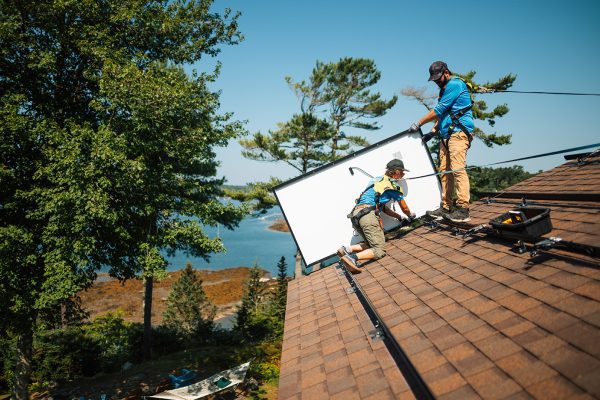
Photo courtesy ReVision Energy
But opponents of clean energy, backed by national funders and fossil fuel interests, frequently spread misinformation to confuse people and set us back, so they can continue to rake in huge profits at the expense of the health of people, communities, and the environment. Instead of cleaner air and more reliable electricity they want to keep us paying for oil, coal, and gas that are fueling destructive storms, making air quality worse, and threatening our heritage industries like farming and fishing.
One of the most common ways that these fossil fuel-backed interests try to block progress is by raising concerns about the energy use and materials needed to build clean energy technologies, like wind turbines or solar panels, or the impacts from disposal.
At the Natural Resources Council of Maine, we always welcome questions about emissions, energy use, and waste, because genuine questions represent a deep and shared value of making sure the Maine we know and love is passed on to future generations in better shape than we found it.
If you’ve got questions prompted by social media posts you’ve seen or stories you’ve read, here’s what you need to know about the real impacts of clean energy.
Our Reliance on Fossil Fuels is Costly
The first thing to acknowledge is that every energy system—whether its oil, gas, solar or wind—has impacts. This means we need to approach the development of any new sources of energy thoughtfully. We can do this by listening to the needs of local communities and acting based on science.
The best way to evaluate these issues is by asking: Which resources are the most damaging relative to the alternatives? The clear, unequivocable answer is that our reliance on fossil fuels is causing enormous damage. These impacts are wide ranging—from polluting our air and water, to harming vulnerable communities during extraction and production, and fueling climate change. Homegrown clean energy sources like solar and wind of course have some impacts, but they pale in comparison to those from coal, oil, and gas.
Lifecycle Pollution from Clean Energy is Much Lower Than Fossil Fuels
One question we often get is this: How much greenhouse gas emissions are associated with manufacturing and building clean energy? Is it even worth it? The way analysts think about this is by measuring what are called “lifecycle emissions,” or all of the emissions associated with a given technology, from resource extraction, construction or manufacturing, operation, and disposal.
When we look at lifecycle emissions—renewable energy has a clear leg up by an order of magnitudes:
- Lifecycle emissions for wind energy (including both onshore and offshore) average 13 grams of carbon dioxide equivalent per kilowatt-hour (g CO2e/kWh).
- Solar averages 43 g CO2e/kWh.
- Natural gas, which is mostly what renewable energy will replace in New England, emits 486 g CO2e/kWh, and
- Oil, which fuels some of our oldest and dirtiest peaking power plants, like Wyman Station in Yarmouth, average 840 g CO2e/kWh.
(Source: https://docs.nrel.gov/docs/fy21osti/80580.pdf).
Fossil Fuels Use 50 TIMES More Materials Than Clean Energy
Another question we get is about the use of materials. For example: “Doesn’t renewable energy use a lot of lithium for EV batteries, concrete and steel for wind turbines, or ‘rare earth’ materials that go into electric motors and generators?” These are all great questions. While it’s true that building clean energy resources will need materials, clean energy has a big advantage here, too, compared to the system we have today.
Fossil fuels are single-use fuels. These older technologies are hungry for resources every single day, and once those resources are produced, they’re burned and gone forever, constantly leaving pollution behind. Clean energy technologies, on the other hand, use materials in construction or manufacturing once, but then produce energy, transportation, or heating for years and years without new major inputs. Plus, many of these materials are recyclable.

Clean Energy Will Have Lower Waste Impacts
The last big set of questions we often hear about clean energy has to do with what happens at the end of a solar panel or wind turbine’s life? Are they recyclable? Do we need to worry about waste?
The answer is yes, always, but when we consider all of the ways we create waste, clean energy is a pretty small contributor. One recent study in the journal Nature evaluated the relative scales of several waste streams worldwide. They found that, worldwide, solar waste generated between 2016 and 2050 would result in between 54 and 160 million metric tons of waste. Wind turbine waste is in the same ballpark, estimated at around 42 million tons. While these are significant and important to try to reduce, they are far smaller than other waste streams including coal ash, plastic waste, and municipal waste.

If we’re truly concerned about addressing the waste crisis facing our cities and towns, we should focus on proven solutions like composting, reuse, and recycling, and ensuring waste and packaging producers are taking responsibility for the trash they create.

Photo courtesy of ReVision Energy
Fossil fuels also leave a toxic legacy that clean energy products don’t. According to the U.S. Environmental Protection Agency, coal ash contains a number of substances harmful to human health, including arsenic, cadmium, and mercury. Fluid waste from hydraulic fracturing or fracking—which is the source of much of the natural gas Maine uses for electricity generation—can be radioactive, and is not currently regulated, leading to dangerous uses, like dust suppression or deicing roads.
With any waste stream, we need to do our best to recycle instead of sending materials to the landfill. By mass, the largest portions of wind turbines are iron and steel, both highly recyclable, and in practice, highly recycled. Solar panels are also made of highly recyclable materials, mostly glass, but also including other valuable materials. Here in Maine, our laws already require recycling of materials, to the maximum extent practicable, when a development is decommissioned. This means, when these projects reach end of life, the finite materials used to construct a solar array are recycled and used again for future projects.
Not every part of these energy technologies are currently being recycled. Wind turbine blades for example are composite materials that are difficult to recycle. Because most solar panels that have ever been installed are still operating and have not yet reached the end of their useful life, large-scale solar recycling operations are just starting to scale up around the country. More work in these areas is important to further reduce the waste impacts of clean energy technologies. But compared to the waste and pollution created by the fossil fuel industry, clean energy still comes out ahead.

Common Loon and baby, by Nathaniel Child
Clean Energy is the Clear Choice for Our Environmental Future
NRCM’s climate team is focused on advancing a clean, affordable energy future. This work is rooted in our decades-old mission to protect, conserve, and restore Maine’s woods, waters, and wildlife. It’s clearer all the time that climate change is the biggest threat to the wild places, plants and animals, and waterbodies that make Maine so special. This is why we work hard to move toward a healthier, more equitable energy system, and away from polluting fossil fuels.
For those of us who care deeply about the future of Maine’s clean air and water, wildlife and healthy communities, we can confidently choose the pathway of American-made clean energy as the best path forward to not only address climate change, but significantly reduce the overall environmental burdens we create when we use energy.
—Jack Shapiro, NRCM Climate & Clean Energy Director
Search
RECENT PRESS RELEASES
Related Post