There Is No Such Thing as Impact Investing (SSIR)
December 11, 2025
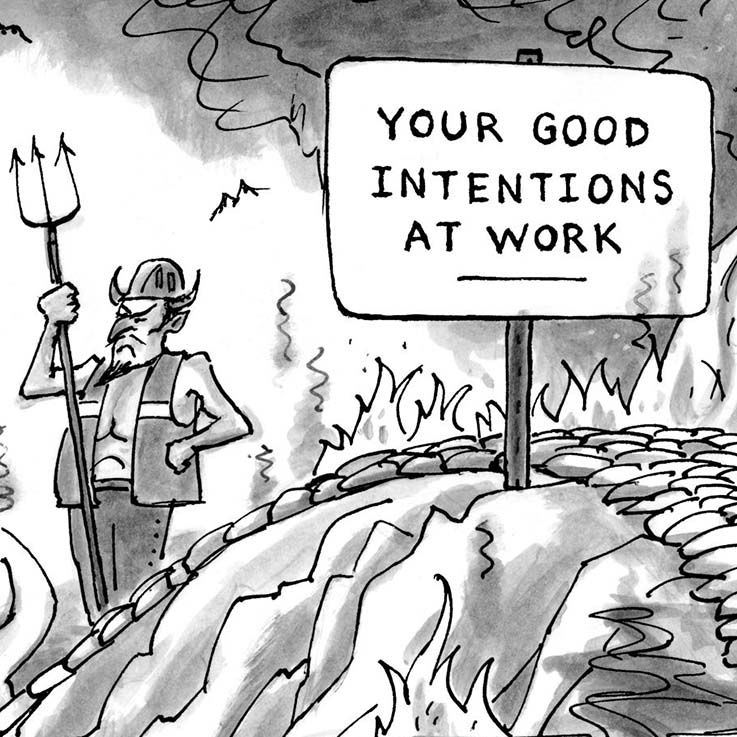
(www.CartoonStock.com)
Sometimes a prosaic AI query produces something that looks more like parody. The other day, I asked Claude to give me the latest definition of “impact investing” and it served up this gem:
“There’s ongoing discussion in 2024 about whether the definition should evolve beyond intentionality toward emphasizing real-world change and the additionality of capital.”
The conclusion of that discussion was basically, “Um, no.” And the increasingly obvious reason is that “real-world change” often requires something less than market rates of return. I’m old enough to remember the heady days when impact investing was about “patient capital” and concessionary finance and maybe—gasp—trying to be accountable for impact. Now what we get is “intentionality.”
And sometimes we don’t even get that. Anyone who works in Sub-Saharan Africa has witnessed the steady dwindling of capital that would qualify for even the most generous definition of impact investing. There are continually fewer practitioners, investing continually less money, and trying to mitigate risk with increasingly onerous due diligence. Given the dramatic contraction of Big Aid, we need market-based solutions more than ever, and it’s a really bad time for impact investing to be failing us.
Luckily, I have a solution to the myriad disappointments of impact investing: Get rid of it.
Are you enjoying this article? Read more like this, plus SSIR’s full archive of content, when you subscribe.
The fundamental problem is that impact investing is neither fish nor fowl. Philanthropists look at the returns impact investors are seeking and think they’re greedy. Investors look at the concessionary deals necessary to drive “real world change” and think they’re dumb. Funders who are at pains to be risk-taking and generous in their grantmaking suddenly become steely-eyed, risk-averse nitpickers when looking at high-impact for-profits. Nobody’s happy.
Impact investing is supposed to occupy a space between philanthropy and commercial investing. Intentions without concessions have left that space mostly empty. This stifles much-needed innovation in poor countries, because the things that make them poor are the same things that make them hard places to start and grow businesses. It’s not going to happen without concessionary finance. “Concessionary” means you’re taking a hit on expected return because you’re serious about impact. That means cheap loans, risky equity positions on generous terms without expectation of higher returns, and even straight-up grants.
That hit you take in the service of impact has a name. It’s “philanthropy.” It takes a different form than traditional nonprofit grantmaking, but it’s still philanthropy.
So. That leaves us with just philanthropy and commercial investing. Philanthropic investors get to be—and feel—generous and commercial investors get to focus on maximizing profits. Start-ups in tough markets get funded, and commercial investors can step in when things have been de-risked. Commercial investors can talk up their intentions without having to worry about additionality (not that they ever really did). Philanthropists get the chance to drive impact, recycle their money, and occasionally see a return. Everybody’s happy.
At Mulago, we’re obsessed with the idea of exponential impact over time and have evolved our funding of for-profits accordingly. It goes like this:
- In most cases, the way a business idea goes exponential—puts a big dent in a big problem—is when lots of businesses take it up.
- That means that the business idea must be attractively profitable, because who wants to take up an idea that isn’t? “Sustainable” does not mean as “scalable.”
- The problem is that many businesses that serve the poor migrate up-market or off mission to pursue profit. It turns out that there is not “double bottom line.” It’s called the bottom line because there’s only one of them.
- Staying on-market and on-mission requires that profit and impact are inextricably aligned. Sadly, this is not common.
- For start-ups, that robust alignment is an early judgment call—you don’t yet have evidence.
- But when you do find a business that has substantial impact and profit potential, and you have a strong case that the two are inextricably aligned, then you have a rare gem on your hands. You need to do everything you can to get that business to the point where it is commercially investable.
Here is an example of that kind of alignment: Hello Tractor has created “Uber for tractors” in West and East Africa. Their platform allows tractor owners to connect with farmers who need mechanized services. Hello Tractor’s addressable market consists of small farms and small tractors, since the vast majority of farmers in sub-Saharan Africa have only a couple of hectares (and big expensive tractors don’t make sense). Hello Tractor makes money only if small-tractor owners and smallholder farmers make money—there’s no upscale market to migrate to. Because of this alignment, and because we are desperate to advance mechanization on African farms, we gave Hello Tractor $200k in early-stage grants. As soon as it made sense, we supplied $300k in cheap debt. While we’ve known them, they’ve gone from zero to 2.5 million farmers served, and they are paying us back right on schedule.
Another example: Pula is a company in Kenya that provides weather and pest insurance for smallholder farmers. They help clients—seed and fertilizer companies, NGOs, financial institutions, and government agencies—design and deliver insurance products that are bundled together with seeds, fertilizer, and farm loans. Pula stacks the deck by providing farmers tailored advice via mobile phones on how to achieve higher yields and income. Because the median farm in sub-Saharan Africa is about a hectare, smallholder farmers represent the only sizable market for farm insurance. We helped Pula launch in 2012 with a $50k grant. In 2018, we put in $300k of convertible debt, which did eventually convert to equity. Pula is now serving five million farmers, and our equity stake grew to six times our investment. We cashed out $400k and still own 2 percent of the company (sometimes patience works out pretty well).
To get to a scale that matters, businesses that improve the life of the poor or protect the environment must get to the point where they can either bootstrap growth or access commercial capital. The job of philanthropic investing is to get them there. And it turns out that if you’re doing philanthropy, you can still get that tax break while using a variety of different forms of capital that fit a firm’s current stage and strategy. Fundamentally, these fall under Program-Related Investments (PRIs), a classification available to businesses that can make a credible case for social impact.
We’ve considered and/or tried various PRI approaches. These are the ones we use:
Grants. Some businesses have a sidecar nonprofit that can take regular old grants. I’m not crazy about those because hybrid structures are usually too complicated and don’t scale. As a foundation, we do a lot of what are known as “Expenditure Responsibility Grants.” With ERGs, you are essentially paying the business to perform a body of work that is both in their interest as a firm and in the interest of social impact broadly. ERGs are a pretty simple thing to do, and because we are more interested in speed and scale than returns, it is often our tool of first resort.
Cheap Debt. Here you have the potential to recycle your money, minus the capital erosion of low-interest rates over time and the higher risk of any debt in these markets. It’s a great, simple tool. We’ve occasionally gotten into trouble because we and others have given a firm too much debt, which can make for a lopsided balance sheet that scares off future equity investors. Convertible debt—debt that can be turned into an equity stake later—can be a good way to meet the needs of a company when they—and you—want to keep options open.
Generous Equity. This means buying a chunk of the company, within a structured round or in a separate transaction. We have found that conventional equity involves a lot more hassle than grants or loans, and as a small shop, we like to avoid it when we can. When we do get involved in equity deals, we push hard for generosity toward founders, who are taking all the usual start-up risk plus the risk inherent in tough markets. Early valuations are mostly fantasy and we want to keep things simple, so we do most of our equity investing in the form of SAFE notes (Simple Agreement for Future Equity). These the easiest and often most rational way to put money in early. You’re basically agreeing that your shares will be valued the same as other shares in a later equity round. SAFE notes have mostly taken the place of convertible debt in our toolkit.
Overall, philanthropic investing is easier than we thought it would be. We’ve tried or considered other approaches like perpetual bonds (a cool idea, but we couldn’t get other investors interested), revenue share agreements (same), recoverable grants (it’s kind of an oxymoron and besides, a lot of investors count it as debt anyway), and loan guarantees (occasionally useful). We have of course participated in some equity rounds, but equity turns out to be a big hassle over time. Moreover, the big problem in many rounds is the lack of a lead investor, and neither we nor most of our philanthropy friends are set up for that role.
Combining traditional grantmaking and philanthropic investing is also fun. Philanthropic investing will bring you into a whole new world of interesting ideas and people, along with new opportunities for impact at scale (especially in the post-Big Aid era). We love the exchange of ideas between the nonprofits and for-profits in our portfolio, and we treat them the same way. It’s also not a terrible thing that firms with what turn out to be bad business ideas or poor execution die off and disappear, unlike failed nonprofits that can wander about as ineffectual zombies for a long time.
I hope that a lot of philanthropic funders will jump into backing high-impact for-profits. But I also hope that self-identified impact investors will use their considerable talents to jump into philanthropic investing: Unless you’ve ingested near-lethal amounts of your own Kool-Aid, it can’t feel great to be huddled on the market-rate, “intentional” end of the returns spectrum. The Global Impact Investing Network says there is $1.5 trillion in impact investment capital out there. I have no idea what that means, but we’d be happy to see a rounding error’s worth of that go into “real world change” (at least for starters), along with a substantial chunk of what currently goes to traditional grantmaking. Philanthropic funding of for-profits gives philanthropists a whole new route to impact, and it gives the people formerly known as impact investors the chance to bathe in the warm glow of real additionality.
So come on in—the water’s fine.
Support SSIR’s coverage of cross-sector solutions to global challenges.
Help us further the reach of innovative ideas. Donate today.
Read more stories by .
Search
RECENT PRESS RELEASES
Related Post