These stocks are set to hit $4 trillion market cap in 2026
January 13, 2026
Though Nvidia (NASDAQ: NVDA) appears set to retain the honor of the only stock to have crossed $5 trillion in market capitalization for at least another year, multiple other blue-chips are all but guaranteed to cross above $4 trillion in 2026.
Specifically, at press time on January 13, both Microsoft (NASDAQ: MSFT) and Apple (NASDAQ: AAPL) are valued between $3 trillion and $4 trillion, and both are strong contenders for a powerful rally in the next 12 months.
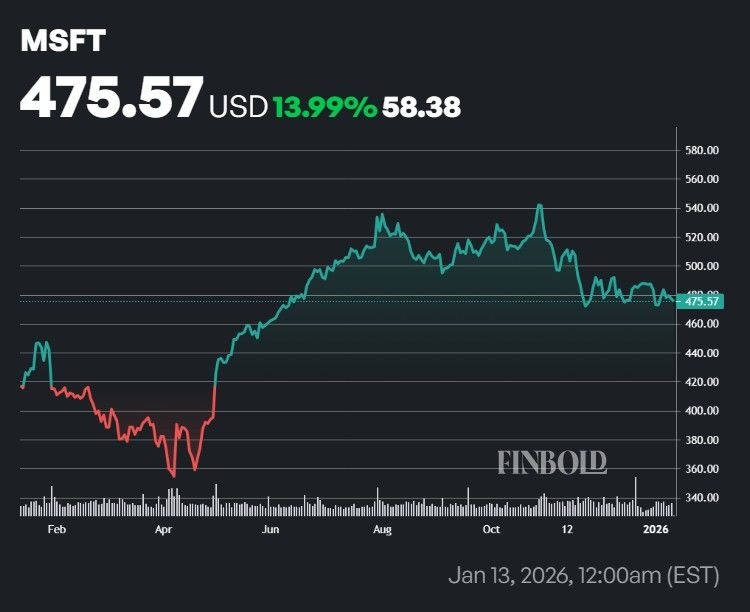
With a press time stock price of $475.57 and a market capitalization of $3.55 trillion, Microsoft is the most likely company in the world to reach a valuation higher than $4 trillion.
The company is a critical player in the ongoing artificial intelligence (AI) boom as the firm behind the Copilot AI model, an early backer of OpenAI, and a major provider of cloud services through Microsoft Azure.
Additionally, the company has a strong track record as its financial reports have, for years, demonstrated an unbroken chain of annual revenue growth.
For example, between 2022 and 2023 – the first year of the ongoing AI boom – Microsoft’s revenue rose to $211.9 billion and, in the 12-month period ended on September 30, 2025, it stood at an impressive $293.8 billion.
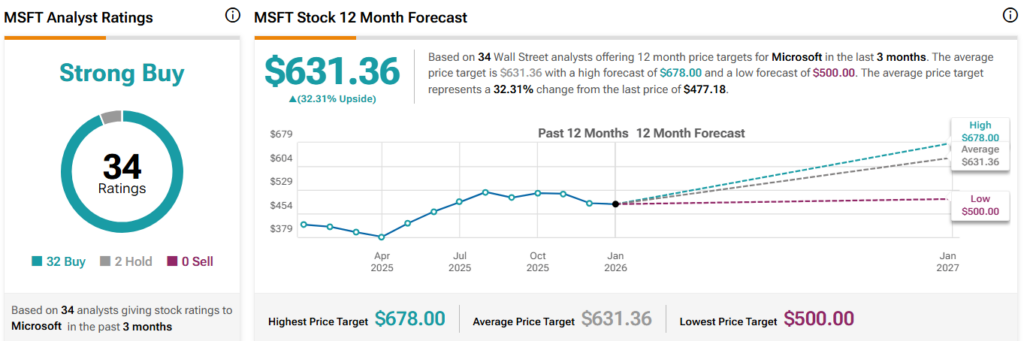
Wall Street experts have also taken note of the technology bluechip’s potential as data, Finbold retrieved from TipRanks on January 13 shows they, on average, expect a 32.31% to $631.36 rally in the coming 12 months.
MSFT shares are also an attractive investment in January 2026, as the downtrend started last October, taking them from about $542 to their press time price of $475.57.
Still, some room for caution remains. Much of Microsoft’s expected growth stems from the belief that the AI boom will continue.
While many analysts evidently believe this will be the case, others have noted risk factors such as the large mismatch between the scope of investments and the scale of the sector’s revenue.
Likewise, President Donald Trump’s recent pledge to move more electricity costs to data center operators could present a risk factor for Microsoft, and elsewhere, the company appears increasingly vulnerable to AI-related shocks due to the poor reputation of the Windows 11 operating system (OS).
Windows OS used to be a core part of the technology giant’s business model, and it arguably remains a critical element for ecosystem capture, even if nothing else.
Apple is, perhaps, in an even better position to soar to $4 trillion than its long-standing rival. The company’s market capitalization at press time is already at $3.85 trillion, meaning that it would need only a 4% rally to cross the threshold.
Furthermore, the blue-chip has largely shed its former issue getting mired in a now-abandoned electric vehicle (EV) project and missing the start of the AI boom meaning it is well-positioned for continued growth.
An especially important catalyst at the start of 2026 came in the form of an artificial intelligence-focused deal with Alphabet (NASDAQ: GOOGL) – the only company other than Nvidia with a valuation higher than $4 trillion at press time.
Under the agreement, Google AI will serve as the foundation for ‘Apple Foundation Models’ in the coming years.
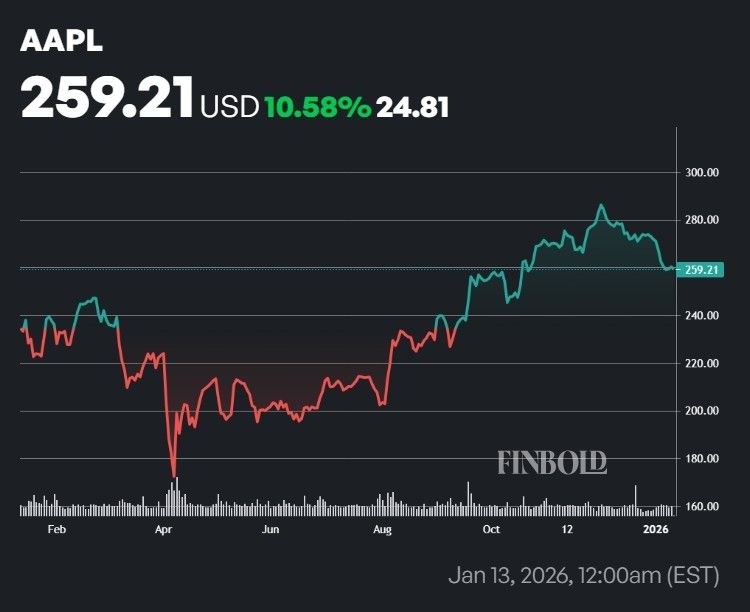
Similar to Microsoft, AAPL shares have been on a downtrend in recent weeks as they dropped from approximately $286 in early December to $259.21 at press time on January 13.
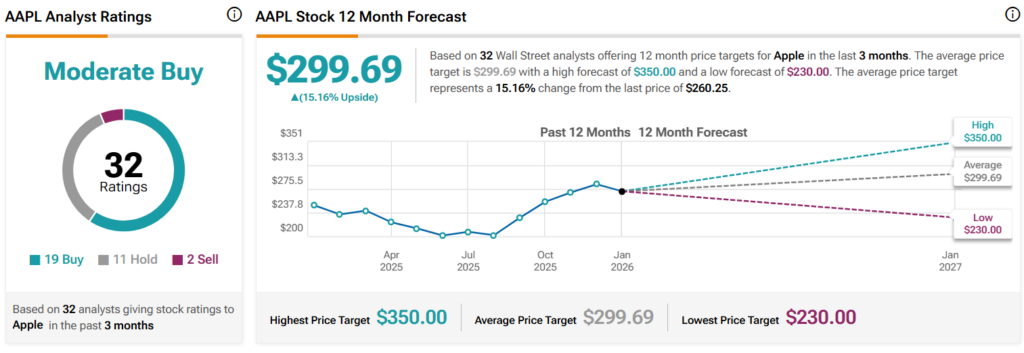
Another similarity is that, per the TipRanks data reviewed by Finbold, Wall Street is overwhelmingly bullish, forecasting on average a 15.16% rally in the next 12 months.
Should this price target be met, Apple would be valued at $4.4 trillion.
Elsewhere and similar to Microsoft, the blue-chip technology giant is also liable to potential AI-related shocks and data center electricity pricing changes hinted at by President Trump.
Unlike Microsoft, Apple’s OS business appears to be a net gainer, along with Linux, from the partial user exodus from Windows.
Featured image via Shutterstock
Search
RECENT PRESS RELEASES
Related Post