This startup raised millions to beam solar power from space after dark
December 14, 2025
Another day, another ambitious company emerges to harness the power of the Sun from Earth’s orbit.
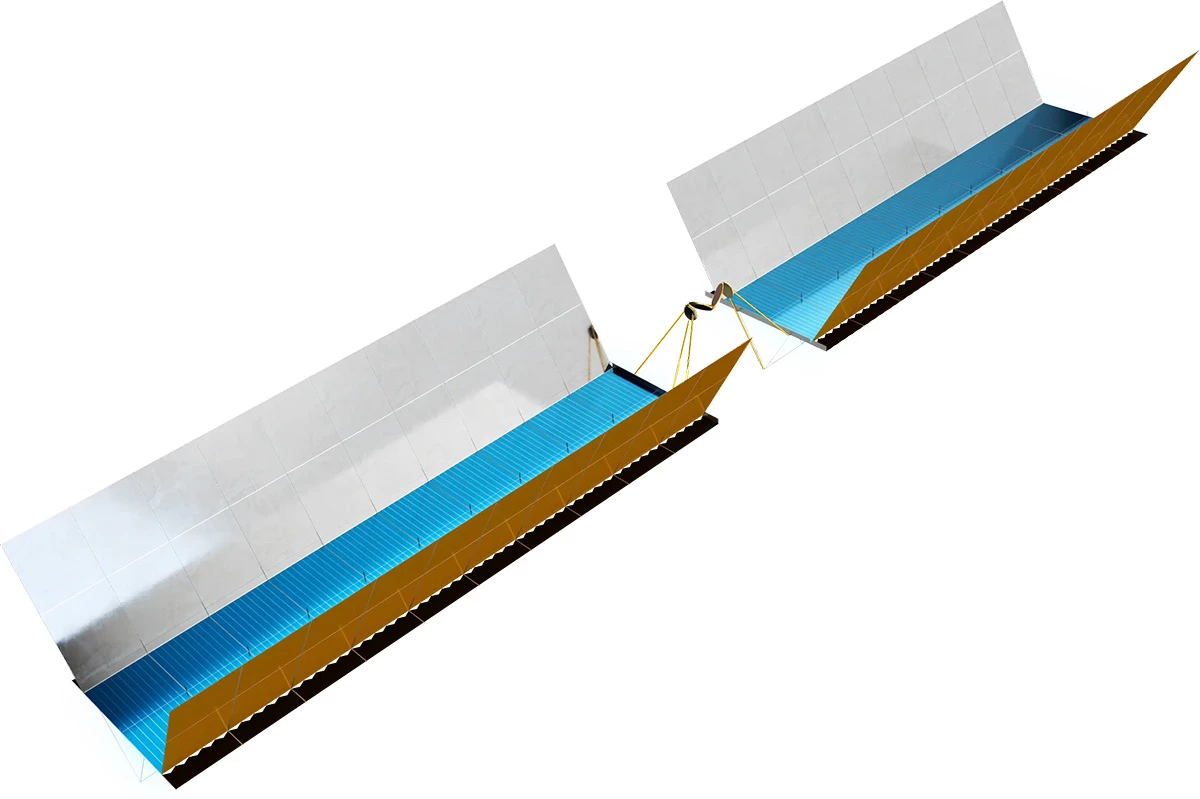
Okay, it’s not quite that common an occurrence, but there are indeed a number of firms giving this a go. The latest to join the fold is Overview Energy, a Northern Virginia-based startup that’s raised US$20 million to try transmitting solar power from satellites down to solar panels on Earth, enabling a 24/7 supply.
Specifically, it plans to use wide-beam near-infrared lasers to continuously deliver power from satellites in geosynchronous orbit (about 22,000 miles or 36,000 km above the Earth’s surface) to existing solar farms. At that altitude, the Sun is visible around the clock, which means Overview’s constellation could help make use of existing solar projects to generate electricity during the 65%-75% of time during the day when they’re otherwise idle.
The company notes this can benefit homeowners by reducing electricity price spikes, and increasing the resilience of connected grids powering critical facilities. The same constellation can also serve different regions throughout the day.
Overview Energy
To prove its tech is up to the task, Overview completed an airborne demo last month, in which a Cessna Caravan light aircraft transmitted power using a laser to a ground receiver made up of conventional solar panels from an altitude of 3 miles (5 km). The startup claims this is the first-ever example of high-power wireless power transfer from any moving platform. And since it uses the startup’s own optics chain and lasers that it plans to use in space, along with regular old solar panels on the ground, this validates its approach ahead of scaling things up.

Overview Energy
It’s worth noting that it’s still significantly cheaper to deploy more solar panels here on Earth than to capture sunlight and send it down here from space. While beaming power wirelessly from orbit down to Earth is a commendable endeavor, it’ll have to practically compete with the possibly simpler route: expanding solar farms on Earth, and further developing battery storage solutions to increase capacity and reduce costs.
Overview’s sunlight-beaming satellites won’t be alone in space. Aetherflux is also gearing up to demo its power transmission system next year with portable ground stations, and UK-based Space Solar hopes to send power to a demonstrator in Iceland by 2030.
There’s also New Zealand’s Emrod, which aims to use a microwave-based transmission system. TechCrunch’s Tim De Chant points out that this approach can’t reuse existing solar farms and instead relies on proprietary ground stations as receivers; these microwave beams also have to be more powerful, and so the companies behind them have to figure out workarounds that prevent harming passerby birds and aircraft. That makes Overview’s near-infrared laser-based method seem more plausible in comparison. We also don’t yet know enough about the efficiency of this system, and what the Levelized Cost of Energy (LCoE) will work out to be.
Up next for Overview is a pilot project, in which it will have a satellite up in low Earth orbit sometime in 2028. Subsequently, the company hopes to begin delivering power from higher up at geosynchronous orbit by 2030. While it’s confident that it’s validated its solution, with altitude being the only major remaining variable, the proof will be in the solar-oven-baked pudding.
Source: Overview Energy
Search
RECENT PRESS RELEASES
Related Post