Thoughts on owning one gas and one electric vehicle
May 21, 2026
How To
John Paul, AAA Northeast’s Car Doctor, hears from a reader considering replacing one of their family’s two gas vehicles with an electric.
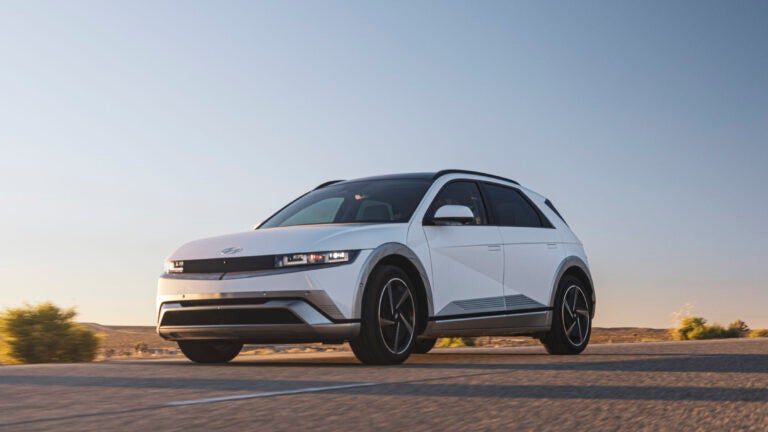
Q. We’re a two-car household and are considering replacing one vehicle with a smaller electric car. We’re looking at a Tesla Model 3 or possibly a Hyundai Ioniq. What are your thoughts on this, including charging options?
A. For many households, a mixed “hybrid garage” can be an excellent solution –one gasoline-powered vehicle (gas-only, hybrid, or plug-in hybrid) paired with a fully electric vehicle. The gasoline car can be used for longer road trips, while the electric vehicle works well for daily commuting and shorter trips. Home charging is what truly makes electric vehicle ownership practical. While long-distance travel in an EV is certainly achievable, it does require some planning to locate reliable high-speed public charging along the way. Expanded public charging infrastructure will make this even easier over time. I have not fully evaluated the Tesla Model 3, but I have driven both the Hyundai Ioniq 5 and Ioniq 6 and found them to be excellent vehicles overall. Regarding home charging, there are many solid options available. One example I recently reviewed was the MSI Smart Charger (EVSE). It’s a plug-in, wall-mounted unit that uses a standard 240V outlet (similar to those used for an electric stove or dryer). Once the outlet is installed, mounting the charger is straightforward—comparable to hanging a television. The charger also includes a well-designed mobile app that allows for easy monitoring and control.
Q. Many of your questions and answers talk about gasoline. Amoco was unleaded well before it was federally mandated and apparently didn’t do any damage to the engines of the time, or they would have been out of business. Were there any special additives or lead substitutes used?
A. Amoco sold both leaded and unleaded gasoline at the same time, but only in limited markets, mostly along the East Coast. I remember as a kid in the 1960s, Amoco unleaded was called “white gas.” I think the slogan was, “Looks like water, goes like gas.” This was very common in areas with boats and was the preferred fuel for outboards, since it would not foul plugs and was 93 octane. In 1975, all new cars sold in the US were required to use unleaded gasoline. Earlier-model engines required the lead in fuel to prevent valvetrain wear.
Q. I am the original owner of a 2018 Lincoln MKZ sedan with approximately 34,000 miles. Recently, the touchscreen – and also the hand buttons controlling temperature and the heater and air-conditioning – does not always respond or responds in a delayed fashion. What is the fix for this, and how would it be diagnosed?
A. I would start with a test of the battery. These systems are very sensitive to battery voltage. The next step is a full scan of the car’s computer systems, not just a simple code check. Typically, what is wrong is a faulty FCIM (front control interface module). There are a couple of tests a technician can perform to determine this. This is a rather complicated system; if it were just the touchscreen, then that would likely be the cause, but when physical controls are acting up, the FCIM is likely at fault.
Q. I was reading your column, and although it’s technically not your field, I felt you might still be the perfect person to ask. We own a 12-year-old Generac whole-house generator, and we have it serviced twice a year. In January, about six weeks after it had been serviced, I noticed it was cranking to start, then stopping, then repeating until it would finally turn over—much like a car. At that time, the serviceman returned at my request and installed new spark plugs. According to the worksheet, he tested it several times, and it turned over normally. Most recently, I was listening again on its self-startup day, and it was cranking repeatedly. So, with your knowledge about engines, what could it be?
A. For any engine to start, it needs fuel, ignition, proper compression (hopefully the valves were adjusted during service), and correct timing. Assuming it is not a timing, compression, or ignition problem, that leaves fuel as the most likely issue. I suspect a fuel-pressure solenoid bleeding off and not maintaining pressure. This could be due to a faulty solenoid, controller, or even a wiring issue. I did find a manual indicating the system will set a fault code if the engine cranks multiple times and does not start. Ideally, the technician should be on site during the automatic startup to observe and test the condition directly.
Q. I have a 2016 Nissan Altima in Florida that I store outside for part of the year with no access to electricity. Whether the car is covered or uncovered, I’ve had ongoing issues with rats nesting in the engine compartment while I’m away for the season. I tried using a battery-powered rodent deterrent connected to the car battery, but I’m not confident it actually works. When I return at the end of the season, the deterrent has completely discharged the car battery. I would appreciate any suggestions.
A. One option is a full car cover that seals to the ground, such as the one available from CoverSeal , which is designed specifically to prevent rodents from entering the vehicle. The drawbacks are that the cover is heavy and, during hurricane season, it can potentially blow off. There are also chemical-based solutions such as poisons and deterrents, but most of these require regular reapplication. Shake-Away is a non-poison option that works by convincing rodents that a predator is nearby. Another natural alternative is a product from EarthKind; it can be effective, but it typically lasts only about 45 days. Additionally, I recommend removing the plastic engine cover while the vehicle is in storage. This cover can create a warm, protected space that rodents find particularly inviting, essentially turning it into a ready-made nesting area.
John Paul is AAA Northeast’s Car Doctor. He has over 40 years of experience in the automotive business and is an ASE-certified master technician. E-mail your Car Doctor question to [email protected]. Listen to the Car Doctor Podcast on Apple Podcasts or other popular podcast sites.
Sign up for the Today newsletter
Get everything you need to know to start your day, delivered right to your inbox every morning.
Search
RECENT PRESS RELEASES
Related Post