Trump touts over $20 trillion in new U.S. investments, but the numbers don’t add up
December 5, 2025
Add CBS News on Google
President Trump has made increasingly sweeping claims about new investments flowing into the United States, citing figures as high as $21 trillion since taking office.
“Twenty-one trillion dollars will be the amount invested in the United States — or committed to invest — in one year,” the president said in a November meeting with Saudi Crown Prince Mohammed bin Salman.
In an Oval Office event this Wednesday, President Trump said, “In 10 months, we have $18 trillion being invested.”
But a CBS News review found no evidence that total commitments or new investments approach the scale the president has cited. While companies and foreign governments have announced large-scale projects since Mr. Trump’s inauguration, the White House has not provided documentation showing total investments approaching $21 trillion — an amount roughly two-thirds of the annual GDP.
The administration’s own list of major investments “made possible by President Trump’s leadership” totaled $9.6 trillion as of the latest update in November, but even that figure is exaggerated. It includes some investments announced under President Biden and trade goals that the U.S. is also partially responsible for.
The White House did not directly respond to CBS News’ questions about these inclusions or the discrepancies between the administration’s total and the much higher figures the president has claimed in his remarks.
“President Trump’s dealmaking has secured trillions in investments to make and hire in America, trillions in commercial opportunities for American companies, and trillions in new export opportunities,” White House spokesman Kush Desai said in a statement.
Federal data shows corporate investment levels are roughly in line with last year, with companies on track to invest over $5 trillion in 2025. The $20 trillion surge Mr. Trump has claimed does not appear in the available data.
Here’s a closer look at some of the investment claims.
Trump claims credit for some corporate investments announced under Biden
The White House list includes more than 100 corporate commitments totaling over $3 trillion. Yet some of the largest were originally unveiled years before Mr. Trump took office and were backed by federal funding under President Biden’s administration.
The administration lists a $200 billion investment by Micron Technology in semiconductor manufacturing and research. However, a company spokesman confirmed $120 billion of that was previously announced in 2022 and supported by $6 billion in funding from Biden’s Chips and Science Act.
Similarly, the White House attributes a $16 billion GlobalFoundries investment in U.S. chip production to Mr. Trump. However, only $3 billion is newly promised this year. A company spokesperson said the remaining $13 billion was originally announced under Biden and backed by tax credits from the Chips and Science Act.
The Trump administration also claims credit for some major clean-energy manufacturing investments, even though its own policies have undercut projects in the sector, said Tom Taylor, a senior policy analyst at Atlas Public Policy, which tracks clean energy investment in the U.S.
The administration cited Invenergy’s $1.7 billion commitment to a clean-energy transmission project announced in May. However, in July, the U.S. Department of Energy canceled a $4.9 billion loan guarantee to Invenergy that had been issued under Biden. A spokesman for Invenergy said the company is continuing its transmission project, but did not respond to a CBS News inquiry about whether the loan cancellation impacted the scale of its investment.
“The administration has kind of been on a tear this year about canceling clean energy projects,” Taylor said. His research shows the administration’s funding cuts and policy shifts have halted over $20.8 billion in clean manufacturing investments this year.
The White House list also contains apparent errors, including a $3 billion pledge by Kraft Heinz that appears twice. The administration has not responded to a CBS News request for clarification.
Foreign trade goals and aspirational pledges inflate totals
Foreign governments account for nearly $6 trillion on the White House’s list, but several of the largest entries are trade targets — not investments in the U.S.
For example, in a joint announcement, the U.S. and Qatar committed to “generate an economic exchange worth at least $1.2 trillion,” without specifying what portion Qatar would spend or when. The figure is also more than five times the gross domestic product of Qatar in 2024.
Similarly, India and the U.S. agreed to “more than double total bilateral trade to $500 billion by 2030” — a trade target, not a singular investment commitment.
Some foreign investment pledges touted by Mr. Trump also appear aspirational to some economists.
Saudi Arabia promised to invest roughly $1 trillion in the U.S. during the crown prince’s visit to the White House in November. But economists, including Maya Senussi at the Wall Street advisory firm Oxford Economics, have questioned whether the oil-rich country could afford an investment that size with global energy prices declining.
History also offers reason for skepticism: Mr. Trump touted in 2017 that Saudi Arabia had agreed to buy $400 billion in U.S. goods, but exports of American goods and services amounted to less than one-fourth of that total over his first term, according to analysis by the Arab Gulf States Institute in Washington.
Current U.S. investment levels remain typical
Federal data suggests that real investment spending — as opposed to announced commitments — remains roughly in line with last year’s levels.
Within the U.S., gross private domestic investment, the broadest measure of what U.S. companies are spending to expand their businesses, is projected to total about $5.4 trillion this year, according to the Bureau of Economic Analysis, or BEA. That’s up roughly $100 billion from the same point last year, but far below the multitrillion-dollar surge Mr. Trump has mentioned.
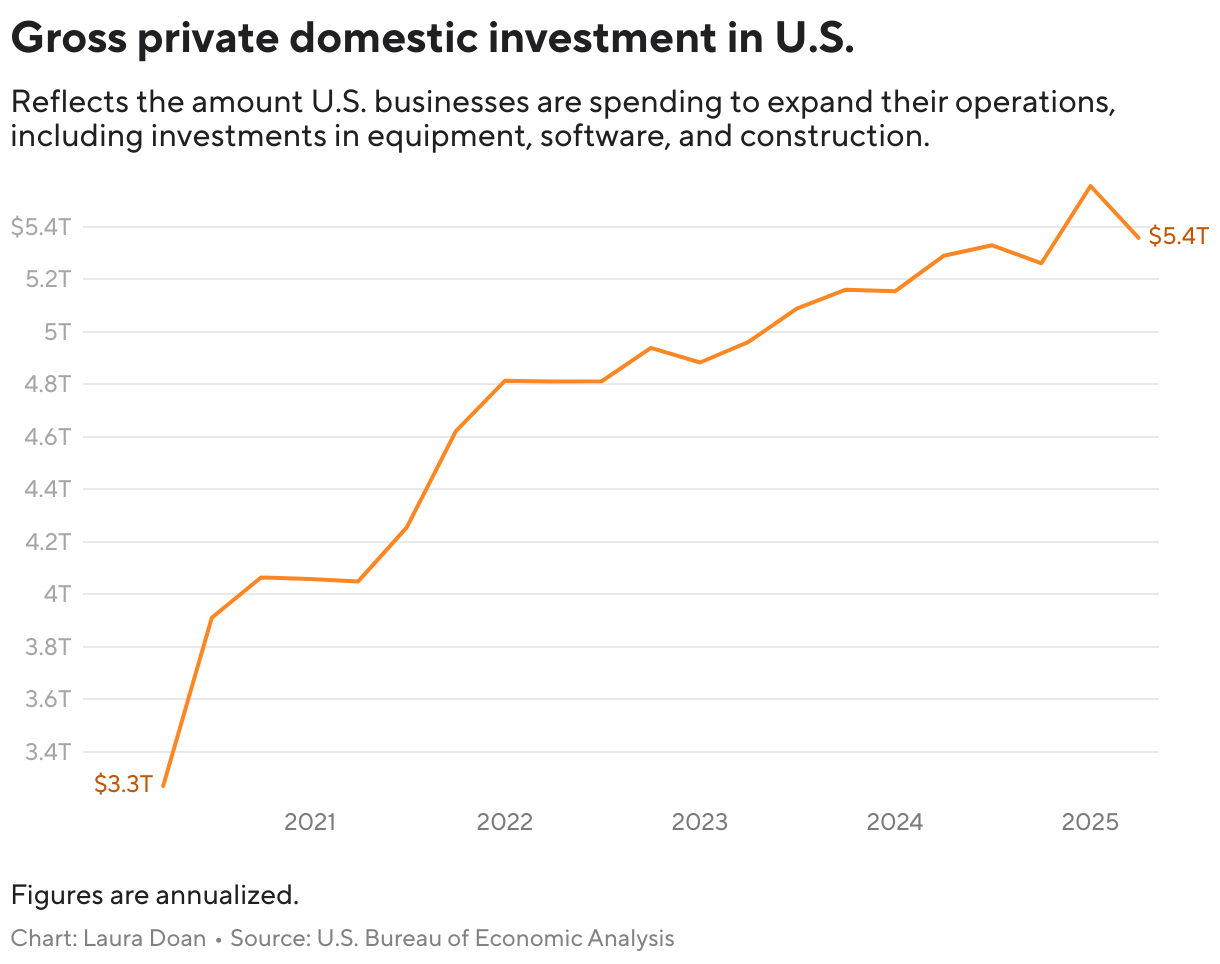
“Trump may be talking about commitments that have yet to happen. But on actual investment spending — so new equipment, buildings and machinery — 2025 is similar to 2024,” Nicholas Bloom, an economics professor at Stanford University, told CBS News in an email.
Some research suggests that foreign corporations have sharply increased the number of spending pledges under Mr. Trump. They’ve promised to invest over $270 billion from January to October, more than double the volume announced under Biden in the same period, according to fDi intelligence, which is part of the Financial Times.
But experts say announcements do not always translate into realized investment.
New foreign direct investment — the actual amount that foreign companies put into U.S. subsidiaries and projects — also remains steady. Foreign companies made roughly $145 billion worth of new investment in the U.S. in the first half of the year, nearly identical to the $144 billion invested in the same time period last year, BEA data shows.
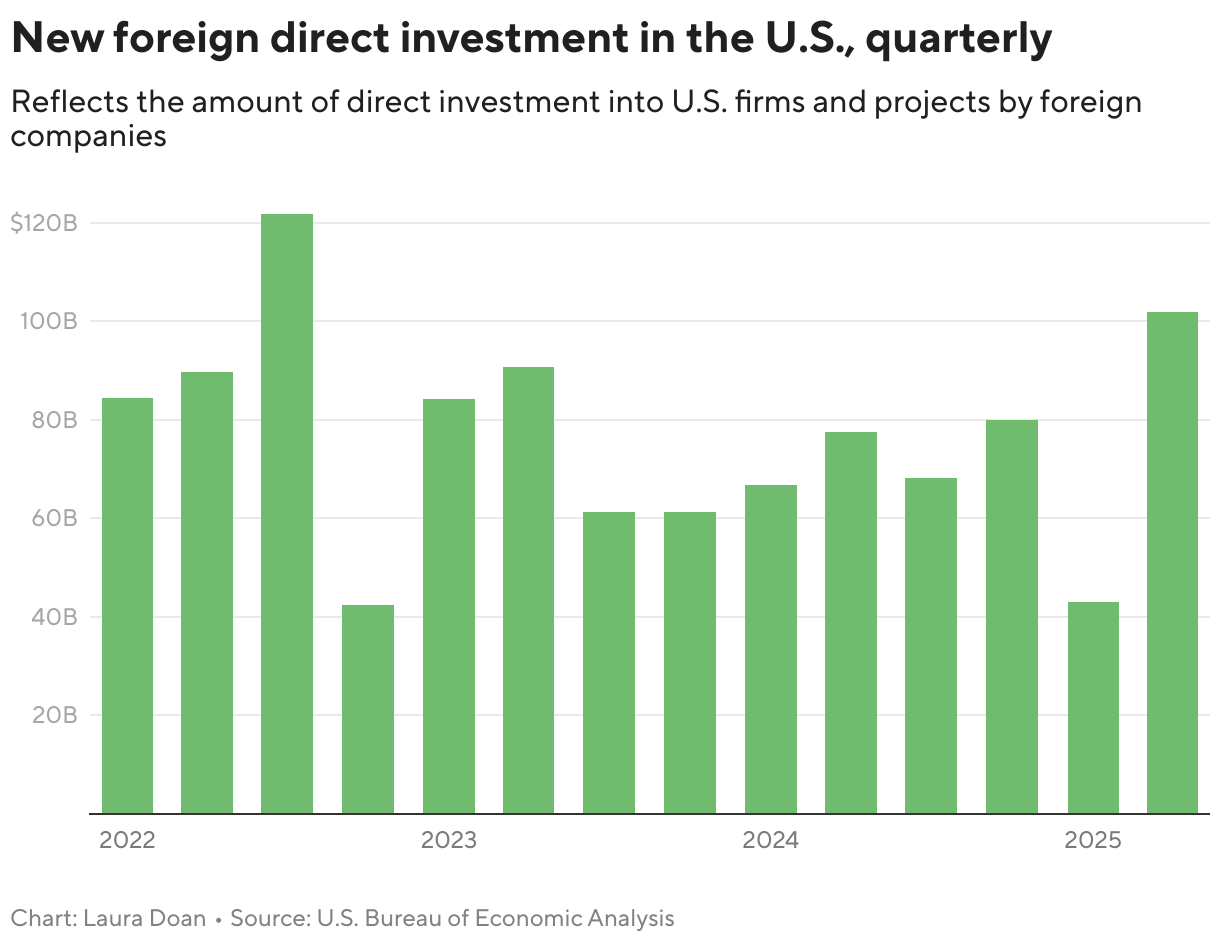
Analysts at the Peterson Institute for International Economics, an independent think tank, estimate foreign investments will come in under $400 billion this year, well below record levels.
“He’s got a lot more in terms of announcements and promises than any prior president. But how much does that really mean in terms of money coming in?” said Gary Clyde Hufbauer, nonresident senior fellow at the Peterson Institute.
Search
RECENT PRESS RELEASES
Related Post