Trump’s Marijuana Rescheduling Move Shows Gun Ban For Consumers Is Outdated, ACLU Lawyers
January 26, 2026
The federal ban on gun ownership by marijuana consumers is nonsensical and unconstitutional—and it’s made all the more confounding by the fact that President Donald Trump recently directed the completion of federal cannabis rescheduling process, ACLU attorneys for a man at the center of a U.S. Supreme Court case say.
In a brief submitted to justices on Friday, attorneys for Ali Danial Hemani gave a comprehensive overview of their legal analysis in the case, U.S. v. Hemani. This comes just over a month before the court is scheduled to hear oral arguments in the proceedings.
Hemani’s counsel with the ACLU are contending that the federal statute 18 U.S.C. §922(g)(3) that prohibits cannabis users from possessing firearms lacks adequate historical analogues, fails to clearly define who is considered an “unlawful user” of a drug and flies in the face of evolving marijuana policies at the state and federal level.
“Like tens of millions of Americans, respondent Ali Hemani owned a handgun for self-defense, keeping it safely secured at home,” the brief says. “Like many of those same Americans, he also consumed marijuana a few days a week.”
Stripping cannabis consumers of their gun rights under §922(g)(3) represents a “draconian” policy that violates the Second Amendment of the U.S. Constitution, the attorneys said.
“While the government has much to say about addiction and substances other than marijuana, none of that matters here,” they said, because the case rests on the specific question of whether Hemani was an “unlawful user” of cannabis—not whether his use constituted addiction.
“So the only question before this Court is whether §922(g)(3) is constitutional as applied to someone who admits to consuming marijuana a few times a week,” they said. “It is not.”
The term “unlawful user” is “void for vagueness,” Hemani’s counsel said. And lower courts across the U.S. have determined that it’s “likely unconstitutionally vague absent at least some sort of temporal connection between drug use and gun possession.”
The brief argues that the government has conceded the limitations of historical analogues to justify the firearm ban for cannabis consumers, including the fact that precedent for barring possession has applied to those actively impaired and that past prohibitions for “habitual drunkards” more narrowly concerned those who routinely “abused” alcohol. In Hemani’s case, he’s simply admitted to using marijuana a few times per week.
“Most states that address the issue ban possession of firearms only by people who are ‘addicted to’ a controlled substance, not ‘unlawful users.’ And the handful that go further have mostly legalized marijuana use in whole or in part,” the brief says. “The federal government’s draconian approach thus not only flouts historical tradition, but makes it an outlier today.”
“Though federal law designates marijuana a ‘controlled substance,’ 40 states have legalized its use to some degree over the past decade. And marijuana use has become increasingly common, especially among younger adults,” it continues. “Indeed, recent studies indicate that there are now more adults who regularly consume marijuana than who regularly consume alcohol.”
Further, the federal government’s “stance on marijuana has shifted in recent years as well.” Case in point: Trump recent signed an executive order directing Attorney General Pam Bondi to expeditiously complete the process of moving cannabis from Schedule I to Schedule III of the Controlled Substances Act (CSA) in recognition of its medical value and relative risk of abuse compared to other drugs.
“Though marijuana would continue to be a ‘controlled substance’ under the CSA (and thus §922(g)(3)) under that proposal, the executive order confirms that the federal government, like most states, no longer views marijuana as comparable to Schedule I substances like heroin and LSD or Schedule II substances like methamphetamine and cocaine,” the attorneys said.
They added that Ҥ922(g)(3) poses a constant threat to a considerable portion of the population, citing data showing that a majority of Americans live in states where they can use marijuana for either medical or recreational purposes.
“The government’s desire to avoid talking about marijuana is understandable. The government itself has recognized that marijuana is not so dangerous or addictive that it cannot be used responsibly and in moderation,” it said. “Just this past month, the President issued an executive order to reclassify marijuana from a Schedule I to a Schedule III controlled substance.”
“The government thus has recognized that marijuana does not present the same dangers as the kinds of drugs on which it prefers to focus here,” the brief says. “That makes it even more difficult to claim that people who consume any type or quantity of marijuana a few days a week pose a categorically constant threat of misusing a firearm.”
The filing was entered with just over a month until the Supreme Court is set to hear oral arguments in the case on March 2.
In the background, the Bureau of Alcohol, Tobacco, Firearms, and Explosives (ATF) recently moved to loosen rules that bar people who consume marijuana and other illegal drugs from being able to lawfully purchase and possess guns by making it so fewer people would be affected.
The interim final rule from ATF seeks to update the definition of “unlawful user of or addicted to any controlled substance” under an existing policy that has been interpreted to deny Second Amendment rights to people who have used illegal substances a single time within the past year.
Last month, meanwhile, attorneys general for 19 states and Washington, D.C. filed their own brief siding with the federal government in the Hemani case, insisting that justices should maintain the current § 922(g)(3) statute.
Several other briefs were also submitted last month for the case, which was granted cert in October. Firearm control groups including Everytown for Gun Safety, Second Amendment Law Scholars, Brady Center to Prevent Gun Violence, Giffords Law Center to Prevent Gun Violence and Global Action on Gun Violence have told the Supreme Court to overturn the lower court’s ruling in the matter, for example. A coalition of history and law professors also submitted a brief.
Also last month, Smart Approaches to Marijuana (SAM) and 21 other prohibitionist groups filed a brief, urging justices to uphold the constitutionality of the federal gun ban for people who use cannabis—which they claim is associated with violence and psychosis.
U.S. Solicitor General D. John Sauer, for his part, told the Supreme Court that people who use illegal drugs “pose a greater danger” than those who drink alcohol.
Meanwhile, the Biden administration was evidently concerned about potential legal liability in federal cases for people convicted of violating gun laws simply by being a cannabis consumer who possessed a firearm, documents recently obtained by Marijuana Moment show.
The previously unpublished 2024 guidance from former President Joe Biden’s Justice Department generally cautioned U.S. attorneys to use discretion in prosecuting federal cannabis cases, particularly for offenses that qualified people for pardons during his term. But one section seems especially relevant as the Supreme Court takes on a case challenging the constitutionality of the current federal gun statute.
With respect to Hemani, in a separate August filing for the case, the Justice Department also emphasized that “the question presented is the subject of a multi-sided and growing circuit conflict.” In seeking the court’s grant of cert, the solicitor general also noted that the defendant is a joint American and Pakistani citizen with alleged ties to Iranian entities hostile to the U.S., putting him the FBI’s radar.
If justices declare 922(g)(3) constitutional, such a ruling could could mean government wins in the remaining cases. The high court recently denied a petition for cert in U.S. v. Cooper, while leaving pending decisions on U.S. v. Daniels and U.S. v. Sam.
The court also recently denied a petition for cert in another gun and marijuana case, U.S. v. Baxter, but that wasn’t especially surprising as both DOJ and the defendants advised against further pursing the matter after a lower court reinstated his conviction for being an unlawful user of a controlled substance in possession of a firearm.
Meanwhile, in recent interviews with Marijuana Moment, several Republican senators shared their views on the federal ban on gun possession by people who use marijuana—with one saying that if alcohol drinkers can lawfully buy and use firearms, the same standard should apply to cannabis consumers.
Separately, the U.S. Court of Appeals for the Tenth Circuit last year sided with a federal district court that dismissed an indictment against Jared Michael Harrison, who was charged in Oklahoma in 2022 after police discovered cannabis and a handgun in his vehicle during a traffic stop.
The case has now been remanded to that lower court, which determined that the current statute banning “unlawful” users of marijuana from possessing firearms violates the Second Amendment of the Constitution.
The lower court largely based his initial decision on an interpretation of a Supreme Court ruling in which the justices generally created a higher standard for policies that seek to impose restrictions on gun rights.
In the U.S. Court of Appeals for the Eleventh District, judges recently ruled in favor of medical cannabis patients who want to exercise their Second Amendment rights to possess firearms.
As a recent report from the Congressional Research Service (CRS) explained the current legal landscape, a growing number of federal courts are now “finding constitutional problems in the application of at least some parts” of the firearms prohibition.
In another ruling, a three-judge panel for the U.S. Court of Appeals for the Eighth Circuit vacated a defendant’s conviction and remanded the case back to a district court, noting that a retrial before a jury may be necessary to determine whether cannabis in fact caused the defendant to be dangerous or pose a credible threat to others.
The Third Circuit separately said in a published opinion that district courts must make “individualized judgments” to determine whether 922(g)(3) is constitutional as applied to particular defendants.
A federal court in October agreed to delay proceedings in a years-long Florida-based case challenging the constitutionality of the ban on gun ownership by people who use medical marijuana, with the Justice Department arguing that the Supreme Court’s recent decision to take up Hemani warrants a stay in the lower court.
—
Marijuana Moment is tracking hundreds of cannabis, psychedelics and drug policy bills in state legislatures and Congress this year. Patreon supporters pledging at least $25/month get access to our interactive maps, charts and hearing calendar so they don’t miss any developments.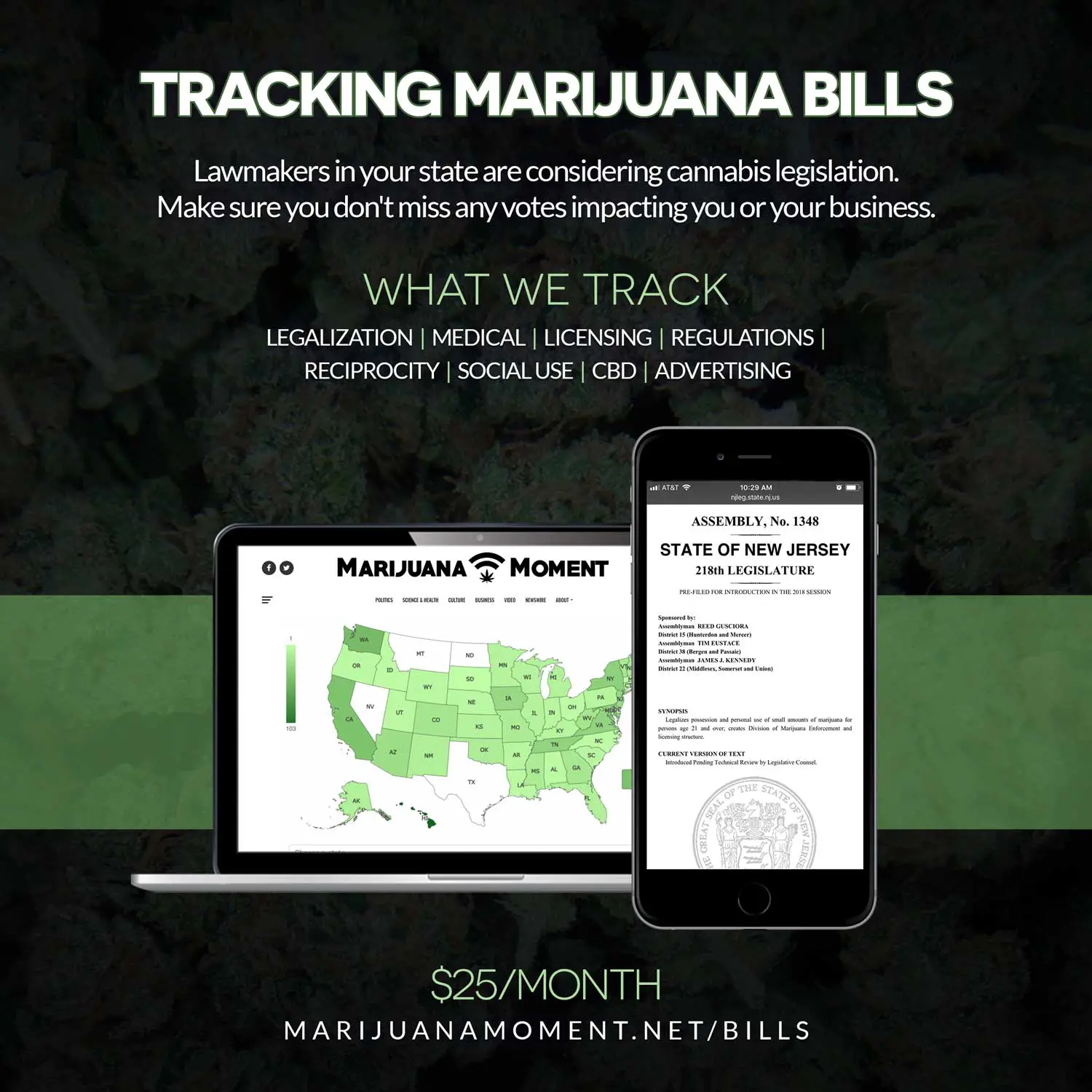
Learn more about our marijuana bill tracker and become a supporter on Patreon to get access.
—
Last year, a federal judge in Rhode Island ruled that the ban was unconstitutional as applied to two defendants, writing that the government failed to establish that the “sweeping” prohibition against gun ownership by marijuana users was grounded in historical precedent.
A federal judge in El Paso separately ruled in 2024 that the government’s ongoing ban on gun ownership by habitual marijuana users is unconstitutional in the case of a defendant who earlier pleaded guilty to the criminal charge. The court allowed the man to withdraw the plea and ordered that the indictment against him be dismissed.
DOJ has claimed in multiple federal cases over the past several years that the statute banning cannabis consumers from owning or possessing guns is constitutional because it’s consistent with the nation’s history of disarming “dangerous” individuals.
In 2023, for example, the Justice Department told the U.S. Court of Appeals for the Third Circuit that historical precedent “comfortably” supports the restriction. Cannabis consumers with guns pose a unique danger to society, the Biden administration claimed, in part because they’re “unlikely” to store their weapon properly.
Meanwhile, some states have passed their own laws either further restricting or attempting to preserve gun rights as they relate to marijuana.
Recently a Pennsylvania lawmaker introduced a bill meant to remove state barriers to medical marijuana patients carrying firearms.
Colorado activists also attempted to qualify an initiative for November’s ballot that would have protected the Second Amendment rights of marijuana consumers in that state, but the campaign’s signature-gathering drive ultimately fell short.
As 2024 drew to a close, the ATF issued a warning to Kentucky residents that, if they choose to participate in the state’s medical marijuana program that’s set to launch imminently, they will be prohibited from buying or possessing firearms under federal law.
The official said that while people who already own firearms aren’t “expected to” turn them over if they become state-legal cannabis patients, those who “wish to follow federal law and not be in violation of it” must “make the decision to divest themselves of those firearms.”
Since then, bipartisan state lawmakers have introduced legislation that would urge Kentucky’s representatives in Congress to amend federal law to clarify that users of medical marijuana may legally possess firearms, though no action has since been taken on that bill.
Kentucky Gov. Andy Beshear (D) said last year that he supported the legislature’s effort to urge the state’s congressional delegation to call for federal reforms to protect the Second Amendment rights of medical marijuana patients, but the governor added that he’d like to see even more sweeping change on the federal level.
Marijuana Moment is made possible with support from readers. If you rely on our cannabis advocacy journalism to stay informed, please consider a monthly Patreon pledge.

Search
RECENT PRESS RELEASES
Related Post