Understanding Sichuan’s Automotive Industry Cluster at a Glance | Gasgoo Global Automotive
April 16, 2026
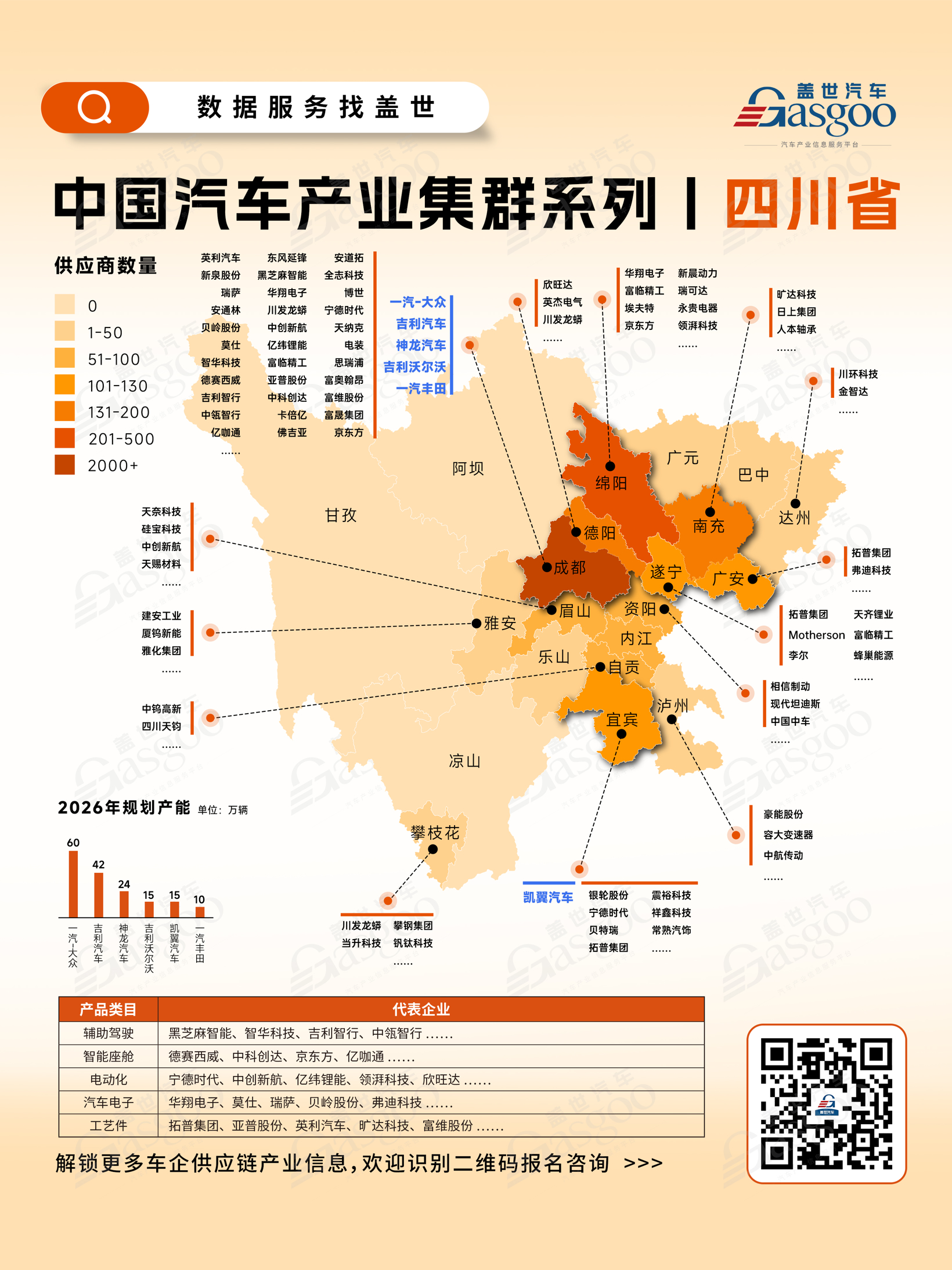
Gasgoo Munich- According to Gasgoo Global Automotive Industry Big Data, Sichuan’s auto industry cluster is defined by a “polarized core with multi-point support” structure. Anchored by Chengdu, the network radiates to neighboring cities like Mianyang and Deyang, forming a cohesive ecosystem spanning vehicle manufacturing, components, and technical services. As the division of labor sharpens across the supply chain—driven by both OEM production and specialized niches—the region is building strong collaborative synergy.
As the provincial hub, Chengdu (home to over 2,000 suppliers) holds a dominant lead in both supplier volume and industrial density, boasting a complete ecosystem that covers vehicle production, intelligent connectivity, and automotive electronics. On the OEM front, FAW-Volkswagen, Geely, Dongfeng Peugeot-Citroën, and FAW Toyota have established a solid production base. Meanwhile, the supply chain has attracted a host of electronics, e-drive, and intelligent-tech firms, including Black Sesame and Desay SV. Overall, Chengdu is evolving from a pure “manufacturing center” into a “dual-core” hub for technology and production, making it the most competitive growth engine in Sichuan.
Leveraging its foundation in electronic information, Mianyang (201–500 suppliers) has carved out a niche in automotive intelligence and electronics. Its supplier base ranks near the top in the province and is dominated by technology firms, creating a distinct “software-hardware integration” profile. Key players include Huaxiang Electronics, Fuling Precision, and BOE. Furthermore, Mianyang is steadily building capabilities in sensors and communications, providing the underlying support needed for autonomous driving and internet-of-vehicles development.
Known for its strength in traditional equipment manufacturing, Deyang (131–200 suppliers) serves as a key support hub for components and upstream production. Its supplier scale is in the mid-to-upper tier, with an industrial structure weighted toward manufacturing and processing. Representative firms like Yingjie Electric and Sunwoda hold sway in power systems and battery-related sectors, laying the groundwork for new-energy vehicles. Additionally, Deyang’s deep expertise in machining and materials enhances the stability and resilience of the regional supply chain.
In terms of production capacity, public data indicates Sichuan’s planned vehicle output for 2026 will exceed 1.66 million units. FAW-Volkswagen leads the pack with roughly 600,000 units, establishing the region’s production baseline. Geely and Dongfeng Peugeot-Citroën form a second tier with approximately 420,000 and 240,000 units, respectively. Meanwhile, Geely Volvo, Kaiyi, and FAW Toyota have planned capacities clustered between 100,000 and 150,000 units, primarily serving to supplement the structure and cover niche markets.
Overall, Sichuan’s auto sector has shifted from a single-point driver to a multi-pole collaborative landscape. It has developed a system with clear division of labor and complementary advantages in key areas like vehicle manufacturing, high-end technology, intelligent applications, and new energy. This collaborative model has significantly boosted the region’s comprehensive competitiveness and resilience within the national automotive map. However, further improvements are needed in resource allocation efficiency and deep supply chain integration. Promoting the efficient flow of resources and collaborative innovation will be essential to sustain risk resistance and elevate global competitiveness.
Search
RECENT PRESS RELEASES
Related Post