Underwater Avalanches Are Pushing Microplastics Into the Deepest Reaches of the Ocean
April 8, 2025
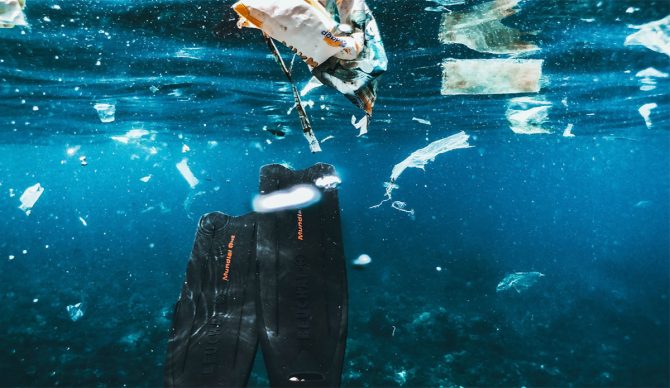
These macroplastics will turn into microplastics, and some of them will likely end up in the deepest part of the ocean. Photo: Unsplash

It is impossible to be in the dark about the scourge of microplastics we’ve unleashed on our planet, but new research published in the Journal of Environmental Science & Technology has shone light on one of the ways they end up in the deep sea.
According to the study, underwater avalanches that move extraordinarily fast push huge amounts of the tiniest bits of plastics off the continental shelf and down into the deepest reaches of the ocean.
Microplastics are pretty terrible for the environment, and by extension, us. There’s still a lot we don’t know about their impacts — NOAA, in fact, still calls the research into them “an emerging field of study” — but it’s clear there are many.
Defined as “small plastic pieces less than five millimeters long which can be harmful to our ocean and aquatic life,” they come from a myriad of different sources. Larger pieces that break down, resin pellets, and microbeads often used in health and beauty products make up the brunt of them. They’re tough to clean up and tough to spot, and given their size, they easily escape most filtration systems, which generally means they end up in the ocean.
“Microplastics on their own can be toxic to deep-sea life, but they also act as ‘carriers,’ transferring other harmful pollutants such as PFAs, ‘forever chemicals’, and heavy metals which makes them an environmental ‘multi-stressor’ which can affect the entire food chain,” said Dr Peng Chen, lead author on the study at the University of Manchester.
The study, which was done by researchers from both the University of Manchester and the UK’s National Oceanography Center, intended to highlight just how wide-spread microplastics are. Some 10 million tons of them wind up in the water every single year, and while things like the Great Pacific Garbage Patch can hog the spotlight because it’s made up of larger pieces, Oceanographic magazine says that “this visible waste is actually less than one percent of the total plastic pollution…”
Underwater avalanches, known to the scientific community as “turbidity currents,” can move at speeds of up to 25-feet-per-second. It’s long been suspected that they played a starring role in the dispersal of microplastics around the sea bed, but until now, it hadn’t actually been observed in real life.
“The research focused on Whittard Canyon in the Celtic Sea, a land-detached canyon over 300km from the shore,” Oceanographic magazine explained. “Through a combination of in-situ monitoring and direct seabed sampling – supported by the RRS James Cook and RRS Discovery – the team were able to witness a turbidity current in action, moving a ‘huge plume’ of sediment at over 2.5 meters per second at over 1.5km beneath the water’s surface.”
Samples pulled straight from that flow found that on top of large amounts of sediment, a large number of microplastics were present. When they looked closer, the researchers found that most of them likely came from clothing fabrics. When we wash our clothes, the microplastics interwoven in them can easily enter the water system, squeeze past the filtration systems that many larger cities have, and wind up entering the ocean.
Turbidity currents are of vital importance to sea life, as they help move nutrients around the deep sea, so it’s particularly bad for deep sea life that they’re shoving microplastics down there.
“These biodiversity hotspots are now co-located with microplastic hotspots, which could pose serious risks to deep-sea organisms,” explained Dr Ian Kane, a geologist and environmental scientist at the University of Manchester. “We hope this new understanding will support mitigation strategies going forwards.”
Search
RECENT PRESS RELEASES
Related Post
![MCA To Release ‘The Gray House [Original Soundtrack From The Amazon Series]’](https://stockwatchindex.com/wp-content/uploads/2026/01/Untitled-5-7-1030x579-7hafYl-500x383.png)