US citizens beat rising energy bills with homegrown power
April 7, 2026
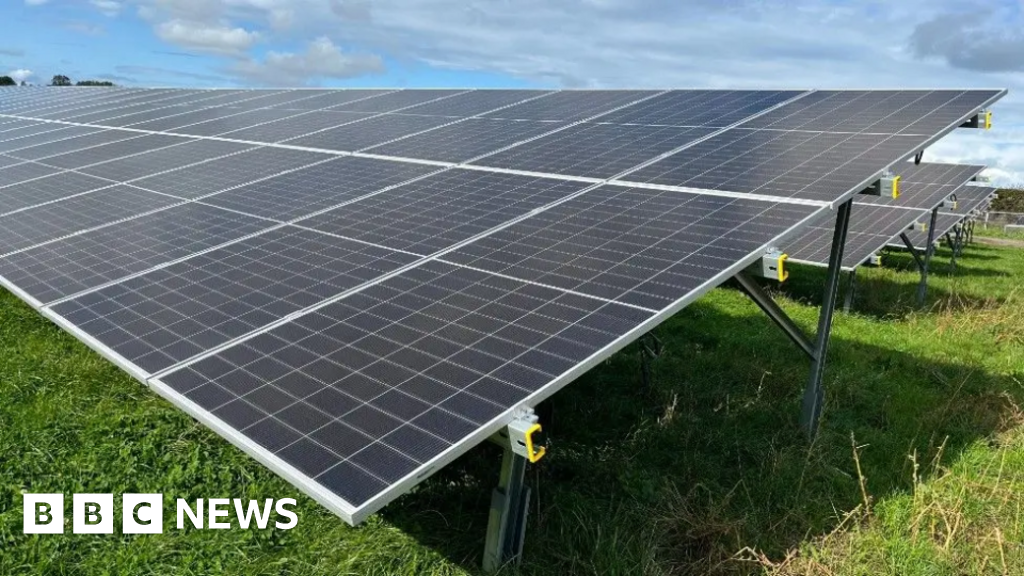
About $150 (€130) is what Brian McGowan says he spent on power last year in his home in Coatesville, Pennsylvania. And since installing additional solar panels in the fall, he expects his bill to be even lower this year.
Ordinarily he would have had to spend over $2000 per year on electricity, around $1000 on gas and buy over $2000 worth of heating oil.
“I have an EV, so I’m not buying gas, which is rapidly increasing at this point. I have a mini split heat pump, so that heats the house the majority of the time, so I’m not burning heating oil,” the engineering technician told DW.
What started out small with a couple of solar panels providing enough energy to run a kettle, a coffee machine and emergency lighting during power outages has turned into a fully-fledged system that includes battery storage and a heat pump — among other things.
And he’s not the only one kitting out his home like this.
John Spezia, a retired college professor living in Steamboat Springs, Colorado, put up solar panels some 13 years ago and recently added a heat pump to heat his home, which allowed him to turn off his gas supply.
“Natural gas is going to go up in price as we saw recently, so we add that to our savings,” he told DW. “That’s maybe $400, $500 and no monthly base rate.”
There are times during the year when he and his wife make more power than they can use, so the excess gets fed into the grid. “But we’re allowed to bank hours, so we get credit through the colder times of the year.”
Power blackouts? Not in this household
McGowan in Pennsylvania runs two systems — an off-grid one he’s relied on for long stretches when the central power has shut down, and a grid-tied one with 30 rooftop solar panels that are also connected to batteries.
“When I had this system put on, we had our first power outage and my wife noticed a flicker and she said, ‘What was that?’ And I looked out the window, and the entire neighborhood was dark. And I said ‘That’s what a blackout looks like for us now. It’s just a flicker and we still have power.'”
He says the area where they live is affected by around three or four power outages a year, with some lasting a couple of days. But he expects more issues as energy demand from data centers increases.
The US Energy Information Administrationreported that in 2024, electricity customers experienced an average of 11 hours of interruptions — roughly twice the annual average recorded over the prior decade.
A study from Stanford University in Californialooked at how homeowners could use solar and battery storage to help them survive power outages. Tao Sun, one of the authors with Stanford’s Civil and Environmental Engineering department, found that 60% of households would also benefit financially.
That, however, included the now scrapped federal tax credit under the Inflation Reduction Act.
How much money can homeowners save by producing their own power?
Many factors influence the potential of savings and earnings, including:
- How much power can be generated at the location where panels are installed and how much capacity has been installed
- How much it costs to set up a system, including labor, permits, solar panels, and batteries
- How much a provider charges per kilowatt hour and how a solar producer is reimbursed for feeding into the grid.
“It’s different state by state, so that also makes a difference,” Sun said.
Under what is known as a net metering scheme, the utility company will credit all electricity sent back to the grid at exactly the same rate the household pays them. That’s the retail electricity rate. Net billing credits, on the other hand, refers to the wholesale rate, so households get credited what the utility company pays for electricity.
“In California, it’s roughly 25% of the retail price,” Sun said. “If I were a homeowner with solar and I lived in a net billing state, then obviously it would make more sense for me to have my own battery storage so I can consume my own [energy].”
How long it takes until the investment has paid itself off also varies greatly, says Ben Delman who works for Solar United Neighbors,a nonprofit organization that offers advice for anyone interested in solar.
He says it ranges anywhere from 2 to 5 years in states with strong solar renewable energy credits and 7 to 11 years in those without, or with a less expensive electricity market.
“Your payoff is very much influenced by how much you’re already paying for electricity,” he said.
About 5 million US households now have metered rooftop solar — that’s close to one in 30 residential homes, according to a report by the Environment America Research and Policy Center.
“It really has become a 50-state phenomenon where in every state across the country, we’ve seen rooftop solar adoption increase dramatically,” said Johanna Neumann, the center’s senior director of the campaign for 100% renewable energy.
“And I think part of that is the environmental benefits, but I think for a lot of people it’s just the energy stability that comes with controlling how you get your power,” added Neumann.
So where to begin with solar at home?
Despite US President Donald Trump’s roll back on tax breaks for residential homes, Neumann says “a number of states still offer tax credits to people to be able to go solar.” Financing might also be available via local banks, and in some cases, leases could be an option.
In recent years, Neumann says states such as Indiana and California have rolled back policies that once fairly compensated residents for excess electricity they feed into the grid.
“A bunch of states are charging solar customers like an additional $50 a month just for having solar. So at that point these people are deciding, ‘well, I’m going to get batteries and I’m just going to cut my ties with the grid’ and that’s where they’re going with that,” said McGowan.
“For anybody else who’s going to do this, make sure you add batteries to the system,” he added.
He says he’s also done a lot of things to make his house more energy-efficient, such as a drain water heat exchanger that recovers heat from drain water. Together with the heat pump, McGowan says he’s now using a fraction of the energy he used to for hot water.
“Have an energy audit in your house, plug up all the leaks and make it as efficient as possible and make sure you have all your appliances and heater electric,” is Spezia’s advice to homeowners interested in producing their own power.
And Sun says to consider both the economic benefit as well as how resilient it makes homes during power outages.
“How much would you pay for your uninterrupted service of power?”
Edited by: Tamsin Walker
Search
RECENT PRESS RELEASES
Related Post