Venture Capital in the Age of Wars: Geopolitical Competition and the Transformation of Inn
June 15, 2026
Venture Capital in the Age of Wars: Geopolitical Competition and the Transformation of Innovation
BESA Center Perspectives Paper No. 2,389, June 15, 2026
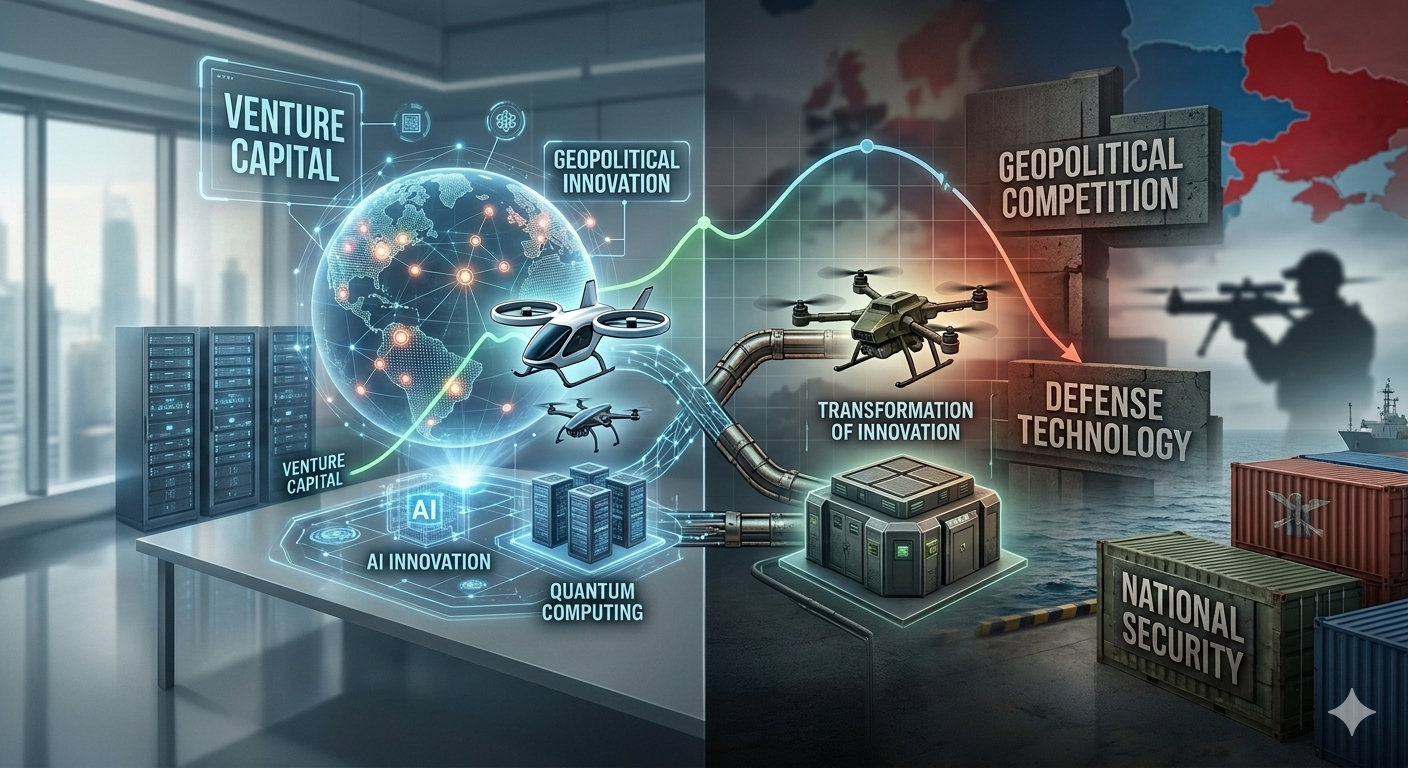
EXECUTIVE SUMMARY: The emergence of an “Age of Wars” is fundamentally reshaping venture capital. Technologies associated with security, resilience, strategic autonomy, and military effectiveness are increasingly replacing consumer-oriented innovation as the primary destinations for investment. As a result, venture capital is becoming progressively intertwined with national security, state policy, and geopolitical competition.
Introduction
The first quarter of the 21st century has witnessed the gradual erosion of the assumptions that underpinned the post-Cold War international order. Expectations that globalization, economic interdependence, and liberal democracy would produce a more stable and integrated world have given way to an era characterized by geopolitical rivalry, regional wars, technological competition, and growing fragmentation of the international system. This transformation has profound implications not only for states and international institutions but also for the allocation of private capital. Venture capital, often regarded as one of the most forward-looking segments of the global economy, offers a particularly useful lens through which to examine changing perceptions of risk and opportunity. Venture investors do not merely finance innovation; they make assumptions about the future. The sectors that attract investment reveal which technological capabilities political and economic elites consider most important for the coming decades.
The end of the globalization-era venture model
During the globalization era, venture capital was largely driven by expectations of expanding consumer markets and increasing global integration. Investors prioritized technologies that benefited from scale, network effects, and international market access. Social media platforms, e-commerce companies, fintech applications, and digital consumer services became the dominant symbols of venture-backed innovation.
This model depended on several assumptions: relative geopolitical stability, open international markets, unrestricted technological exchange, and the continued expansion of globalization. Over the past decade, these assumptions have become increasingly questionable.
The resurgence of great-power competition, the growing use of sanctions and export controls, disruptions to global supply chains, and the outbreak of major interstate conflicts have altered investment priorities. Venture capital is increasingly directed toward technologies designed to operate under conditions of uncertainty rather than stability. Cybersecurity, artificial intelligence, autonomous systems, energy security, advanced manufacturing, critical infrastructure, and defense-related technologies have become major areas of interest. The shift reflects a broader transition from an economic logic centered on efficiency toward one centered on resilience.
The changing role of the state is equally significant. Governments are no longer mere regulators of innovation ecosystems; they increasingly act as investors, strategic partners, and customers. Public procurement, industrial policy, and national security priorities are becoming major drivers of technological development. The result is a growing convergence among venture capital, state strategy, and geopolitical competition.
The Ukraine War and the rebirth of defense technology
The Russian invasion of Ukraine in 2022 represented a turning point in the relationship between venture capital and national security. While military innovation had long attracted government funding, many private investors remained reluctant to engage with defense-related technologies because of regulatory, reputational, and environmental, governance and social (ESG) considerations.
The war demonstrated that startup-driven innovation could play a decisive role on the battlefield. Drones, satellite communications, cyber capabilities, data analytics, and AI-assisted targeting systems became essential components of modern warfare. Small technology companies proved capable of producing operationally significant innovations at a speed often exceeding that of traditional defense contractors.
As a result, defense technology increasingly moved from the margins of venture investment toward the mainstream. Technologies previously viewed as politically sensitive became attractive investment opportunities. Defense-focused venture funds expanded rapidly, and governments sought closer cooperation with private technology firms.
The implications extend beyond Ukraine itself. Investors increasingly recognize that future conflicts are likely to be shaped by the same combination of software, artificial intelligence, autonomous platforms, and digital infrastructure that has characterized the Ukrainian battlefield. In this sense, the Ukraine war accelerated a broader reassessment of the relationship between innovation and security.
The Middle East as a laboratory of strategic innovation
The ongoing conflict in the Middle East has reinforced trends that first became visible after 2022. Unlike many previous regional conflicts, the current confrontation involves actors possessing highly sophisticated technological capabilities, particularly Israel.
Israel occupies a unique position within the global innovation ecosystem. Its combination of military experience, technological expertise, and entrepreneurial culture creates unusually close links between security requirements and technological development. As a result, the region increasingly functions as a laboratory for the testing and deployment of advanced technologies.
The significance of this development extends beyond military applications. Technologies initially developed for defense purposes frequently generate civilian applications in cybersecurity, communications, artificial intelligence, data analysis, and autonomous systems. This dual-use character makes defense innovation particularly attractive to venture investors.
Consequently, the Middle East conflict is not creating an entirely new investment paradigm. Rather, it is accelerating a broader transformation already underway and strengthening the position of defense technology, strategic infrastructure, and AI-enabled systems within global venture capital markets.
Geopolitical fragmentation and the new geography of venture capital
One of the most significant consequences of the Age of Wars is the fragmentation of global capital flows. Venture capital has traditionally been among the most internationalized forms of investment. Today, however, geopolitical considerations increasingly influence where capital originates, where it is invested, and which technologies receive support.
The emerging global landscape is characterized by the formation of partially distinct technological and financial ecosystems. The United States and its allies constitute one such ecosystem; China and its strategic partners constitute another. Between them exist a limited number of intermediary states seeking to maintain relationships with both sides.
This fragmentation affects investment decisions at multiple levels. Regulatory restrictions, export controls, national security reviews, and concerns about technological dependence increasingly shape cross-border investment activity. As a result, startups often find it easier to attract funding from investors located within their own geopolitical sphere.
Countries such as the United Arab Emirates, Singapore, and India have sought to benefit from this environment by positioning themselves as intermediary hubs. Yet even these states face growing pressure to align critical technological infrastructure with one major power or another. Their neutrality is becoming selective rather than absolute.
The consequence is a venture capital ecosystem that is less global, more regionalized, and increasingly influenced by geopolitical considerations.
Artificial intelligence and strategic competition
No technology illustrates the transformation of venture capital more clearly than artificial intelligence. AI has evolved from a promising commercial technology into a strategic asset with implications for economic competitiveness, military effectiveness, and national power.
Governments increasingly view leadership in artificial intelligence as a national objective. The result is an unprecedented convergence among state interests, private investment, and technological development.
The scale of capital concentration in AI is unprecedented. According to industry reports, AI-related companies attracted more than one-third of global venture capital investment during 2024–25, and a relatively small number of firms accounted for a disproportionate share of total funding. Large language model developers, advanced semiconductor companies, and AI infrastructure providers have emerged as the primary beneficiaries of this trend.
For venture capital, this transformation has produced two important effects. First, investment has increasingly concentrated around foundational technologies rather than consumer applications. Computing infrastructure, advanced semiconductors, data centers, foundation models, and autonomous systems are attracting growing shares of available capital.
Second, AI is contributing to the emergence of a “winner-takes-most” investment environment. The enormous financial requirements associated with advanced AI development favor a relatively small number of dominant firms capable of attracting large-scale funding.
At the same time, defense technology has become one of the fastest-growing sectors in venture capital. Global investment in defense-related startups has expanded dramatically since 2022, driven by heightened geopolitical tensions, increased military expenditures, and growing recognition of the strategic importance of dual-use technologies.
This trend further strengthens the connection between venture capital and strategic competition. Technologies once evaluated primarily according to market potential are now assessed according to their contribution to national capabilities and technological sovereignty.
Israel and the future of defense innovation
Israel provides an important case study for understanding the future relationship between venture capital and national security. The country’s innovation ecosystem benefits from close interaction among military institutions, research organizations, startups, and private investors.
Many of Israel’s most successful technology companies emerged from capabilities originally developed for security purposes. Cybersecurity, intelligence systems, autonomous technologies, and advanced communications remain among the country’s strongest sectors.
Although political controversies and rising anti-Israel sentiment in parts of Europe may create challenges for certain investment channels, Israel’s technological advantages remain substantial. More importantly, the growing strategic significance of cybersecurity, AI, and defense technology aligns closely with the country’s comparative strengths.
For this reason, geopolitical instability is unlikely to diminish Israel’s importance within global innovation networks. On the contrary: the increasing demand for strategic technologies may reinforce its position as one of the world’s leading centers of defense-related innovation.
Conclusion
The Age of Wars is transforming the foundations of venture capital. The era in which investment decisions were primarily shaped by globalization, consumer demand, and market expansion is giving way to one in which geopolitical competition, technological sovereignty, and national security play a central role.
The wars in Ukraine and the Middle East have accelerated this transition by demonstrating the strategic importance of emerging technologies. Artificial intelligence, cybersecurity, autonomous systems, and defense-related innovation have become critical components of both national power and venture investment strategy.
At the same time, geopolitical fragmentation is reshaping the geography of capital, creating increasingly distinct technological ecosystems and reducing the degree of global integration that characterized earlier decades.
Venture capital remains a mechanism for financing innovation, but its underlying logic is changing. Increasingly, investors are not simply asking which technologies will generate the highest returns. They are asking which technologies will provide resilience, strategic advantage, and technological superiority in an increasingly competitive and unstable international system.
The emerging venture ecosystem reflects a broader transformation of the international order itself. Capital, innovation, and national security are becoming increasingly interconnected. As geopolitical competition intensifies, venture capital is evolving from a tool of globalization into an instrument of strategic statecraft. In this sense, the future geography of innovation may reveal as much about the future distribution of power as traditional indicators of military and economic strength.
Prof. Leonid Sorkin is an independent researcher and consultant specializing in geopolitics, venture capital, technological innovation, and international political economy. His work examines the relationship between geopolitical competition, military conflict, artificial intelligence, and global investment trends.
Share this article:
Search
RECENT PRESS RELEASES
ESG Investing Promises More than It Delivers
SWI Editorial Staff2026-06-12T12:40:49-07:00June 12, 2026|
SpaceX IPO Winners: These 8 Early Investors Scored Big
SWI Editorial Staff2026-06-12T12:35:24-07:00June 12, 2026|
Baltimore Police seize illegal cannabis products, ghost gun & drugs at smoke shop
SWI Editorial Staff2026-06-12T12:30:01-07:00June 12, 2026|
SpaceX president Gwynne Shotwell just gave another hint at a Tesla merger
SWI Editorial Staff2026-06-12T12:28:31-07:00June 12, 2026|
Secure Some Extra Storage With These Early Amazon Prime SSD and HDD Deals
SWI Editorial Staff2026-06-12T12:27:02-07:00June 12, 2026|
Tesla Holder Merz Sits Out SpaceX IPO in Bet on Musk Merger Bid
SWI Editorial Staff2026-06-12T12:26:01-07:00June 12, 2026|
Related Post