Volkswagen overtakes Amazon as Rivian’s (RIVN) largest shareholder with 15.9% stake
May 5, 2026
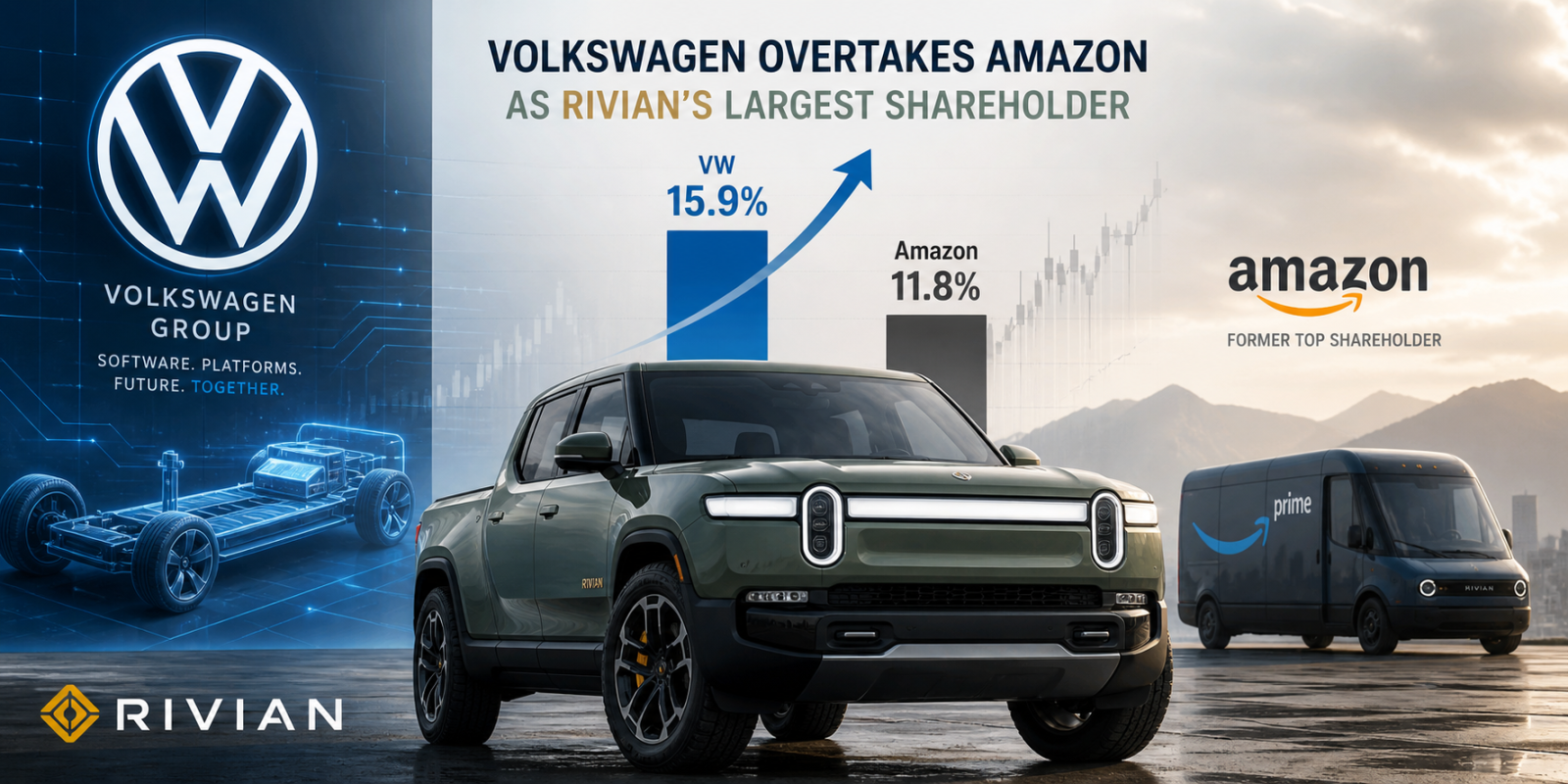
Volkswagen now owns 209.8 million shares of Rivian (RIVN), representing a 15.9% stake in the EV startup, according to a new SEC filing. The German automaker has overtaken Amazon as Rivian’s single largest shareholder for the first time since the company’s 2021 IPO.
The stake increase came after Volkswagen’s US subsidiary purchased 62.9 million new shares on April 30 at $15.90 per share — a roughly $1 billion investment triggered by the joint venture hitting its latest testing milestone.
The $1 billion share purchase is the latest tranche under the up to $5.8 billion investment agreement that VW and Rivian signed in November 2024. The deal structures VW’s investment in $1 billion increments, each contingent on the Rivian and Volkswagen Group Technologies (RV Tech) joint venture hitting specific milestones.
This particular tranche was unlocked after the joint venture completed winter testing of its production-intent zonal architecture for first-generation software-defined vehicles. Prototype vehicles from VW, Audi, and Scout Motors all passed the validation, clearing the way for VW to cut the check.
Advertisement – scroll for more content
Including this latest purchase, VW has now deployed roughly $3.3 billion of its $5.8 billion commitment to Rivian — an initial $1 billion convertible note in mid-2024, approximately $1.3 billion at the joint venture’s launch for background IP licenses and equity, and now this latest $1 billion equity tranche.
Amazon held approximately 158.4 million Rivian shares heading into the transaction. Before VW’s latest purchase, Amazon was still Rivian’s top outside investor — a position it held since leading Rivian’s $700 million funding round in 2019.
But the April 30 share issuance changed the math. VW now holds 209.8 million shares (15.9%) compared to Amazon’s roughly 158.4 million shares, which have been diluted to approximately 11.8% of the expanded share count. Amazon’s stake has eroded from about 20% at the time of Rivian’s IPO to under 12% today, entirely through dilution — Amazon hasn’t sold a single share.
The shift is significant. Amazon’s investment in Rivian was always strategic — tied to a deal for 100,000 electric delivery vans. VW’s investment is fundamentally different: it’s buying Rivian’s software and electrical architecture expertise to rescue its own stalled EV platform development.
VW’s urgency to invest in Rivian stems from the slow-motion collapse of its in-house software division, Cariad. Years of delays and billions in cost overruns forced VW to effectively demote Cariad to a coordination role, outsourcing core vehicle software development to partners including Rivian and Xpeng.
VW’s next-generation Scalable Systems Platform (SSP) — supposed to underpin everything from the next Golf EV to Porsche’s electric lineup — has been pushed back repeatedly. The first VW models running Rivian’s software and electrical architecture are expected in 2027, and VW is betting the future of its entire EV lineup on this partnership delivering.
For Rivian, the cash is critical. The company posted $1.38 billion in Q1 2026 revenue and recently began R2 production at its Normal, Illinois plant, but it remains cash-intensive as it scales. Each $1 billion VW tranche extends Rivian’s runway without forcing the company to raise capital on the open market at dilutive prices — though existing shareholders, including Amazon, are still getting diluted through the private placements.
This is a remarkable turn. Amazon backed Rivian with a $700 million check in 2019 when the company was a startup with zero production vehicles. Now, less than five years after Rivian’s IPO, a legacy automaker has quietly become its biggest shareholder — not because it believes in electric delivery vans, but because it desperately needs Rivian’s software to fix its own broken EV development.
The VW-Rivian dynamic is one of the more interesting relationships in the industry right now. VW is one of the world’s largest automakers, and it effectively admitted that it cannot build competitive EV software on its own. Rivian, which still loses money on every vehicle it builds, has something VW’s $40+ billion Cariad investment couldn’t produce: working software architecture.
There’s still roughly $2.5 billion left in VW’s commitment, tied to future milestones. If the joint venture continues to deliver, VW’s stake in Rivian could climb well above 20% by 2027. At that point, the question shifts from whether VW is committed to Rivian to whether it’s positioning for something bigger.


Search
RECENT PRESS RELEASES
Related Post