‘We can stitch together our past’: the AI-generated time-travellers vlogging from history
May 26, 2026
“I have just arrived in Tudor London, 1536,” a young woman in a green puffer jacket tells the camera. “I’m going to check in at my room in the inn, get into the market. Then, later I am meeting the actual king – yep, Henry VIII – in person.”
On YouTube and other social platforms, users are flocking to watch AI-generated “history influencers”, characters that vlog their travels to historical settings.
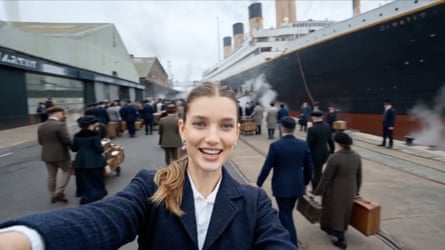
One of the most popular channels is Chloe VS History, with more than 610,000 Instagram followers and 15m views on YouTube. Viewers can watch Chloe try eel pie at a Tudor market, explore the first-class suites on the Titanic and take a plunge in an ancient Roman bath.
The format has been replicated by other channels, such as Janella Through Time, Nova VS History and Esmetimetravels. Popular destinations include ancient Rome, Pompeii, the wild west and England during the Black Death.
The creator of Chloe VS History, 32-year-old Jonathan Laramie, said the goal was to “get younger people more interested” in different periods of history.
“History is a very visual experience, but it’s just not taught that way,” he said. “It’s taught via a textbook. And that is not compatible with lots of students. So why not use the technology we have to bring that to life in a really visceral way?
“Vlogs are very popular on YouTube because people get attached to a particular character. I’m taking an already-proven format on YouTube and just applying it to history.”
While AI-generated historical videos have been circulating for the past year, Laramie said the sophistication of current AI video generation tools had “absolutely changed the game” for content creation.
“I was just thinking: ‘Wouldn’t it be great to actually represent history with a kind of “real person”, who has time travelled to that point?’”
Laramie uses Seedance 2.0 to produce his videos, using historical sources, journal articles and contemporaneous drawings to refine the output.
Even with this commitment to accuracy, Laramie said, there are occasional hiccups. “For example, in ancient Rome [videos], we’ve had people wearing sunglasses or watches. The AI is trained on modern data, so when you’re asking it to do historical stuff, there is a risk it’s going to hallucinate.”
While the response has been overwhelmingly positive, Laramie said his content occasionally received the label of “AI slop” – referring to low-effort, mass-produced content generated by models.
“I totally get it,” said Laramie. “Some people just see it as really scary that AI can do this now. Some people see it as a threat. I think whatever you make with AI at this moment in time is going to be labelled AI slop by some people, because of the pure fact it’s AI.
“I’m trying to use it for purely positive reasons, and say: ‘This is what you can do with it now, and isn’t this great? We can actually stitch together our past and bring it to life so vividly.’”
His first video to go viral was a 14-minute video of Chloe onboard the Titanic, which gained 4m views. “I want to try to talk to the captain about the iceberg,” Chloe tells the camera at the start of the episode. “I feel like someone should at least try to say something. Wish me luck!”
On Friday, Laramie was presented with a World Influencers and Bloggers award (WIBA) in recognition of influencers and content creators at the Cannes festival for his work on the channel. “I absolutely did not expect the success from it. I could not believe it,” he said.
“It’s a new form, it’s brilliantly done, and I like the humour,” said Adam Smith, a historian at Oxford University. He has seen Chloe VS History and other “time travel vloggers” on his Instagram feed and believes the format could “massively enhance” how history is taught to young people.
“In one sense, there’s absolutely nothing new about it,” said Smith. “They’re in a very long tradition. I put it in the same bracket as something like Horrible Histories, these things that popularise history and make it engaging and funny and immersive.

“What these AI [videos] are doing is connecting with that visceral, tangible sense of: ‘Oh my God, that could have been me, that was an earlier version of me.’ It’s quite a deep-seated psychological need in many people, to understand themselves in time.”
Smith suggested AI-generated video could be used to enhance historical documentaries and educational tools, visualising lesser known historical events and figures.
“Rather than the really predictable things, like Vesuvius or the plague, maybe we could use that kind of technology and do new things with it,” said Smith. “Creative people could work really well with academic historians and people doing primary research – so not just regurgitating stuff, but really thinking and rethinking about the past.”
“Ways of presenting history always evolve. Remember when Ken Burns did his first documentary on the American civil war in the 1990s? Everyone was blown away by the fact he zoomed in and out of photographs.”
“It’s not as if Chloe videos are going to replace an academic monograph or a museum,” said Smith. “They’re doing slightly different things with different moods. So I think the potential is really, really exciting.”
Search
RECENT PRESS RELEASES
Related Post