‘We finally have a tool to at least shave some tenths of a degree off’: author Bill McKibb
December 23, 2025
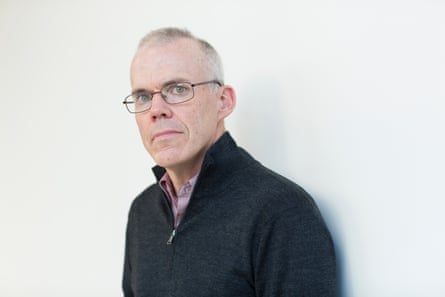
Bill McKibben’s book The End of Nature, published in 1989, warned early of the dangers of climate changes and he has been campaigning and writing ever since. His most recent book, Here Comes the Sun, takes a look at the soaring potential of renewable energy
Is your latest book a more optimistic take on this world?
Optimism may not be exactly the right word. The things that we were warning about in The End of Nature almost 40 years ago have happened. The planet is now warming fast. The scientists were absolutely right. We face an endless series of disasters that will get worse. This is the main legacy of our moment on Earth so far.
But as of the last three or four years, we finally have a tool, not at this point to stop global warming – it’s too late for that – but perhaps to at least shave some tenths of a degree off how hot the planet gets. And that tool is cheap energy from the sun and the wind and the batteries to store that power when the sun goes down or the wind drops. Alternative energy is the commonsense, obvious, straightforward way to make power on this planet, which is why 95% of new generating capacity around planet Earth last year came from these clean sources.
What inspired you to write this book?
Mostly because I felt like I had a scoop. I’m an old journalist at heart. I do this newsletter every week on Substack called The Crucial Years, which, I think because it’s free, has turned into the largest newsletter of its kind around climate and energy and the environment. It means that I get to keep track of all the things that are happening on a weekly basis around the world.
About 36 months ago, if you were paying attention, you couldn’t help but notice this sudden spike beginning. We’d finally hit the steep part of the S curve. All of a sudden there were stories coming in from around the world, especially, it must be said, China, which is providing the leadership here, and which is doing things on an almost inconceivable scale. In May, the Chinese were building three gigawatts of solar panels a day. A gigawatt is the rough equivalent of a big coal-fired power plant. They were putting up one of those out of solar panels every eight hours. This is like building the pyramids or something, the scale at which this is going on.
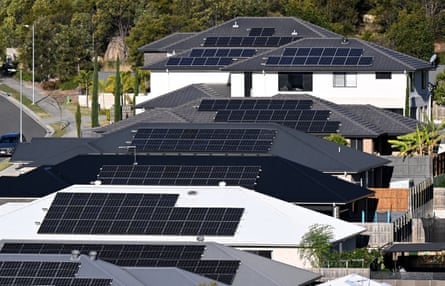
There are similar stories from many corners of the world, and they just keep coming. In Australia, they’ve built so much solar power that the government has now decided that electricity will be free for all Australians for three hours every afternoon. Human beings for 700,000 years have worked hard to get energy for our lives, if it meant collecting firewood, if it meant paying your electric bill. Now you don’t have to do that any more, at least if you’re in a place that’s had the foresight to build the solar panels and the wind turbines.
How will a transition to solar power address global inequality and the disparities that exist in the developing world, in parts of our country as well, many of which came to be because of the fossil fuel industry?
As long as you rely on a source of power that’s only available in a few places, the people who control those places will end up with inordinate wealth and power. John D Rockefeller, the first plutocrat, was the first guy to recognise that. His heirs include Vladimir Putin, who’s using his winnings to run a land war in Europe. They include the Koch brothers, our biggest oil and gas refiners and pipeline suppliers, who use their winnings to systematically undermine our democracy. They include the king of Saudi Arabia, who likes to cut up journalists like you and me with saws.
The world on the other side of this is very different, because there’s sun and wind everywhere, for everyone, and it works best toward the equator. So this is perhaps even a way to start rebalancing a little bit of this north-south division. If you’re in the 80% of humanity that lives in countries that have to import fossil fuel, this couldn’t be really better news, because once you’ve paid the money to build your solar panel or your wind turbine, then you no longer have to come up with American money to buy the next tankerload full of oil.
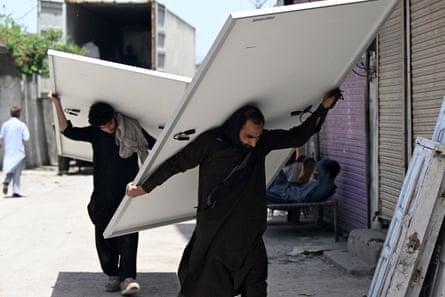
Pakistanis, mostly working by themselves, without government help, have put up so many solar panels in the last few years that the Pakistani government last month cancelled the delivery of 27 huge cargoloads full of liquefied natural gas from Qatar. They had to pay a penalty, but it was cheaper to pay the penalty than to import this gas that they didn’t need any more because now they’ve got lots of solar panels.
So we have enough money on the planet to make the transition that’s required to really put the brakes on this advance towards climate disruption. What’s keeping folks from providing the resources for poor fossil fuel-trapped countries from making the full transition right away?
To some degree, it’s really starting to happen, and it’s happening with Chinese financing and Chinese technology. The Chinese exported half again as much worth of green tech last year as America did of oil and gas. The force that’s slowing down all of this, of course, is the fossil fuel industry, which understands this good news for everybody else as the worst possible news for its future prospects, and they have trillions of dollars’ worth of hydrocarbons in the ground at today’s market prices that they would like to get out and sell for trillions of dollars, which they won’t be able to do if we’re busily converting to sun, wind, to EVs and heat pumps. So they’re doing everything they possibly can to stop that transition.
In our country, where their work is the most advanced, that meant when Donald Trump asked them for a billion dollars in campaign donations last year, they came up with about half a billion in donations and advertising and lobbying in the last election cycle, and that was enough to convince the president to shut down windfarms off the coast of New England that were 80% complete, or put the kibosh on a huge solar farm in Nevada that by itself would have powered 2m homes, more than 1% of American homes. We can’t have this stuff that the rest of the world is busily building because our oil and gas industry has corrupted our president – not that that was a very hard task – and so now we get to pretend that climate change isn’t real, that green energy doesn’t work and that we’re somehow all going to go back and inhabit the 1950s again.
Why is it that people are acting this stupid? Let’s be blunt.
All transitions are hard and they involve change, and our species doesn’t deal particularly well with change. And in this case, we’ve had 35 years of a full-on disinformation campaign from the fossil fuel industry about climate change, about alternative energy, all designed to drive home the idea that only the way that we’re doing things now could possibly work. And that’s sunk in with too many people, especially in this country, but the rest of the world is quickly shaking off that habit.
You could tell watching the climate talks this year in Belém, Brazil, that people are sort of moving past the US, like we’re sort of receding into the rearview mirror. It’s becoming clearer and clearer where the future lies.
As patriotic Americans, that should upset us. These technologies were all invented in the US. The first solar cell in 1954 at Bell Labs in New Jersey. The first industrial wind turbine in 1941 at Grandpa’s Knob in Vermont. We could have owned these technologies, and instead we’ve just ceded them to our theoretical main rival on this planet. I don’t think there’s been an act of national self-sabotage quite like this that I can think of anywhere in human history.
Here Comes the Sun is a handbook for people who are trying to wrap their heads around this notion that “hey, it really does make a lot of sense to make the transition away from fossil fuel and will be better for us”. It’s not just, I think you use the term, the Whole Foods of energy, that so-called alternative energy. No, this is the main game.
This is the Costco of energy, man – cheap, available in bulk, on the shelf, ready to go.
How is this book doing? To what extent are people grabbing this and saying: “Oh, my goodness, this really is possible to make a change?”
It’s doing well. It’s been fun. We use it as a kind of organising vehicle for this thing in September that we called Sun Day – not Earth Day, but Sun Day. We had 500 events across the country; people are waking up, and I think that they’ll wake up more as the next year goes on.
My guess is that one of the two or three key issues for the midterm elections, on which all attention will be focused, are going to be electricity prices, which are soaring, as you would expect, because we’re permitting every datacentre that anyone could ever want to build at exactly the same moment that we’re constricting the supply of sun and wind. You don’t need to be a Nobel prize-winning economist to know that when you increase demand and decrease supply, prices are going to rise, and that’s exactly what’s happening.
Anything you want to add to our discussion?
We’ve talked about the economic necessity of doing this and the climate urgency of doing this, but there’s also just a certain amount of beauty that comes with it. When we were getting ready to do Sun Day, one of the things we did was make a playlist of all the songs about the sun. Obviously, I stole the title of my book from George Harrison; Here Comes the Sun is the most listened-to Beatles song on the world’s streaming services. There were hundreds of songs to choose from, which, by the way, is hundreds more than if you tried to compile a playlist of great songs about fracking.
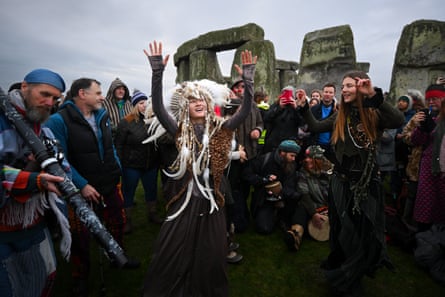
The reason is that humans have a deep, deep connection to the sun. We don’t really know how prehistoric people thought, but all the piles of stone they left behind, like Stonehenge, point towards the equinox or the solstice. As soon as people were in the business of making myths, the first thing they had to explain was how the sun rose over here, set over here.
I was in Rome in September with the new pope, who had summoned people for a conference on the 10th anniversary of Pope Francis’s epic encyclical on global warming. The new pope said: “Yes, we’re going to continue this work that Francis set us on. In fact, next year, the Vatican will become the first fully solar-powered nation on Earth, when they flip the switch on this big new solar farm they’re finishing up outside Rome.”
When it was my turn for my remarks, I just said: “I think this is fantastic. Let’s henceforth concentrate on energy from heaven, not from hell.” I think that’s a useful mantra for the period ahead.
This article originally appeared on Inside Climate News, a nonprofit, non-partisan news organisation that covers climate, energy and the environment, in collaboration with Living on Earth, an environmental news magazine distributed by the Public Radio Exchange. Sign up for the newsletter here.
Search
RECENT PRESS RELEASES
Related Post