We Took a Close Look at Jeep’s ‘Gas-Powered EV’ — Its V6 Engine Has One Job, and It Isn’t Driving the Wheels
May 7, 2026
EREVs are the future, and Jeep might be leading the way with the upcoming Jeep Grand Wagoneer 4xe. The new SUV uses a gas-powered engine to charge its 130 kWh battery pack which in turn powers a pair of electric motors.
When you look at the platform’s benefits, it’s no wonder Stellantis is going along the EREV route with Jeep and RAM. As is Volkswagen, Ford, and Nissan are amongst the manufacturers working on EREVs too, and many Chinese EV manufacturers have been building EREVs for years.
In theory, it gives you the best of both worlds. The SUV provides EV levels of performance, thanks to the motors providing a total of 647 horsepower and 620 lb-ft of torque, with zero range anxiety.
The extended range electric vehicle will boast over 500 miles of range, with some sources suggesting it can do 100 miles on battery power alone. That battery can be topped up via a charging port, just as with any other EV or plug-in hybrid. But there’s also a gas tank, and an engine that can keep the charge at a healthy level indefinitely.
So if you’re low on range, you just pull into a gas station and fill up your tank. Then you drive away immediately afterwards.
The system is also pretty efficient. As the engine will be running at a lower RPM than it would if it was actually driving the vehicle, you should get far more miles per gallon than you would in the ICE or hybrid equivalent.
While I couldn’t get an exact fuel tank size out of Jeep, I did ask if that tank was smaller than the 26.5 gallons you get on a regular Grand Wagoneer. The response was “they had to fit a bunch of batteries into the vehicle, without compromising interior space” so make of that what you will.
I managed to get a close up look at a pre-release Jeep Grand Wagoneer 4xe in Texas and was honestly shocked by how similar to the ICE vehicle the EREV is.
The Jeep Wagoneer 4xe’s EREV elements are hiding in plain sight
At first glance, this just looks like a regular 2026 Jeep Grand Wagoneer. The charging port on the front driver’s side does suggest some kind of electric element, but if I hadn’t been told it was an EREV, I’d just assume I was looking at a plug-in hybrid.
Despite a pair of motors and a large battery pack going somewhere, the interior looks pretty much identical to the standard Grand Wagoneer too. You still have a generous three rows, along with a lot of cargo space in the back.
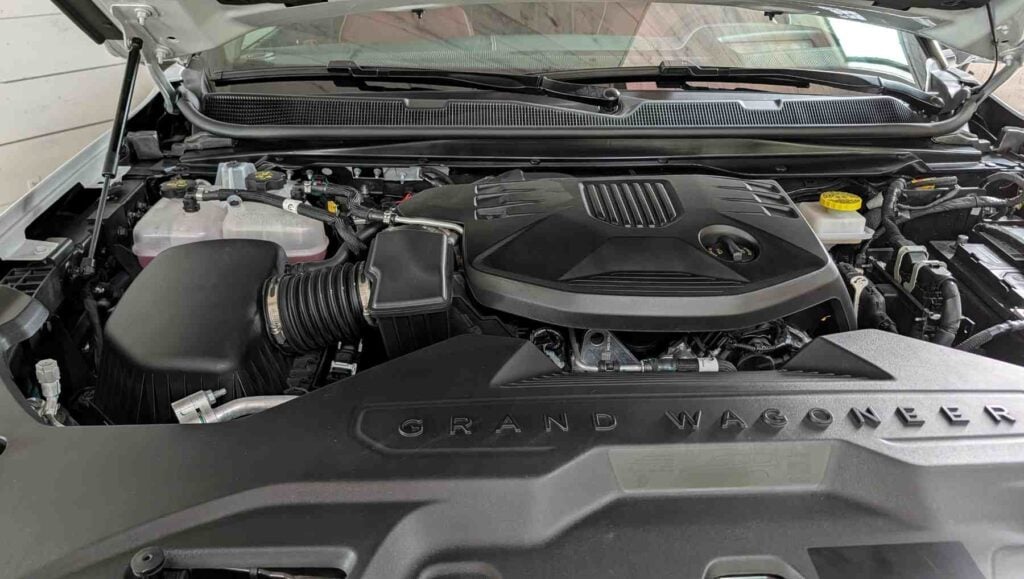
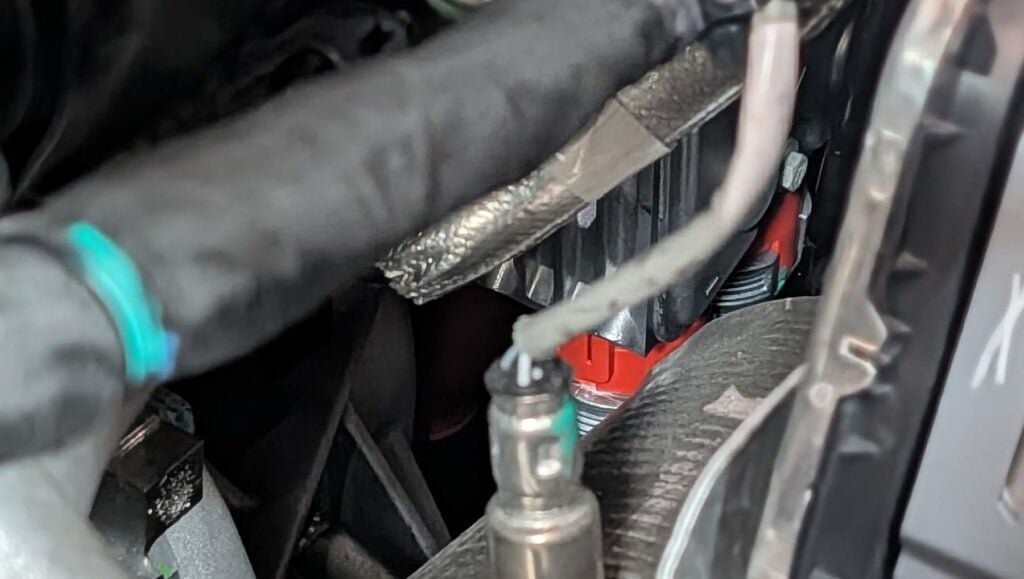
Pop the hood, and things are even more confusing. You find yourself looking at a pretty hefty 3.6 liter V6. Not a frunk, not an electric motor, and not a bunch of battery hardware. You need to look deep down inside the engine bay if you want to spot the motor, which seems to be nestled where the gearbox would be in a regular Grand Wagoneer.
Putting the electrical components there makes the most sense as that engine is just a gas-powered generator. It’s not driving the wheels, the motor is. Instead, it’s just there to keep the batteries topped up.
The new Jeep may have the biggest “generator” in an EREV
On the face of it, the 3.6 liter V6 is a bit of a strange choice for an EREV. Usually, manufacturers tend to go for relatively small, efficient, engines. In China, where EREVs are very common, you’ll usually find a 1-liter or sub 1-liter engine humming away under the hood.
The Jeep spokesperson I talked to suggested that the company wants to go with something it sees as tried and true. And this particular V6 has served Stellantis well over the years. The bigger engine will also generate more power and have an easier time keeping those batteries topped up than a smaller one.
Then there’s the fit to consider. On an ICE Grand Wagoneer, you’re going to find a similarly sized 3-liter Hurricane Twin-Turbo V6 under the hood. Jeep didn’t have to do anything drastic with engine mounting points to get it in there. A smaller engine would likely mean a drastically redesigned engine bay, and potentially a lot of dead space. Yes, a motor had to be added, but the transmission and twin-turbo are already absent.
One downside may be on the maintenance and pricing front. A large V6 is always going to cost more to manufacture and maintain. But it’s also not going to be as expensive to run and maintain as the V6 in the front of an ICE Grand Wagoneer.
It’s constantly operating within its comfort zone. No hard revving, no redlining, just some relatively easy work generating charge for the batteries. This is far easier on the engine, which should translate to significantly less wear and tear across its lifespan.
Jeep says we’ll see their EREV on the road at some point in 2026, with a late summer launch initially targeted. And where Jeep goes, the rest of Stellantis is set to follow.
Search
RECENT PRESS RELEASES
Related Post