What Adam Smith’s The Wealth of Nations reveals about failed energy transitions
May 22, 2026
In November 2025, the United Nations held its 30th Climate Change Conference (COP30) in Belém, Brazil, marking three decades of annual negotiations to address the human drivers of global warming. Yet since the first COP meeting in 1995, global carbon emissions from fossil fuels grew from 23 billion tonnes to an all-time high of 38.1 billion tonnes by the time leaders from nations around the world descended on South America for its annual talks. Proving that despite supposed growing climate action, carbon emissions continue to rise at astronomical rates.
In a capitalist system, it is hardly surprising that the same profit motive that spurs investment in low‑carbon energy also drives continued investment in fossil fuels. But to see why growing capital tends to produce ever‑higher consumption, despite technological innovation and an apparent commitment to cutting emissions, we need to return to basics. Turning to social philosopher and political economist Adam Smith’s The Wealth of Nations, a foundational work of the late 18th century, can help us understand the forces behind this stalled progress.
The worst kind of surprise
The trends in carbon emissions are stark. While we have built extensive renewable energy infrastructure over the past 30 years, data from the World Energy Consumption Database show that energy generated by renewables, biofuels, and nuclear power has more than doubled.
There have been gains in energy efficiency, however. We are much more energy-efficient than we were 30 years ago. According to data from the World Energy Consumption Database and the Maddison Project Database, we estimate that producing a dollar of goods and services in 2018 required only two-thirds as much energy as in 1990.
So, if we are producing more renewable energy and using it more efficiently, how is it that carbon emissions continue to grow?
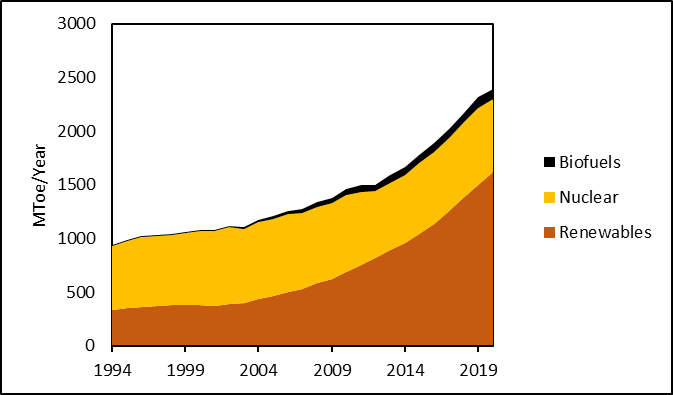
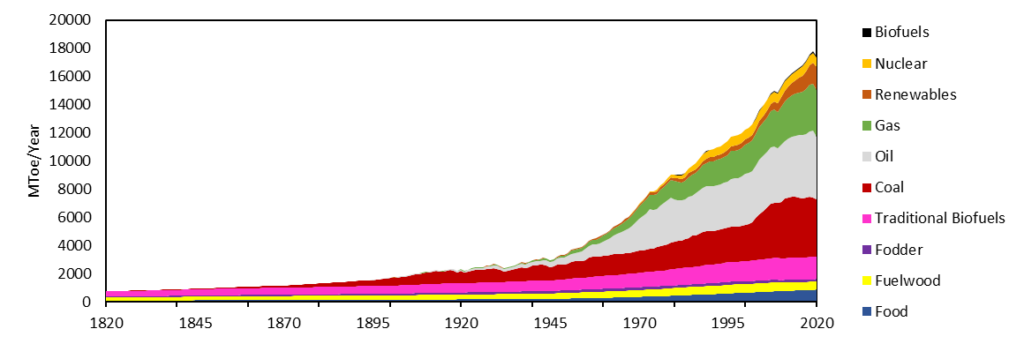
Looking further back in time at all energy sources (not just low-carbon) reveals that growth in low-carbon energy has not been accompanied by a decrease in fossil fuel use. Capitalism did not spur a transition from one energy source to another. Rather, new energy sources have been added to the available energy stock.
The rules of capital: money, money, money
When Adam Smith wrote about capitalism, he was capturing the core dynamics that still shape economic life today. Combine his ideas with today’s research on energy use, and a clear picture emerges of why our energy use keeps climbing. Ecological Economists argue that all economic activity ultimately relies on the moving and reshaping of materials. Whether mining, restructuring metal to make a laptop, steaming milk for a latte, or burning fuel to power a fishing boat, everything runs on energy. Seen this way, the history of economic growth is really a story of innovation and investments in machinery that bring new forms of energy into production, or help us use energy more efficiently. In The Wealth of Nations, Smith already tracks both trends: how new forms of energy can drive growth and examples of processes that have been made more energy-efficient.
Through an apocryphal tale of a boy employed to open and close a fire engine’s valve, he illustrates an early example of innovation. In this story, the boy finds a way to connect the valves so that they “open and shut without his assistance.” From an ecological economics perspective, we can read this as an energy-efficiency gain. Before the boy’s innovation, the system required two primary energy inputs: fossil energy to power the machine and the boy. After the boy’s innovation, the machine requires only fossil fuel energy and is therefore more efficient.
To explain how machinery drives economic growth and productivity, he compares Italian and English cloth production of the period. Italian textile manufacturers used wind and watermills, while English textile manufacturers relied on manual labor rather than mechanical technology. One energy source (human labor) replaces another, more powerful one: the wind and water that powered Italian mills.
One of Smith’s principal contributions to economics was the advancement of the concept of ‘capital’. Before Smith, capital was principally considered to mean money invested in production. But The Wealth of Nations prompted new ways of defining capital. In it, Smith argued that physical goods, such as machinery, can serve as capital when used to generate profit. For Smith, “the sole reason” that a capitalist would invest in machinery is to generate a profit. Why did 16th-century Italian textile capitalists invest in wind and watermills? Why do modern global capitalists invest in wind turbines?
Invest in low-carbon energy and challenge the profit drive.
The implication of Adam Smith’s insights is that one part of the low‑carbon transition—investing in low‑carbon energy and energy efficiency—is relatively straightforward. This is because these investments already fit comfortably within a capitalist economic system: they were happening even before the first COP meetings and will likely continue even if COPs ceased. In other words, this kind of investment aligns with profit‑seeking behavior and is therefore simply “good capitalism,” rather than something that depends on international climate negotiations.
As capital chases profits, we should expect to see investment in renewable energy, after all, it adds more energy to production. This allows you to make more stuff, which is useful for making a profit. We should also expect to see innovations in energy efficiency. This is useful for cutting costs, which is useful for making a profit. But we should also expect to see investments in fossil fuels – they bring a large quantity of energy into production, which is useful for making a profit. And when energy efficiency saves energy in one process, capitalists will use that energy in another to make more stuff and make more profits.
There is no mechanism within capitalism that pushes capitalists to leave energy in the ground. That has to come from outside. The degrowth and post-growth movements point to ways of producing and consuming that don’t rely on capital or profits. Future COPs must learn from this and from Smith if they are to reverse 30 years of failure and change the trajectory of emissions before it is too late.
Search
RECENT PRESS RELEASES
Related Post