Wheels of Change: Automation in India’s Automotive Sector
April 13, 2026
Executive Summary
India’s automotive industry contributes about 7% to the national gross domestic product (GDP) and employs roughly 32 million people directly and indirectly (NITI Aayog, 2025). India’s experience is analogous to the historical experiences of industrialising nations, such as the US, Japan, and Germany, where the automotive industry has long been a central engine of growth.
Supporting this growth, the auto-component industry has become a vital segment of the economy, spanning large corporations to micro-enterprises across manufacturing clusters nationwide. It accounted for 2.3% of India’s GDP in FY2025, employed 1.5 million people, and grew roughly at 14% annually between FY2020–2025 (India Brand Equity Foundation [IBEF], n.d.).
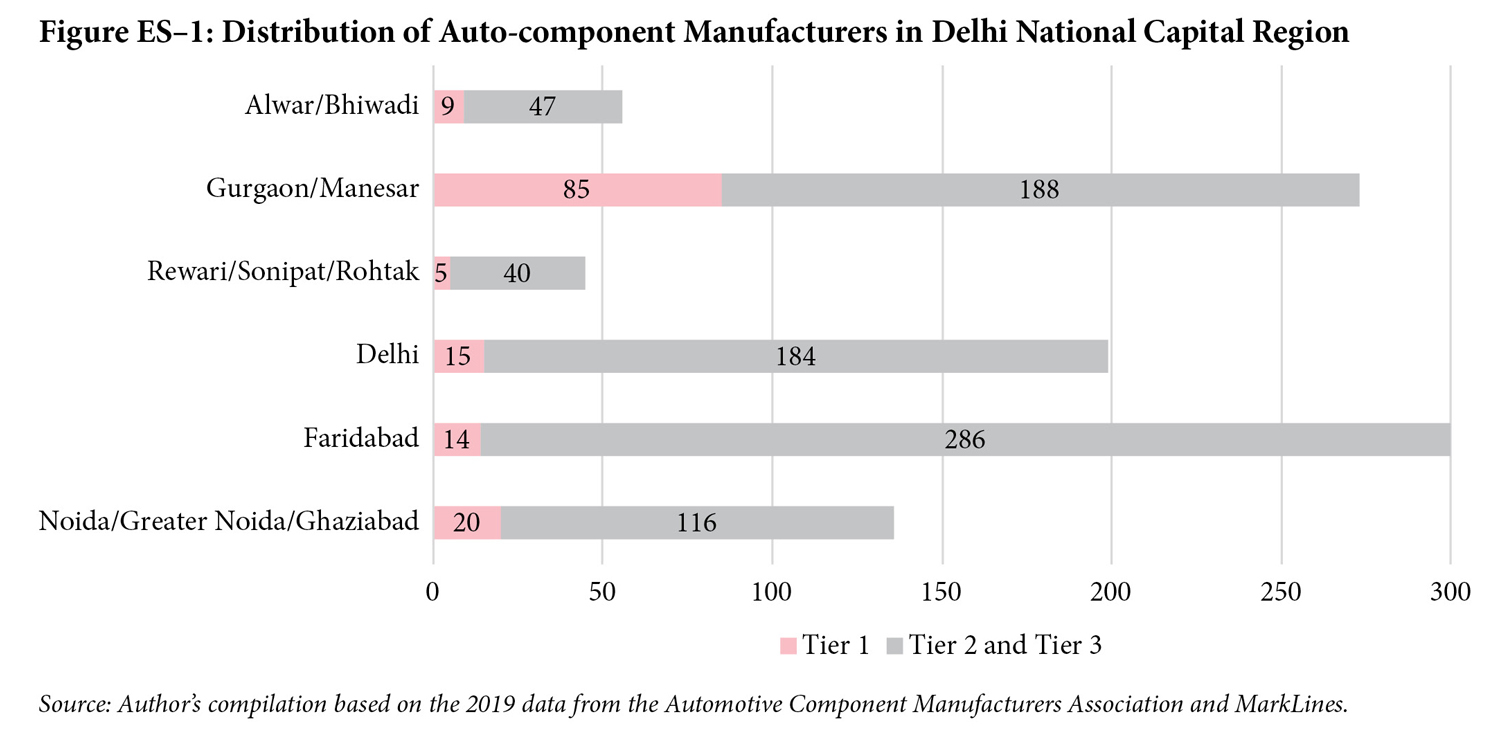
India’s northern cluster of the automotive industry accounts for roughly half of the country’s four-wheeler production. This cluster lies along NH48, extending from Haryana (Gurugram, Manesar, Rewari, and Bawal) to Rajasthan (Bhiwadi and Alwar). Haryana’s early role in hosting the Maruti–Suzuki and Hero–Honda joint ventures (JVs) in the 1980s resulted in the growth of a dynamic auto component industry in the region. However, data from the Automotive Component Manufacturers Association [ACMA], Society of Indian Automobile Manufacturers [SIAM], and MarkLines analysed for this study show that around 80% of auto-component firms in the Delhi–Haryana cluster are Tier-2 and Tier-3 Micro, Small, and Medium Enterprises (MSMEs), while only about 20% are large Tier-1 manufacturers with deep linkages to global supply chains.
Globally, the automotive industry has been at the forefront of Industry 4.0 adoption—integrating robotics, Internet of Things (IoT) systems, advanced sensors, automated quality checks, and data-driven maintenance into production processes. India, though a subsequent entrant, now ranks among the top 10 robot-installing countries (International Federation of Robotics [IFR], 2023), with the automotive sector accounting for around 40% of all industrial robot installations in the country.
Objective and Scope of the Study
This study examines how automation is unfolding in India’s auto-component manufacturing and what it means for firms and workers. The focus is not on the Original Equipment Manufacturers (OEMs)—whose automation strategies are well-documented—but on the heterogeneous base of Tier-1, Tier-2, and Tier-3 component manufacturing companies.
Primary research was conducted in three auto-component factories in the Gurugram–Manesar cluster, each of which was treated as a case study.
- A large Tier-1 manufacturer with a global presence;
- A medium-sized MSME supplying to domestic OEMs;
- A small MSME using a specialised technology.
These firms differ significantly in size, capital intensity, product characteristics, labour composition, and market orientation. Observations from the shop floor and discussions with management and union leaders form the empirical basis for this analysis. These insights were supplemented with data from industry groups like ACMA, SIAM, the Annual Survey of Industries (ASI), and international studies. By providing evidence from the shop floor, this study contributes to the broader debates about technological change in emerging economies.
The study was guided by two questions:
- How is automation taking place in auto-component firms, and what factors influence automation decisions?
- What are the implications of these automation patterns for workers, skill requirements, and the broader trajectory of the industry?
Key Findings
Automation is the fastest among Tier-1 suppliers
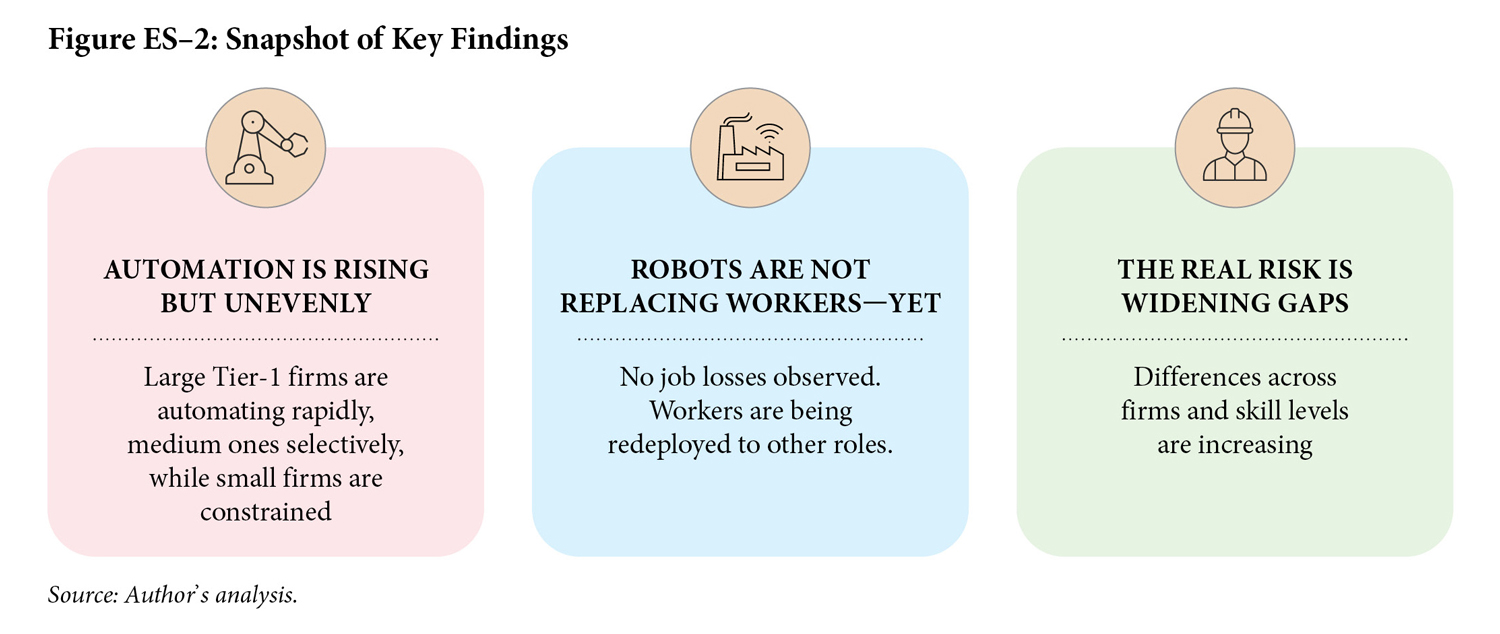
Automation is occurring most rapidly among Tier-1 suppliers that handle high volumes and operate under strict quality standards set by international OEMs. These firms have invested in robots for welding, forging, material handling, and automated inspection. Their rationale for adopting automation is not just to replace labour but to achieve quality consistency, traceability, safety, and cycle-time reduction. In these companies, automation is part of a long-term commitment to precision manufacturing and export competitiveness.
Micro, Small, and Medium Enterprises automate selectively and reactively
For MSMEs, automation is less about competing and more about coping with local constraints such as labour volatility, absenteeism during festive times, and the difficulty of finding workers who can adapt to higher-quality or time-sensitive production. Managers emphasised that robots “do not fall sick, do not take leave, and do not vary in their output,” all of which are critical for meeting OEM schedules. Their introduction of robots or semi-automated systems is aimed at resolving bottlenecks: repetitive tasks causing strain, high temperatures, or high levels of precision that are unsustainable for workers.
Small firms face structural barriers to automation
Small firms face several structural barriers, even though they are enthusiastic about automation in principle. The specialist firm examined in this study produces hundreds of items and receives small monthly orders, often in batches of 5,000–10,000 units. Automation set-up times, limited shop-floor space, and the lack of economies of scale make investments in robots unviable. Even when owners wish to automate, they simply cannot justify the capital expenditure. These firms typically struggle with productivity, limited working capital, outdated modes of production, and a shortage of trained technicians.
Labour regimes shape automation decisions
There is continued dominance of contract labour across the auto-component industry. Contract labourers are recruited through a manpower agency and can be retrenched by the company anytime, for example, if there is a lean season in production, thus giving firms flexibility; however, this also introduces instability in production. Owners noted that contractual workers have weaker attachment to the workplace and greater absenteeism—factors that directly influence a firm’s push towards automation. In contrast, where firms employ permanent workers in specialised roles, the preference is to retain them due to high training costs. These workers could move from being operators to supervisors with the oversight of one or two workers. In a larger MSME, they would oversee a line of production or become a trainer who could train other workers on operating industrial robots.
India’s new draft Labour Codes of 2025, which formally introduce fixed-term employment (FTE) as a recognised category, aim to promote direct hiring and help reduce excessive contractualisation. Fixed-term employees are entitled to the same statutory benefits as permanent employees. Whether FTE becomes significant in industrial settings, replaces contractual labour, and how it interacts with automation and skill formation remains to be seen.
Automation has not yet led to significant job losses in the three firms studied
None of the three firms had retrenched workers, though the reasons for not doing so were different in each case. In the large Tier-1 company and the medium-sized one, as business was booming, workers whose jobs were now being done by robots were redeployed to other roles, such as inspection, maintenance, and supervision. In the case of the small manufacturer, workers had been trained in a niche technology, and hence it was too costly to retrench them.
Workers expressed no fear of losing jobs to robots. In fact, union leaders described automation as inevitable and beneficial. They viewed robots as improving safety, reducing drudgery, and enhancing production quality. This echoes international evidence suggesting that while robots may displace certain repetitive tasks, they do not necessarily eliminate employment in aggregate. Indian data also point in that direction, as ASI data show that among the workers in the manufacturing sector, the percentage of total workers employed by the automobile industry in fact increased from 6% in 2012–2013 to 7% in 2022–2023.
Implications of Uneven Automation
The uneven adoption of automation, as evidenced in this study, may result in three kinds of gaps:
- Skill gap: The shop floor of an automated or semi-automated plant demands abilities that differ from those in manual settings: monitoring machine dashboards, understanding cycle-time logic, troubleshooting, and collaborating with automated systems. These are not necessarily “higher” skills, but they are different skills. Workers who acquire them can command higher wages and more stable employment. Those who cannot become increasingly marginalised. International scholarship—from Acemoglu and Restrepo to McKinsey Global Institute—warns that the next generation of automation, integrating artificial intelligence (AI)-driven quality control, predictive maintenance, and collaborative robots, will widen the skill gap further.
- Intra-industry gap: The significantly slower pace of automation in smaller component manufacturers threatens to widen the gulf between Tier-1 firms and MSMEs, which form the majority of the component industry in the National Capital Region (NCR). This has direct implications for the future readiness of small firms in the region and can result in Tier-1 component makers cornering a massive competitive advantage.
- Regional gap: This uneven progression of automation can create regional imbalances within India’s auto industry. Regions with a concentration of Tier-1 firms—such as Pune or Chennai—may accelerate technologically, while clusters dominated by MSMEs—like the Delhi–Haryana belt—risk stagnation unless supported by targeted policy interventions.
Policy Recommendations
- Firstly, there is a need to strengthen the training ecosystem. Industrial Training Institutes (ITIs) and polytechnics currently lag behind the needs of automated manufacturing. The Dattopant Thengadi National Board for Workers Education and Development (formerly the Central Board for Workers Education), which runs programmes to bridge the domain and employability skill gap, has to factor in the rapid adoption of robots in industries like automotive.
- Secondly, MSMEs need support to adopt automation through subsidised credit, shared automation centres where pilot projects can be tried out, and cluster-based technology facilities that reduce the burden of capital expenditure.
- Thirdly, policymaking must anticipate that not all displaced or under-skilled workers will be able to transition into robot-assisted roles. Public policy must consider pathways for ‘decent work’ as defined by the International Labour Organisation, for those outside the ambit of skilling, to avoid polarisation of workers.
Conclusion
Automation in India’s auto-component industry is not happening at a uniform scale and pace, and is shaped by firm size, labour markets, and structural constraints. Workers do not presently feel threatened and, in many cases, welcome automation. However, the shop floor in automotive manufacturing will inevitably change due to technology creating gaps in skilling as well as competitiveness of firms within the northern auto corridor and also across regions. The long-term trajectory will depend on how policy prepares workers and firms for this phase of industrial change.
Search
RECENT PRESS RELEASES
Related Post