Why Bitcoin, Ethereum, and XRP are falling?
November 30, 2025
Bitcoin (BTC), Ethereum (ETH), and Ripple (XRP) are off to a bearish start in December, with over 4% losses by press time on Monday. Bitcoin, Ethereum, and Ripple face renewed selling, risking further losses to $80,000 BTC, $2,100 ETH, and $1.90 XRP, respectively.
The fresh sell-off wave aligns with Bank of Japan (BoJ) Governor Kazuo Ueda’s statement that possible interest rate hikes could be considered if the economy continues to evolve as predicted, which could increase borrowing costs and negatively affect carry trades.
Bitcoin trades below $87,000 by press time on Monday, preparing for a potential bearish marubozu candle on the daily chart. The intraday sell-off extends the pullback after the $92,800 level retest seen last week.
In line with renewed selling, the Relative Strength Index (RSI) is at 33 on the daily chart, pivoting downside towards the oversold after last week’s recovery and indicating a fresh wave of supply pressure. If RSI remains below 30, it could signal an extended downtrend in BTC prices.
Furthermore, the Moving Average Convergence Divergence (MACD) shifts from an uptrend to risking a potential cross below the red line, which would trigger a sell signal.
The immediate target for Bitcoin bears remains the $80,600 support level from November 21. If the cryptocurrency market fails to find a new bullish catalyst, BTC could revisit the April 7 low of $74,508.
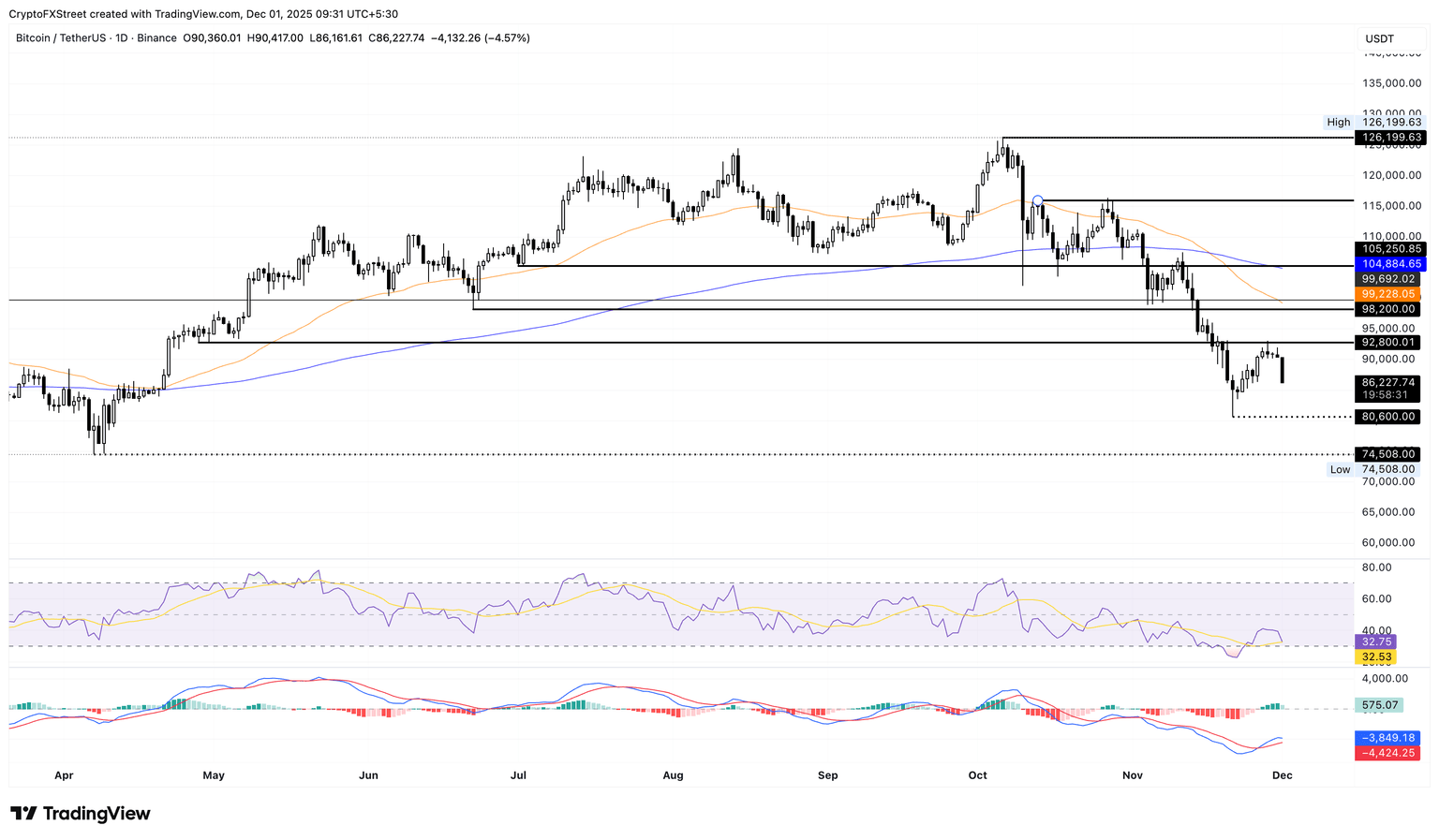
However, if a catalyst such as a potential US Federal Open Market Committee (FOMC) decision to cut interest rates, Bitcoin could rebound to $90,000 amid easier access to capital.
Ethereum retraces 5% on the downside by press time on Monday from a resistance trendline on the daily chart. The bearish start to the week risks breaking below the supply zone near $2,800.
If ETH marks a successful daily close below the November 21 low of $2,623, it would confirm the range breakdown and potentially extend the decline to the June 22 low of $2,111.
Similar to BTC, the RSI at 34 and MACD risk a cross below the signal line indicate Ethereum is on the edge.
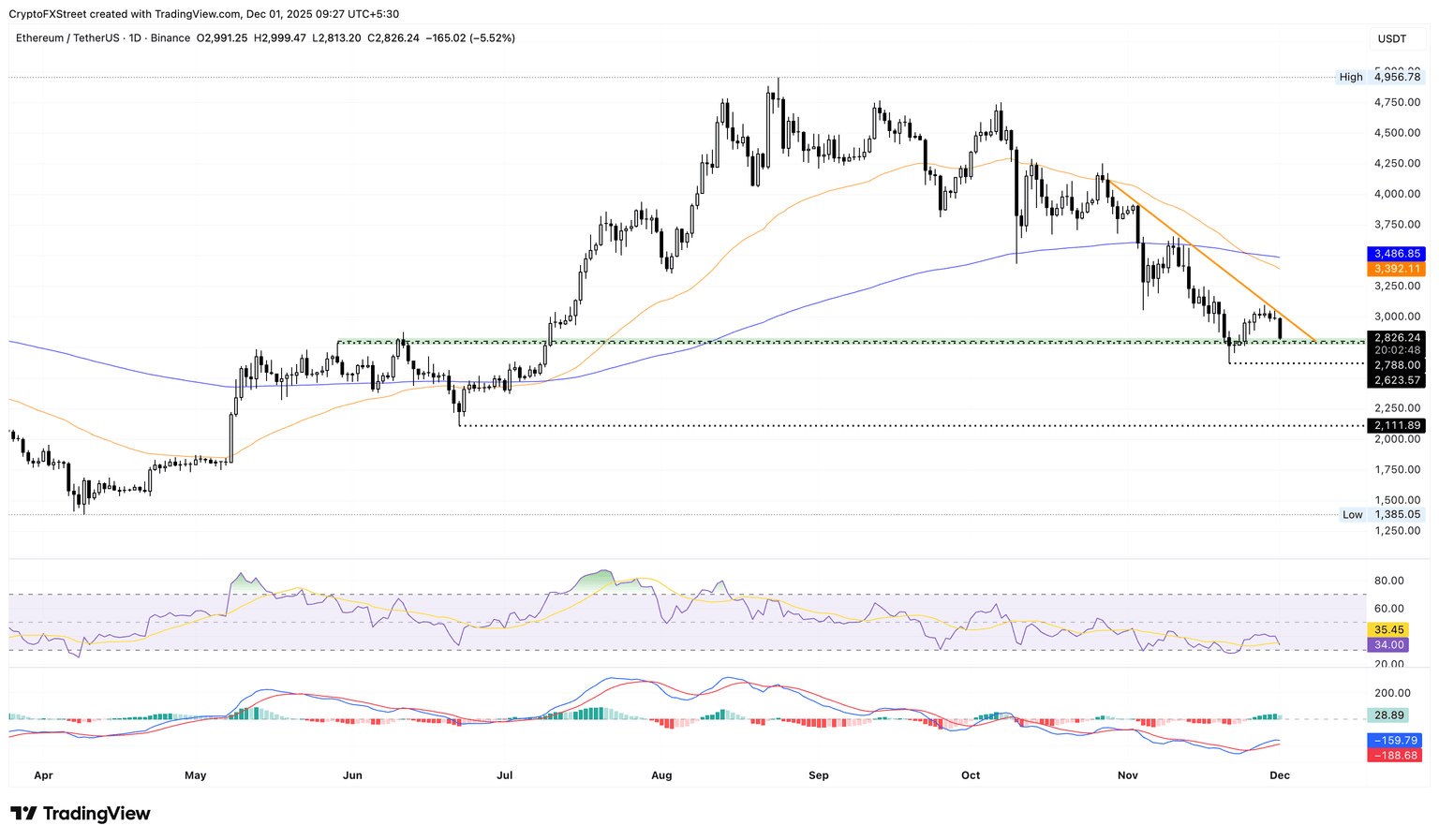
Looking up, a bounce back in Ethereum could challenge the overhead trendline near $3,000.
XRP price is down over 4% by press time on Monday, extending the 2% loss from Sunday. The cross-border remittance token is trading close to the $2.00 psychological level, with bears targeting the $1.90 support level, marked on June 22.
Momentum indicators on the daily chart signal similar bearishness for XRP, with the RSI at 40, suggesting increased selling pressure. Meanwhile, the MACD is closing towards the signal line for a potential crossover, which could confirm a bearish shift in the XRP price trend.
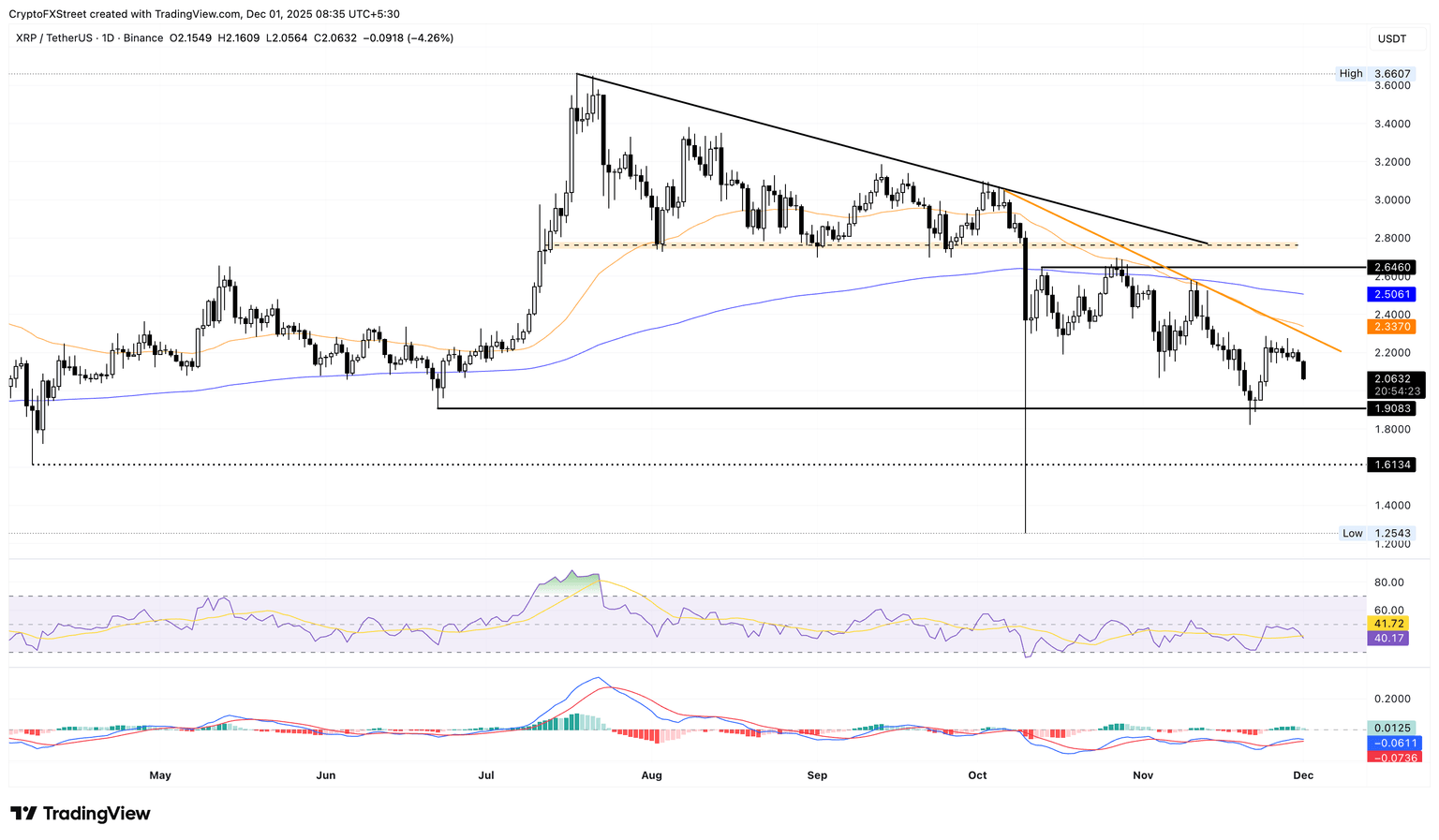
Optimistically, if XRP bulls hold dominance at the $2.00 level, a rebound towards the resistance trendline formed by connecting the October 6 and November 10 highs near the $2.20 level could be possible.
Bitcoin is the largest cryptocurrency by market capitalization, a virtual currency designed to serve as money. This form of payment cannot be controlled by any one person, group, or entity, which eliminates the need for third-party participation during financial transactions.
Altcoins are any cryptocurrency apart from Bitcoin, but some also regard Ethereum as a non-altcoin because it is from these two cryptocurrencies that forking happens. If this is true, then Litecoin is the first altcoin, forked from the Bitcoin protocol and, therefore, an “improved” version of it.
Stablecoins are cryptocurrencies designed to have a stable price, with their value backed by a reserve of the asset it represents. To achieve this, the value of any one stablecoin is pegged to a commodity or financial instrument, such as the US Dollar (USD), with its supply regulated by an algorithm or demand. The main goal of stablecoins is to provide an on/off-ramp for investors willing to trade and invest in cryptocurrencies. Stablecoins also allow investors to store value since cryptocurrencies, in general, are subject to volatility.
Bitcoin dominance is the ratio of Bitcoin’s market capitalization to the total market capitalization of all cryptocurrencies combined. It provides a clear picture of Bitcoin’s interest among investors. A high BTC dominance typically happens before and during a bull run, in which investors resort to investing in relatively stable and high market capitalization cryptocurrency like Bitcoin. A drop in BTC dominance usually means that investors are moving their capital and/or profits to altcoins in a quest for higher returns, which usually triggers an explosion of altcoin rallies.
Search
RECENT PRESS RELEASES
Related Post