Why the AI boom is driving up the price of your next car: Inside RAMageddon
March 25, 2026
 Credit: Vladdeep | Envato Elements
The automotive industry is staring down a structural threat that mirrors the 2021 semiconductor crisis, but this time the root cause may be more permanent. While the previous shortage was a byproduct of pandemic-era logistics and supply chain hiccups, the “RAMageddon” phenomenon is a result of strategic capacity reallocation.
The global memory market has pivoted toward High-Bandwidth Memory (HBM) to feed the substantial demand for AI. This fundamental shift means automakers will have to contend with a shrinking pool of silicon, which comes at the worst possible time for vehicle manufacturers.
In so many words, cars today are high-performance computers on wheels, an attribute that enables automakers to offer customers the latest and greatest features to enhance the vehicle ownership experience. The “food source” that powers those next-gen features on a modern vehicle, features that would elevate said ownership experience, automakers are now having to share that with AI data centers, which require a substantial piece of the proverbial pie.
This fundamental market shift may mean the MSRP of your next vehicle is affected by the explosive growth of data centers.
Two flavors of memory
Standard DRAM and AI-driven HBM
To get a clear picture of why this shift is so impactful, it helps to look at the two flavors of memory currently fighting for space in the world’s most advanced factories. Standard DRAM (Dynamic Random-Access Memory) and the aforementioned HBM.
DRAM serves as a workhorse memory. In your vehicle, it is the invisible engine behind everything from smooth infotainment screen swipes to the split-second calculations required for adaptive cruise control and other advanced safety systems.
HBM is essentially a supercharged version of DRAM. While it uses the same basic silicon material, HBM is engineered for the extreme data processing required by AI giants, moving data at bandwidths up to 1.2 TB/s, roughly 10 times the data throughput of the memory found in a high-end laptop.
The wafer penalty
Skyscrapers versus ranch homes
 Credit: chormail | Envato Elements
The primary driver of rising car prices in this context isn’t necessarily a lack of factories, but rather a shift in what those factories are being asked to produce. The memory industry is currently dominated by three giants, Samsung, SK Hynix, and Micron, who operate massive fabrication facilities (fabs) that “bake” these chips onto silicon wafers.
Currently, these fabs are split between producing standard DRAM for automotive and other consumer product verticals, such as laptops and smartphones, and the more complex HBM for AI infrastructure.
It’s helpful to think of the manufacturing difference in terms of architecture. While standard DRAM is built like a single-story ranch home, HBM is more like a skyscraper. It stacks 12 to 16 layers of memory vertically to achieve the extreme speeds required for modern AI.
This leads to a physical wafer penalty. Because HBM is more complex, it consumes roughly three times the total silicon wafer capacity required to produce the same amount of memory as a standard chip. It also requires longer manufacturing cycles, with some HBM4 stacks taking twice as long to bake as a standard DRAM chip.
In high-volume manufacturing, every “skyscraper” chip produced for an AI data center effectively cancels out the production capacity of three “ranch home” chips for the auto industry. This physical math is becoming a point of contention as data centers need HBM and cars need standard DRAM. They are both fighting for the same real estate in terms of silicon wafers and fab space.

RAM prices have doubled, here’s my plan to survive the ‘RAM-pocalypse’
Some of us have rather short memories…
New margin gap
Automaker and supplier dynamic changes
 Credit: Ford
While the wafer penalty limits how much can be made, the margin gap determines who gets it. According to S&P Global Mobility, the suppliers mentioned above, Samsung, SK Hynix, and Micron, control 88% of the automotive DRAM market.
These companies are now facing a profitability divide that hasn’t existed before. In the automotive sector, memory has traditionally been treated as a commodity, sold in bulk to vehicle manufacturers who demand the lowest possible prices. In certain situations where automakers and suppliers are at the negotiating table, automakers can have the upper hand as many of them own and control multiple top-selling vehicle lines.
This dynamic is a double-edged sword for suppliers. While an order for millions of units from a global automaker provides a degree of predictability, it often comes with the stress of razor-thin profit margins. Historically, suppliers felt forced to accept these lower-margin automotive bids simply because the sheer volume was too massive to ignore.
Behind closed doors in Detroit, you will sometimes hear someone from the supplier community say, “they really beat us over the head” or “raked us over the coals” in reference to a discussion they had with an automaker. Those expressions are followed by uncertainty about how that supplier will get that program off the ground and make it profitable, while still delivering on time for the automotive OEM.
Plante Moran’s latest automaker and supplier working relations index found that Toyota, Honda, and General Motors are the industry leaders in helping suppliers manage costs, risks, and uncertainty. While they finished as the top three in the study, Nissan, Ford, and Stellantis ranked as the bottom three. The annual study tracks supplier perceptions of their automaker customers, rating them across eight major purchasing areas, broken down into 20 commodity areas.
“OEMs in the top three score better in the basics: communication, responsiveness, accessibility, engagement, and buyer knowledge,” explained Dr. Angela Johnson, Principal, Plante Moran Management Consulting, Supplier Relations Analytics. “These skills help suppliers operate more efficiently, and in turn, create strong relationships.”
In the delicate dance that is the relationship between automakers and suppliers, the ongoing AI boom has rewritten the script. With AI data centers now offering both high volume and high margins, often paying a premium for the same silicon wafers, suppliers no longer feel obligated to settle for the terms and conditions of the auto industry. This effective leveling of the playing field may prompt some automakers to reevaluate how they engage suppliers.
“Stronger relationships enable OEMs and suppliers to work together and better navigate industry uncertainty with more equitable risk and cost sharing,” Dr. Johnson said.
During the February 2026 Wolfe Research summit, Ford CFO Sherry House said the Dearborn-based automaker has access to a sufficient DRAM supply, but noted that potential shortages are being incorporated into its forward planning. At the ALSC Europe 2026 conference in mid-March, Stellantis Vice President Carlos Vazquez described a move toward an “anti-fragile” supply chain, using AI-enabled prediction tools with human oversight and collaboration to pinpoint shortages before they stall production lines.
Meanwhile, BMW has reportedly begun shifting toward multi-year “scarcity contracts” to lock in supply of the aging DDR4 chips that power their current digital cockpits, effectively treating standard memory as a high-value specialty component rather than a bulk commodity.
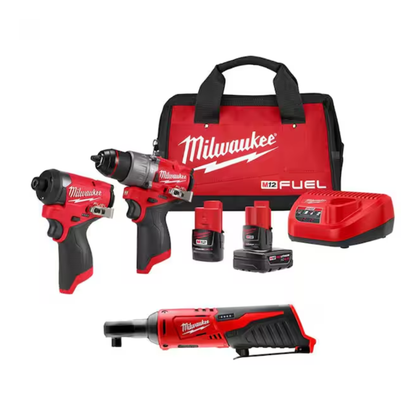
Milwaukee M12 FUEL Combo Kit
What’s Included
M12 impact driver, hammer drill, 3/8-inch ratchet, charger, two batteries
Warranty
5-year warranty on tools, up to 3-year warranty on batteries.
If you’re looking for a great DIY starter kit from Milwaukee, this M12 3-tool combo kit is it. With an impact driver, hammer drill, and 3/8-inch ratchet, along with a 4Ah and 2Ah battery, this kit is a great starting point for projects both at home and on your vehicle.
Reallocation of resources
Panic buying and production disruptions
Data from TrendForce shows that DRAM suppliers will continue to reallocate their resources to support rising AI server demand. While that TrendForce report focuses on how products like laptops and client SSDs are experiencing price hikes due to suppliers prioritizing the AI boom, it’s not a far leap to see how automotive would be affected.
According to S&P Global, demand from AI data centers with higher profit margins is diverting DRAM supply away from the auto industry, leading to a potential semiconductor shortage that could cause automotive-grade DRAM prices to spike between 70% to 100%, triggering, as S&P Global described, “panic buying and production disruptions across the industry.”
In its second-quarter fiscal 2026 report, Micron Technology confirmed that its data center business is achieving gross margins of 74%, versus 68% for its automotive and embedded business unit. In that report, dated March 18th, 2026, Micron’s revenue from its data center business was nearly $5.7 billion, versus $2.7 billion for its automotive and embedded business unit.
“In the AI era, memory has become a strategic asset for our customers, and we are investing in our global manufacturing footprint to support their growing demand,” said Sanjay Mehrotra, Chairman, President, and CEO of Micron Technology.

3 insider tricks to get VIP treatment at any car dealership
Red carpet treatment, even if you buy something used.
The consumer impact
More subscription-based features
 Credit: Prostock-studio / Envato Elements
When fab space is limited, suppliers will prioritize the AI skyscrapers that offer higher margins over the automotive ranch homes that offer less. Automakers may need to pay a scarcity premium to secure a spot in line, as it were, a cost that may eventually translate to higher MSRPs on dealer lots as it’s passed onto the consumer.
Car buyers may also notice that more automakers are paywalling a wider range of features behind monthly or yearly subscriptions after an initial trial period. These subscription-based services can take many forms, though infotainment is a good example, as automakers can continue to paywall features like Wi-Fi hotspots, video streaming, and cloud-based navigation with real-time traffic updates and voice commands.
Subscription-based packages are a way for automakers to drive revenue after the sale and help offset costs associated with something like an industry-wide DRAM reallocation.
AI revolution and sticker shock
The outlook for the remainder of 2026 remains tight, and a new hurdle looms just over the horizon.
S&P Global notes that DRAM makers are beginning to phase out older-generation chips (such as DDR4 and LPDDR4) that many current cars were designed to use. By 2028, the supply of these older chips may dry up entirely, forcing manufacturers to undertake expensive mid-cycle redesigns to keep their tech current.
While new fabrication plants are under construction to support the AI boom, supply chain relief for automakers and other consumer product manufacturers might be hard to come by, at least for the foreseeable future.
Ultimately, RAMageddon underscores that vehicles are computers on wheels. As long as silicon remains the world’s most contested resource, any sticker shock car buyers experience going forward may be linked to the AI revolution.
Search
RECENT PRESS RELEASES
Related Post







13