Will the Stock Market Crash Under President Trump in 2026? Historical Data Offers a Grim A
February 5, 2026
The S&P 500 could decline sharply in 2026 under pressure from high valuations, sweeping tariffs, and midterm elections.
The S&P 500 (^GSPC 0.51%) has advanced 1% year to date, and the benchmark index for U.S. stocks sits within a percentage point of its record high.
However, the economic fallout from President Trump’s tariffs, coupled with high valuations and midterm elections, could cause the stock market to decline sharply or even crash in 2026. Here’s what investors should know.
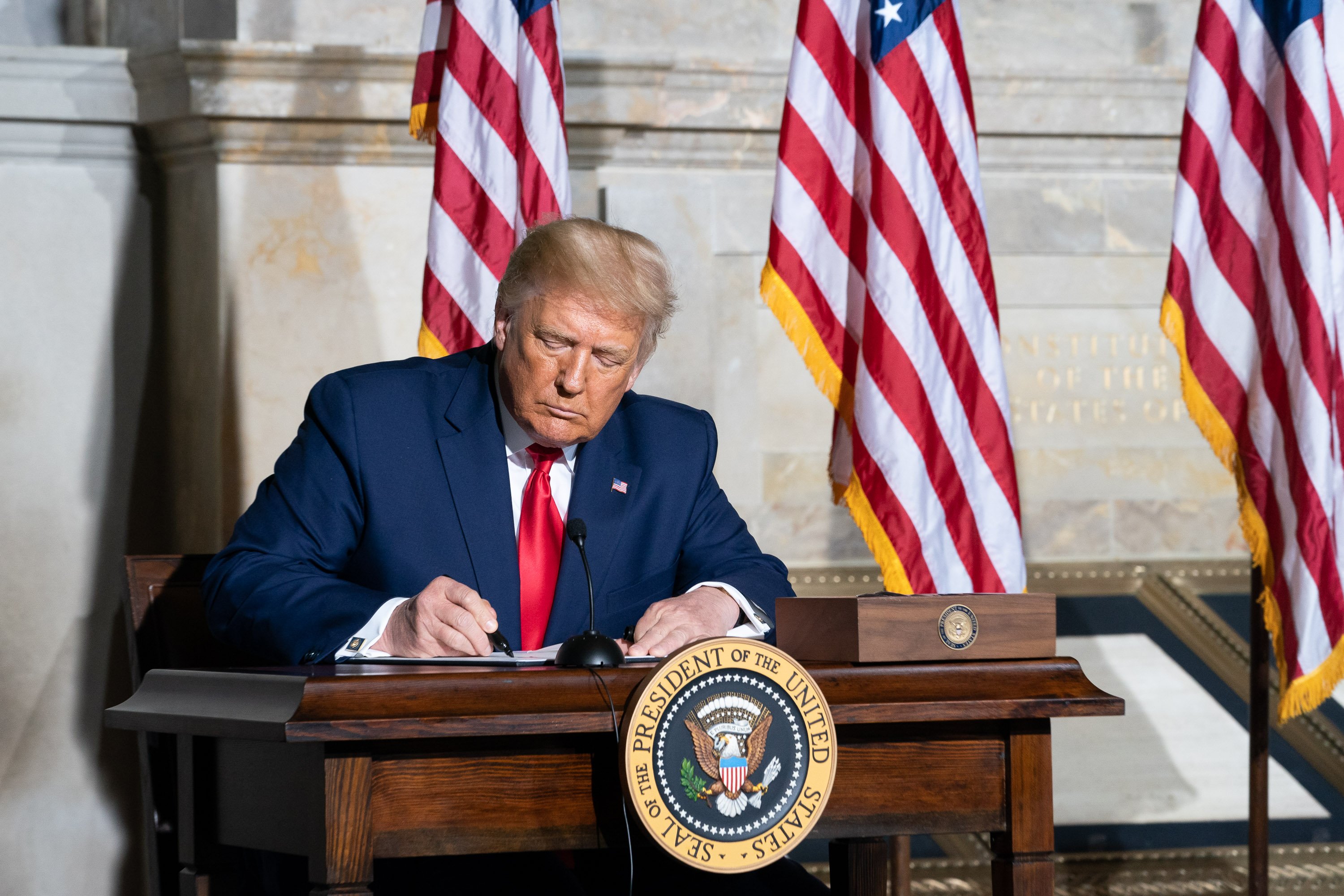
Image source: Official White House Photo by Joyce N. Boghosian.
President Trump says tariffs are strengthening the economy and exporters are paying the bill, but data suggests otherwise
In January, President Trump wrote an editorial in The Wall Street Journal. He said the tariffs imposed by his administration, which have raised the average tax on U.S. imports fivefold, have led to “extraordinarily high economic growth!” But that is a wild misrepresentation:
- While real GDP growth was well above average in the second and third quarters of 2025, the economy contracted in the first quarter. Collectively, real GDP increased 2.51% during the first nine months of 2025. That is actually below the 10-year average (2.75%), the 30-year average (2.58%), and the 50-year average (2.84%).
- Furthermore, artificial intelligence (AI) spending contributed 0.97 percentage points to real GDP growth during the first nine months of 2025, according to the Federal Reserve Bank of St. Louis. That means real GDP would have increased just 1.54% without AI spending.
President Trump’s editorial also claimed the tariff burden has “fallen overwhelmingly on foreign producers and middlemen, including large corporations that are not from the U.S.” He wrote, “According to a recent study by the Harvard Business School, these groups are paying at least 80% of tariff costs.” But that statement seems to be a complete fabrication.
The study Trump linked explicitly states, “Our results suggest that U.S. consumers paid up to 43 percent of the tariff burden, with the rest absorbed by U.S. firms.” Nowhere in the report do the authors suggest that foreign exporters have paid a substantial percentage of the tariffs.
Here’s the big picture: President Trump says tariffs have strengthened the economy, but GDP growth was below average through the first three quarters of 2025. AI spending is what truly supported the economy. “Without it, U.S. GDP would have almost flatlined,” according to Goldman Sachs.
History says there is a 50/50 chance the S&P 500 declines at least 19% in 2026
The S&P 500 trades at 22.2 times forward earnings, according to FactSet Research. That is a very expensive valuation. The index has only sustained a forward price-to-earnings (P/E) ratio above 22 during two periods in the past 40 years: The dot-com bubble and the Covid-19 pandemic. Both situations led to bear markets.
Importantly, Wall Street expects S&P 500 earnings to accelerate in 2026. In other words, not only is the index’s valuation elevated by historical standards, but also the ratio in question, the forward P/E has by definition already priced in very strong financial results. If S&P 500 companies fail to meet those high expectations as President Trump’s tariffs weigh on the economy, stocks could fall sharply.
There is one more data point to consider. The S&P 500 has suffered a median intra-year drawdown of 19% in midterm election years. In other words, history says there is a 50/50 chance the index falls at least 19% in 2026. That happens because midterm elections create uncertainty. The political party in power typically loses seats in Congress, leaving investors to wonder about future fiscal, trade, and regulatory policies.
Here’s the big picture: The stock market face several headwinds in 2026: high valuations, tariffs, and midterm elections. Against those headwinds, the odds of a bear market (or even a stock market crash) are elevated. However, there is a silver lining for investors: Every past drawdown has been a buying opportunity and there is no reason to believe the next one will be different.
Search
RECENT PRESS RELEASES
Related Post