Wisconsin Democratic Lawmakers Announce New Marijuana Legalization Bill To Promote ‘People
February 2, 2026
Wisconsin Democratic lawmakers are unveiling a new bill to legalize marijuana in the state—though its prospects of passage remain dubious with Republicans still in control of both chambers of the legislature.
“Legalization of cannabis is not radical. What’s radical is continuing a system that destroys lives, drains resources and ignores the will of the people,” Rep. Darrin Madison (D) said during a press conference on Monday. “Wisconsin’s ready.”
While a majority of states, including most of those neighboring Wisconsin, have legalized marijuana, “Wisconsin hasn’t, which leaves us behind the curve,” he said. “Not because the evidence isn’t clear, not because people don’t support it, but because politics keeps on blocking progress.”
“The will of the people is clear on this issue, and today we’re acting on it,” he said. “Legalizing cannabis in Wisconsin is an economic necessity, a public safety strategy and a racial justice imperative.”
Madison also made the case that, because President Donald Trump signed into law large-scale legislation that included provisions to ban most consumable hemp products, legalization at the state level could give the industry a “lifeline, allowing them to transition from hemp-derived THC to cannabis-derived THC and keep jobs, investments and innovation right here in our home state.”
“Legalizing cannabis is about replacing a failed punishment model with smart, evidence-based regulation,” he said. “People already use cannabis. Regulation ensures products are tested, labeled and safe, especially at a time when unregulated substances and opioids continue to claim lives across Wisconsin.”
Rep. Andrew Hysell (D) also spoke at Monday’s event.
“If I’m going to boil down what marijuana legalization is really about, it’s super simple: Legalization is about freedom—the freedom of adults to make up their own mind and to make their own choice whether to consume cannabis,”he said. “In the United States, Wisconsin is an outlier in terms of denying people this freedom. We are only one of a few states that completely bans the marijuana plant.”
“Standing in the way of the people’s freedom is not good politics. Almost 70 percent of Wisconsinites want full adult use legalization, and even more want medical,” Hysell said, adding that Wisconsin residents “deserve the freedom to make their own choices about cannabis, so let’s give them that right. It’s time.”
Here are some of the main details of the forthcoming bill, according to a legislative analysis shared with Marijuana Moment:
- Adults 21 and older could purchase and possess marijuana and hemp THC products.
- Hemp would be defined as a cannabis product containing up to 10 milligrams of an intoxicating cannabinoid such as delta-9 THC per 12 fluid ounces or per serving or per package of an edible.
- Any cannabis product with higher concentrations of intoxicating cannabinoids would be considered marijuana.
- The possession limit for marijuana would be up to 2.5 ounces of flower in a public space, up to five pounds of cannabis flower in a private residence, up to one gram of THC in a cannabis-infused product and up to 15 grams of a cannabis concentrate.
- A “Division of Cannabis Regulation” would be established within the state Department of Agriculture, Trade and Consumer Protection. The division would be responsible of overseeing the “production, processing, transportation and testing of cannabis.”
- In order to sell marijuana in a dispensary, a business would need to receive a license from the state Department of Revenue (DOR).
- People 18 and older (or younger with consent from a parent or caregiver) could register as a medical marijuana patient if they have a qualifying condition, which includes cancer, glaucoma, AIDS/HIV, Crohn’s disease, Alzheimer’s disease, amyotrophic lateral sclerosis, post-traumatic stress disorder (PTSD), opioid use disorder or “any other medical condition or treatment DHS designates by rule as a debilitating medical condition or treatment.”
- Marijuana would be subject to 10 percent excise tax for producers, a 10 percent excise tax for processors, a 5 percent tax for retailers for adult-use sales, a 10 percent occupational tax for cannabis microbusinesses, an optional 5 percent excise tax on retailers by localities and a 3 percent excise tax on marijuana for the buyer (unless that individual is a registered medical cannabis patient).
- Revenue from the 3 percent excise tax for consumers would go to DOH to support research into the health effects of cannabis use.
- Under the bill, there would be a “process to review convictions for acts that have been decriminalized under the bill. If the person is currently serving a sentence or on probation for such a conviction, the person may petition a court to vacate the conviction and expunge the record or, if applicable, adjust the conviction to a lower crime.”
- The legislation also contains provisions providing employment protections for people who use marijuana in compliance with the law while off the clock.
Meanwhile, a top Republican Wisconsin lawmaker recent said that President Donald Trump made the “wrong” choice to order the rescheduling of marijuana—which he called a “dangerous drug.”
However, Assembly Speaker Robin Vos (R) said the upside is that research barriers may be lifted in a way that demonstrates medical cannabis can be effectively used in a limited way as an alternative to prescription medications.
With just under a year before voters elect their next governor, the majority of the current candidates have made clear that they will support efforts to legalize marijuana—in part to fund public programs such as increased access to broadband.
And while there’s been splintering on the issue between the two chambers of the legislature, a Senate panel recently took up a Republican-led bill that would legalize medical marijuana in the state.
Senate President Mary Felzkowski (R) and Sen. Patrick Testin (R) filed the legislation, and the Senate Health Committee debated the proposal at a hearing in October, taking testimony from patients and other advocates. Members didn’t vote on the bill, but the chair said the panel would be advancing it “fairly quickly.”
Vos, for his part, said that month that he hopes lawmakers in the state can “find a consensus” on legislation to legalize medical marijuana. But he added that the cannabis bill filed by his Republican leadership counterpart in the Senate is “unlikely” to pass his chamber because it is “way too broad and way too wide-ranging.”
As the 2025 session was set to get underway, Felzkowski said she was “hoping to have a conversation” in the legislature about legalizing medical marijuana—though the Republican Assembly speaker still represented “an obstacle,” she added.
The Senate leader has previously sponsored medical cannabis legislation in past sessions, formally introduced the new legislation.
Meanwhile, a Republican candidate for governor of Wisconsin who has since left the race said in July that he was “open to considering different opportunities” when it comes to legalizing medical or adult-use marijuana in the state, though he has provided little in the way of specifics so far.
Current Gov. Tony Evers (D), who supports legalizing cannabis, isn’t seeking re-election—but he said in June that if his party can take control of the legislature, the state can “finally” legalize marijuana so that residents don’t have to go to neighboring Illinois to visit its adult-use market.
Separately in June, a poll from Marquette Law School found that two in three Wisconsin voters support legalizing marijuana.
The survey found that support for cannabis reform has generally increased over time since the institution first started tracking public opinion on legalization in 2013, with 67 percent of voters now backing the policy change. That’s 17 percentage points higher than the 2013 results.
Democrats are the most likely to favor legalizing cannabis, at 88 percent, followed by independents (79 percent). However, a majority of Republicans (56 percent) said they’re still opposed to adult-use legalization.
Underscoring the importance of party control, the state’s Republican-controlled Senate and Assembly this summer rejected another attempt to legalize marijuana, defeating amendments to budget legislation that would have ended prohibition in the state and established new medical and recreational cannabis programs.
Evers has routinely attempted to change that policy as part of his budget requests—and Democratic leaders have similarly pushed for reform.
Republicans in the legislature also cut the marijuana provisions from a state budget proposal in May, as they’ve done in past sessions.
Despite Republicans’ move to cut legalization from the budget legislation, party leaders recently acknowledged that the debate over medical marijuana legalization is “not going to go away,” and there’s hope it can be resolved this session.
—
Marijuana Moment is tracking hundreds of cannabis, psychedelics and drug policy bills in state legislatures and Congress this year. Patreon supporters pledging at least $25/month get access to our interactive maps, charts and hearing calendar so they don’t miss any developments.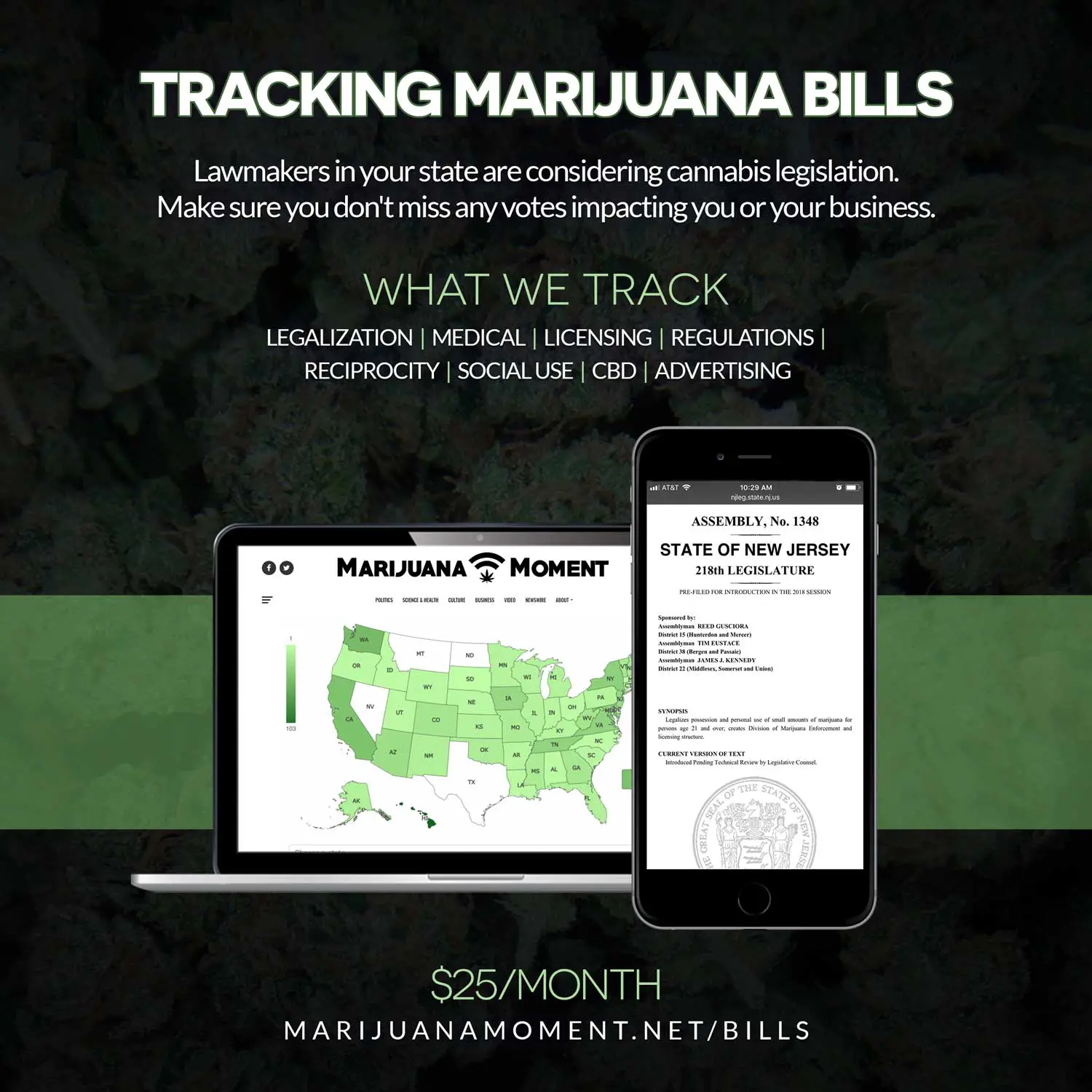
Learn more about our marijuana bill tracker and become a supporter on Patreon to get access.
—
“I don’t think anyone is naive enough to think that marijuana and THC products aren’t present in the state of Wisconsin when they are readily available over state lines, so I think we need to come to an answer on this,” Assembly Majority Leader Rep. Tyler August (R) said in February. “I’m hopeful that we can.”
“If we’re going to call it medical marijuana, it needs to be treated like a pharmaceutical. But the marijuana debate is going to be something that is not going to go away,” Sen. Dan Feyen (R), the assistant majority leader, said at the time. “The margins are tighter.”
There have been repeated attempts to legalize medical marijuana in the legislature over recent years, including the introduction of legislation from the Assembly speaker that called for a limited program facilitated through state-run dispensaries. That proved controversial among his Republican colleagues, however, and it ultimately stalled out.
Evers previewed his plan to include marijuana legalization in his budget last January, while also arguing that residents of the state should be allowed to propose new laws by putting binding questions on the ballot—citing the fact that issues such as cannabis reform enjoy sizable bipartisan support while the GOP-controlled legislature has repeatedly refused to act.
Previously, in 2022, the governor signed an executive order to convene a special legislative session with the specific goal of giving people the right to put citizen initiatives on the ballot, raising hopes among advocates that cannabis legalization could eventually be decided by voters. The GOP legislature did not adopt the proposal, however.
Evers said in late 2024 that marijuana reform is one of several key priorities the state should pursue in the 2025 session, as lawmakers work with a budget surplus.
Days after he made the remarks, a survey found the reform would be welcomed by voters in rural parts of the state. Nearly two thirds (65 percent) said they support legalizing cannabis.
Last May, the governor said he was “hopeful” that the November 2024 election would lead to Democratic control of the legislature, in part because he argued it would position the state to finally legalize cannabis.
“We’ve been working hard over the last five years, several budgets, to make that happen,” he said at the time. “I know we’re surrounded by states with recreational marijuana, and we’re going to continue to do it.”
A Wisconsin Democratic Assemblymember tried to force a vote on a medical cannabis compromise proposal in 2024, as an amendment to an unrelated kratom bill, but he told Marijuana Moment he suspects leadership intentionally pulled that legislation from the agenda at the last minute to avoid a showdown on the issue.
Meanwhile, the state Department of Revenue released a fiscal estimate of the economic impact of a legalization bill from then-Sen. Melissa Agard (D) in 2023, projecting that the reform would generate nearly $170 million annually in tax revenue.
A legislative analysis requested by lawmakers estimated that Wisconsin residents spent more than $121 million on cannabis in Illinois alone in 2022, contributing $36 million in tax revenue to the neighboring state.
Evers and other Democrats have since at least 2024 insisted that they would be willing to enact a modest medical marijuana program, even if they’d prefer more comprehensive reform.
Read the full text of the new marijuana bill below:
Marijuana Moment is made possible with support from readers. If you rely on our cannabis advocacy journalism to stay informed, please consider a monthly Patreon pledge.

Search
RECENT PRESS RELEASES
Related Post