Worldwide, a quarter of new car sales are electric vehicles or hybrids
May 28, 2026
Many Americans are open to buying an electric or hybrid vehicle the next time they shop for a car. About a third of U.S. adults (32%) say they’re very or somewhat likely to seriously consider purchasing an electric vehicle, and 44% say the same about a hybrid, according to a Pew Research Center survey from March. The survey took place a few weeks into the U.S. military conflict against Iran, which has led to sharply higher gas prices nationwide.
However, electric and plug-in hybrid vehicles made up only 10% of all new cars sold in the United States in 2025, according to the most recent data from the International Energy Agency (IEA). That was well below the global average of 25% and far below the share in many of the 58 other countries for which 2025 data is available.
In eight countries in the IEA data, at least half of all new cars sold in 2025 were electric vehicles or plug-in hybrids. Only four countries met this threshold in 2024.
Norway easily led the way: 97% of its new cars sales last year were EVs or hybrids, and the country has long incentivized people to buy EVs over gas-powered cars. From 1990 to 2022, Norway exempted EVs from the typical taxes for a new car purchase. (Today, buyers pay some but not all of those taxes.) Other perks that have been in the mix over the years include free or reduced-price tolls, ferry tickets and municipal parking for EVs. Meanwhile, Norway’s gas prices are some of the highest in the world at more than $9 per gallon, as of mid-May.
In 2025, 97% of new cars sold in Norway were electric vehicles or hybrids
% of new car sales that were electric or hybrid in each country, 2025
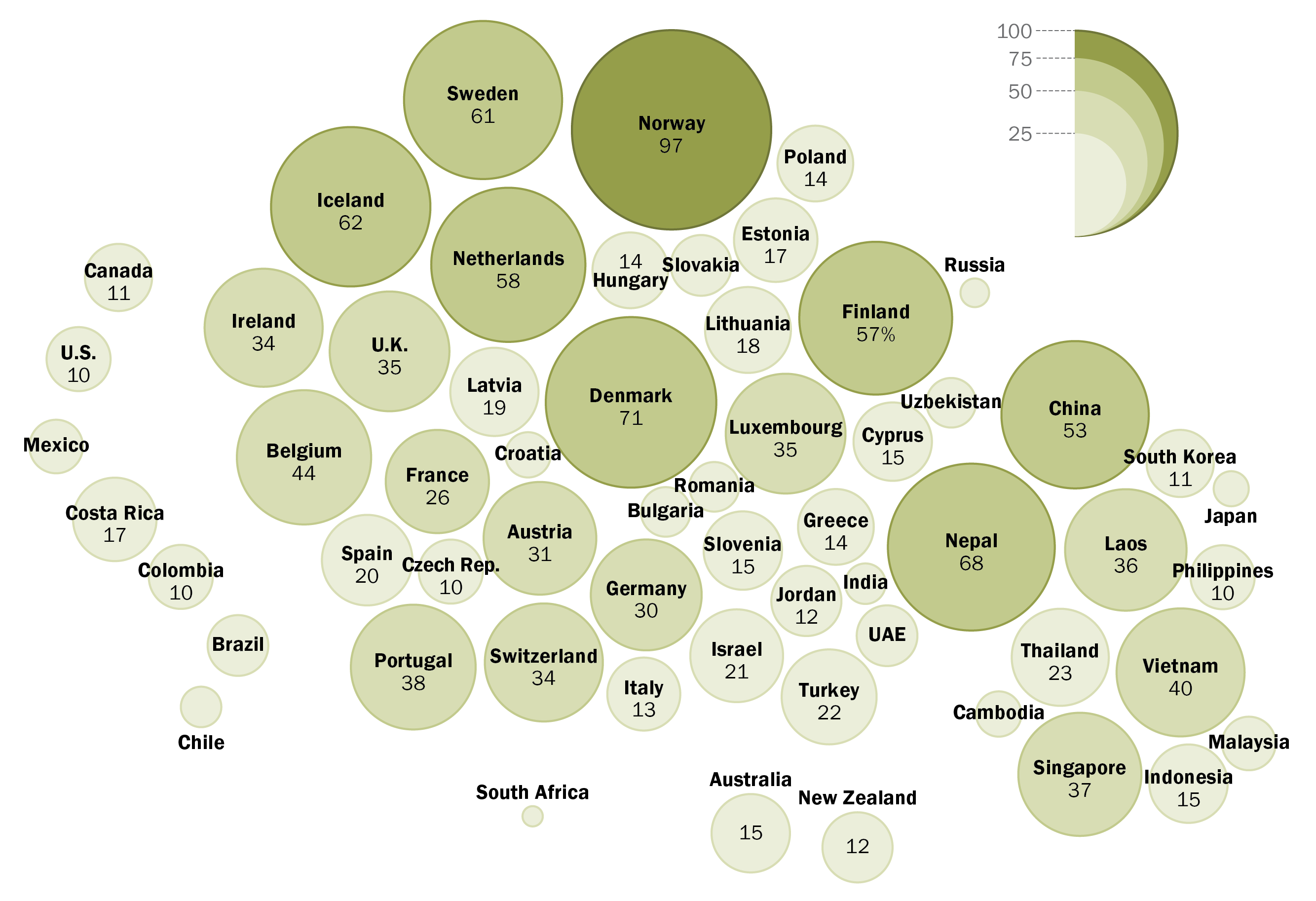
Note: New car sales only. EVs and hybrids include battery-electric vehicles, plug-in hybrid vehicles and fuel cell vehicles. Chart shows 59 countries where 2025 data was available.
Source: International Energy Agency, “Global EV Outlook 2026.”
PEW RESEARCH CENTER
In 2025, 97% of new cars sold in Norway were electric vehicles or hybrids
% of new car sales that were electric or hybrid in each country, 2025
| Country | % |
|---|---|
| Norway | 97 |
| Denmark | 71 |
| Nepal | 68 |
| Iceland | 62 |
| Sweden | 61 |
| Netherlands | 58 |
| Finland | 57 |
| China | 53 |
| Belgium | 44 |
| Vietnam | 40 |
| Portugal | 38 |
| Singapore | 37 |
| Laos | 36 |
| Luxembourg | 35 |
| United Kingdom | 35 |
| Ireland | 34 |
| Switzerland | 34 |
| Austria | 31 |
| Germany | 30 |
| France | 26 |
| Thailand | 23 |
| Turkey | 22 |
| Israel | 21 |
| Spain | 20 |
| Latvia | 19 |
| Lithuania | 18 |
| Estonia | 17 |
| Costa Rica | 17 |
| Indonesia | 15 |
| Australia | 15 |
| Cyprus | 15 |
| Slovenia | 15 |
| Poland | 14 |
| Greece | 14 |
| Hungary | 14 |
| Italy | 13 |
| Jordan | 12 |
| New Zealand | 12 |
| Korea | 11 |
| Canada | 11 |
| Philippines | 10 |
| Colombia | 10 |
| United States | 10 |
| Czech Republic | 10 |
| Slovakia | 9 |
| Brazil | 9 |
| United Arab Emirates | 9 |
| Malaysia | 7 |
| Mexico | 7 |
| Bulgaria | 6 |
| Uzbekistan | 6 |
| Romania | 6 |
| Croatia | 5 |
| Cambodia | 5 |
| India | 4 |
| Chile | 4 |
| Japan | 3 |
| Russia | 2 |
| South Africa | 1 |
Note: New car sales only. EVs and hybrids include battery-electric vehicles, plug-in hybrid vehicles and fuel cell vehicles. Chart shows 59 countries where 2025 data was available.
Source: International Energy Agency, “Global EV Outlook 2026.”
PEW RESEARCH CENTER
EVs and hybrids also accounted for half or more of all new car sales in Denmark (71%), Iceland (62%), Sweden (61%), the Netherlands (58%) and Finland (57%) in 2025. All except Iceland are members of the European Union, which adopted a rule that will ban sales of new gas-powered cars starting in 2035. The Netherlands has also invested especially heavily in EV charging infrastructure: In 2025, it had about 207,000 public charging points – the fourth-most in the world, despite being a relatively small nation.
In 2025, more than half of all new car sales in China (53%) were EVs or hybrids for the first time, up 5 percentage points from the year before. China provided over $230 billion in government support for EVs from 2009 to 2023. While it has since scaled back some of that support, EVs sold in China are still relatively affordable by international standards. The median price of an EV in China was $43,000 in 2025. That’s about $20,000 more expensive than the median gas-powered car there but cheaper than the median EV in all other countries where price data is available.
Nepal (68%) is the eighth country where at least half of new cars sold in 2025 were EVs or hybrids. While Nepal sold relatively few EVs in 2025, sales increased more than fivefold since 2022 (from around 2,500 to around 13,000).
Worldwide, electric vehicles and plug-in hybrids rose from 4% of all new car sales in 2020 to 25% in 2025, according to the IEA. All countries with data for both years saw an increased share over that span.
In some countries, electric vehicles and hybrids have increased sharply as a share of all new car sales
% of new car sales that were electric or hybrid in select countries
Note: New car sales only. EVs and hybrids include battery-electric vehicles, plug-in hybrid vehicles and fuel cell vehicles. For Vietnam, only reported shares above 0% are shown.
Source: International Energy Agency, “Global EV Outlook 2026.”
PEW RESEARCH CENTER
In some countries, electric vehicles and hybrids have increased sharply as a share of all new car sales
% of new car sales that were electric or hybrid in select countries
| Region | 2015 | 2016 | 2017 | 2018 | 2019 | 2020 | 2021 | 2022 | 2023 | 2024 | 2025 |
|---|---|---|---|---|---|---|---|---|---|---|---|
| World | 1 | 1 | 1 | 2 | 3 | 4 | 9 | 15 | 18 | 21 | 25 |
| China | 1 | 2 | 2 | 5 | 5 | 6 | 16 | 29 | 38 | 48 | 53 |
| United States | 1 | 1 | 1 | 2 | 2 | 2 | 5 | 8 | 10 | 10 | 10 |
| Vietnam | – | – | – | 0 | – | – | 0 | 3 | 10 | 19 | 40 |
| Norway | 22 | 29 | 39 | 49 | 56 | 75 | 86 | 89 | 90 | 92 | 97 |
| Iceland | 4 | 6 | 14 | 20 | 26 | 52 | 70 | 69 | 71 | 43 | 62 |
Note: New car sales only. EVs and hybrids include battery-electric vehicles, plug-in hybrid vehicles and fuel cell vehicles. For Vietnam, only reported shares above 0% are shown.
Source: International Energy Agency, “Global EV Outlook 2026.”
PEW RESEARCH CENTER
Roughly 21 million new electric and hybrid cars were sold around the globe in 2025.
In the United States, EVs and hybrids rose from 2% of new car sales in 2020 to 10% five years later. In 2025, 1.5 million new electric and hybrid cars were sold in the U.S., the most of any country besides China.
China’s growth in EV and hybrid sales has been far more dramatic, rising from 6% of its market in 2020 to 53% in 2025. That’s the largest increase of any country in the IEA data from 2020 to 2025.
China also dominates the global market by sheer volume: In 2025, 62% of all new electric and hybrid car sales worldwide were in China. This year, Chinese automaker BYD surpassed Tesla as the manufacturer with the most EV and hybrid sales worldwide. And in April, China reportedly exported more EVs than traditional cars for the first time.
Most Nordic countries have also seen big jumps in EV and hybrid sales as a percentage of their total new car sales. For example, the share in Denmark increased from 16% in 2020 to 71% in 2025.
In Iceland, though, the share has fluctuated in recent years. In 2020, 52% of all new cars sold in Iceland were electric or hybrid. That percentage peaked at 71% in 2023 but plummeted to 43% a year later, amid a large drop in all car sales in the country in 2024. In 2025, car sales recovered, and the share of new cars sold that were EVs and hybrids rebounded to 62%.
In January 2024, Iceland’s government ended a tax exemption on new EV purchases, which had saved buyers as much as $9,600 each. It also added a road-use fee for EVs and hybrids based on the distance they’re driven each month. (The government instated the same fee for all other cars in 2026.)
There has also been significant growth more recently in the shares of EVs and hybrids sold in several Southeast Asian countries. For example, the share in Vietnam rose from 3% in 2022 to 40% in 2025. And in Laos, it rose from 3% to 36% over the same span. The share in the Philippines rose from 1% to 10% between 2024 and 2025.
In a 2023 Pew Research Center survey, 53% of U.S. adults said they were not too or not at all confident that the United States would build the charging stations and infrastructure needed to support large numbers of electric vehicles. Only 17% said they were extremely or very confident in this, and another 30% were somewhat confident.
In 2025, the U.S. had about 240,000 public charging points, according to the IEA. That was the third-most in the world behind China (4.7 million) and South Korea (491,000).
However, the U.S. added charging points between 2020 and 2025 at a slower pace than all but three other countries with available data. The number of charging points in the U.S. increased by nearly 150%, but it increased more than five times as quickly in China in that span.
In the U.S. and globally, the number of charging points increased more slowly than the number of EVs and hybrids sold between 2020 and 2025. In most of Europe, though, the number of charging points increased faster than sales.
Search
RECENT PRESS RELEASES
Related Post