Can Scotland’s politicians really cut your energy bills?
May 5, 2026
Can Scotland’s politicians really cut your energy bills?
 BBC
BBCThe cost of living has dominated a Holyrood election campaign run against the backdrop of the global fallout from the ongoing Iran war.
Every main party in Scotland has pledged to cut household energy bills in one way or another.
They range from improving home insulation to setting up a whole new energy market, and frequently differ – from doubling down on North Sea drilling to replacing it entirely with renewables.
But with key powers over energy held at Westminster, and prices often set on international markets, BBC Verify has been assessing if any of the pledges can actually be delivered.
How are energy prices set?
Scotland is part of a GB-wide national grid where power is generated from a wide range of sources such as gas, nuclear and wind.
Retail electricity bills depend on two main factors – how the electricity is being generated in any given moment, and the network costs of transmitting it from generator to consumer.
The transmission cost is higher in parts of Scotland because electricity generated there has further to travel to reach the UK’s major population hubs, principally around south-east England.
That’s despite Scotland generating more renewable electricity than its population uses.
Official statistics show that in 2024, some 26.8 terawatt hours (TWh) of electricity was consumed in Scotland compared with a total generation from renewables alone of 38.3 TWh.
But gas still dominates the GB-wide electricity market, of which Scotland is a part.
And proposals for so-called zonal pricing, which advocates have suggested will give Scottish households the cheapest bills in Europe, were dismissed by the UK government.
The “day-ahead” market runs as an auction with the grid operators buying electricity on an ascending scale starting with the cheapest.
But when the bids are in, all providers receive the same price as the highest bidder – which is normally gas.
Estimates vary but the Department for Energy Security and Net Zero has calculated that gas sets the price 60% of the time – although it’s aiming for that figure to be cut to 50% by 2030.
Market confidentiality makes it impossible to precisely say what the cost of electricity would be without gas in the day-ahead market, but a study by the Energy and Climate Intelligence Unit suggests that the day-ahead price in 2024 was cut by 25% because of large wind farms displacing fossil fuels and by almost a third in 2025.
Installing more renewable generation and erecting more high-voltage pylons to transmit power around the UK should displace fossil fuels over time.
The UK government has a parallel plan to “decouple” the price consumers pay for electricity from the wholesale cost of gas by encouraging older wind farms on to the same terms as newer ones.
The “contracts for difference” mechanism provides a guaranteed price for the electricity, which should mean less of our generation is tied to the cost of natural gas.
Holyrood’s limited powers over energy prices
The bulk of powers over energy are held at Westminster, meaning the MSPs elected on 7 May will not be able to legislate on them.
The energy regulator Ofgem sets the “price cap” which dictates how high energy bills can rise, and updates it every three months.
The cap has been relatively stable over the last three years, since a spike during the Russian invasion of Ukraine in 2022.
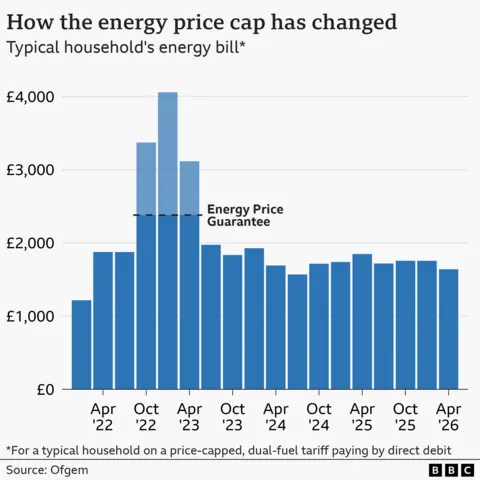
Bills were further limited during that period by the “energy price guarantee”, which saw household bills capped with the UK government effectively paying the difference to energy providers.
Holyrood would not be able to run a programme like this, but in theory MSPs can use social security powers to set up welfare payments to specific groups to help with fuel costs – such as the pension age winter heating payment.
The Scottish Conservatives have suggested using funds from the ScotWind programme – the leasing of plots of the seabed to offshore wind farm developers – to give cash back to households.
ScotWind funds were initially pledged to green projects, but have frequently been used to plug gaps in the Scottish budget, and the Fraser of Allander Institute has said handing the cash back to households would limit the government’s flexibility to use it to support public services.
Other parties have their eye on the funds too – Scottish Labour said it would use the money to provide crisis loans to energy-intensive businesses and bulk-buy fuel to drive down petrol prices, while the Lib Dems want to direct the funds to communities in areas close to wind farms.
 Reuters
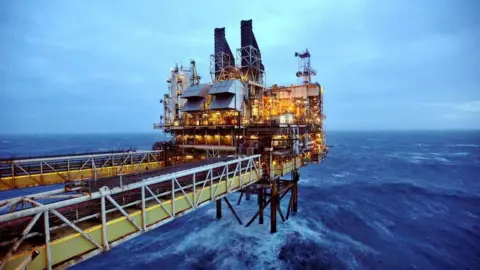
The Scottish Parliament has no control over what happens around oil and gas, with licensing and regulation – as well as taxes such as the Energy Profits Levy – run from Westminster.
But a number of parties have based their arguments around the North Sea nonetheless.
The Scottish Conservatives are pushing for increased drilling, as part of a package which they say could save households £200 a year.
Their plan also includes abolishing VAT on energy bills – another tax under Westminster control – and cutting subsidies for green energy projects.
Reform UK also advocate putting fossil fuels back at the forefront of the UK’s energy mix, while slashing the “net zero” projects which Holyrood does oversee.
But many analysts believe increasing oil and gas production in the North Sea would have very little impact on consumers’ bills.
Meanwhile the Scottish Greens are calling for an “immediate end to new oil and gas extraction”, saying the next Scottish government “must leverage all the powers available under devolution” to halt this.
The SNP has leaned into the fact that most powers are reserved, by arguing that independence is necessary to let Scotland dictate its own energy policy.
It claims bills could be cut by a third after Scotland set up its own electricity market, although there are a lot of hypotheticals involved – beyond the initial point about Scotland becoming independent – which mean the level of any savings is highly uncertain.
The SNP also wants to see changes to charges for energy transmission, also currently under Westminster control.
The cost of shifting electricity around the system is increasing as more infrastructure is built to transport electricity from Scotland to population centres in England where the demand is greater.
The charges, which are higher for developers in the north of Scotland because it has further to go, have been condemned by the industry as unfair.
One energy firm has said their project west of Orkney cannot go ahead unless there’s an overhaul to the way the system is funded.
What can Holyrood control when it comes to energy?
 Getty Images
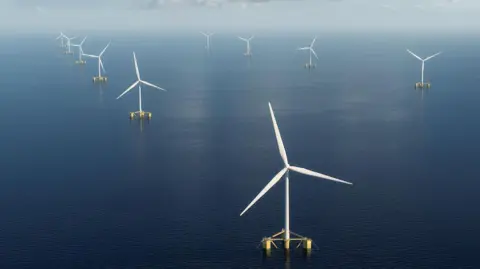
Holyrood’s most significant power when it comes to energy is in the field of renewables.
The Scottish government is responsible for large-scale energy projects – where capacity exceeds 50 megawatts (MW) – such as the 307 turbines it approved to be installed at Berwick Bank in the North Sea.
Local planning authorities deal with smaller projects (capacities of 50MW or less) including approval for household renewables such as installing solar panels where permission is required.
Wind is the largest driver of renewable electricity in Scotland and generated more than three quarters of all renewable electricity output in the country last year.
Many of the parties have committed to renewable energy investment at the election.
The Scottish Greens have promised a “renewables revolution” with a £600m investment programme in onshore and offshore wind, tidal and solar energy, while the Scottish Liberal Democrats pledged to quadruple solar energy generation.
The Fraser of Allander Institute says this is “ambitious” and that it would require improvements to grid infrastructure, costs which the party had not acknowledged.
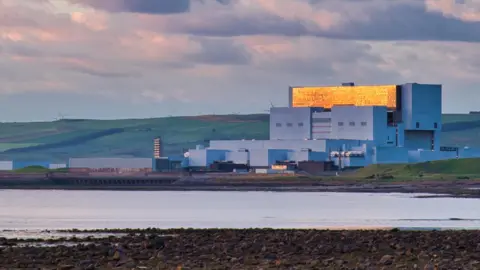
While nuclear energy is the responsibility of the UK government, in practice Holyrood can block any new developments using its power over the planning system.
Scottish Labour has put reversing this ban at the top of its energy agenda and Reform UK has also backed this idea.
Another area where Holyrood can act is in ensuring homes are well insulated and energy efficient – cutting bills by reducing energy use.
The Scottish Liberal Democrats plan for £100m investment in insulation to help people cut their bills, while Scottish Labour also have a warm homes plan.
The Scottish House Condition Survey 2024 suggests around one in 10 homes are in the lowest Energy Performance Certificate bands (E, F and G), meaning they are less energy efficient and have higher heating costs.
The Scottish Greens also have proposals for a “comprehensive household retrofitting programme” and want to pay for people to install heat pumps and solar panels while removing fossil fuel boilers, with a goal of phasing them out of “most households” by 2035.
But swapping boilers for heat pumps would be no easy feat. Boilers made up the vast majority (89%) of primary heating source in Scottish homes in 2024, while heat pumps represent just 2%.
Plans for a similar programme were dropped on two separate occasions in the most recent parliamentary term, with ministers concerned they would “make people poorer”.
How realistic are the energy bill pledges?
 Cerulean Winds
Ultimately, a lot of the pledges to cut energy bills are looking years down the road from this Holyrood election.
This is either to a point where new renewable or nuclear infrastructure has been installed, or even to the point where a referendum has taken place and Scotland has transitioned to independence.
But as we have seen during the conflict in Iran, it is hard to forecast what energy bills will look like in a matter of months, never mind years.
Changes have also been proposed to the way the existing UK market works which also make any comparison to proposed future bills inherently uncertain.
On top of that, financial watchdogs and think-tanks alike have warned that Holyrood’s budgets are likely to be extremely tight in the coming years.
There are things that parties can do within the powers that the Scottish Parliament has.
But none of them will necessarily be quick or easy to deliver.

Search
RECENT PRESS RELEASES
Related Post