April Exports Surge to New High: Chery Maintains Clear Lead, BYD and SAIC Break Records
May 10, 2026
Gasgoo Munich- Export data for April 2026 has once again sent shockwaves through the Chinese auto industry.
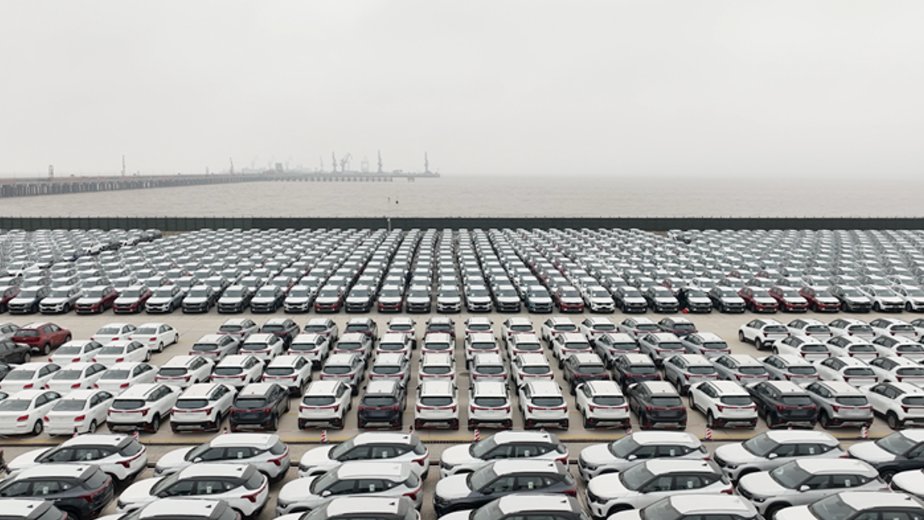
Chery Group exported 177,600 units in a single month, while BYD moved 134,500 and SAIC Motor Passenger Vehicle topped 125,000. Combined, overseas sales from just these three top automakers exceeded 430,000 vehicles. Factoring in exports from Geely, Changan, Great Wall Motor, and emerging startups, total passenger vehicle exports by Chinese brands in April are poised to firmly breach the 700,000 mark.
From a 53% year-on-year growth rate in the first quarter to multiple automakers shattering historical records in April, China’s auto exports are undergoing a critical shift from quantitative accumulation to qualitative transformation. By synthesizing official automaker announcements, industry association data, and the Gasgoo Institute export database, Gasgoo Auto aims to dissect the underlying logic driving this overseas surge.
The Resonance of Oil Prices, Product Competitiveness, and Channel Dividends
Judging by the April report cards of leading automakers, both the scale and structure of exports have shifted significantly.
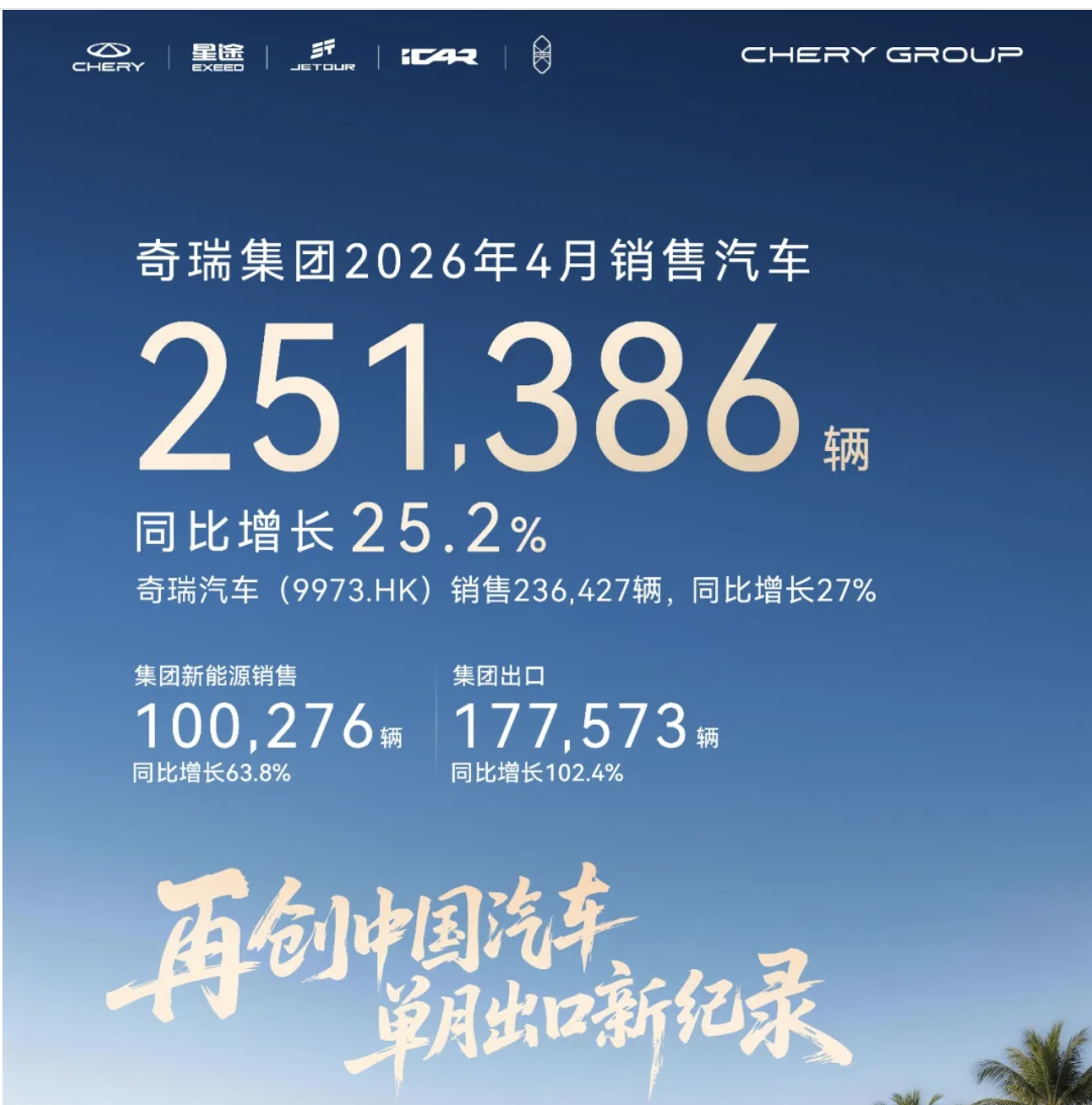
Image Source: Chery Group
Chery Group sold 251,400 vehicles in April, up 25.2% year-on-year. Of these, exports accounted for 177,600 units—a staggering 102.4% surge—making up 70.6% of total sales. This implies Chery has fully transitioned to an “export-led” growth model. After breaking records with nearly 150,000 units in March, April saw it clear two successive 10,000-unit hurdles, marking the twelfth consecutive month of exports exceeding 100,000. From January to April, cumulative exports reached 570,900 units, a 66.3% increase, securing Chery’s position at the top of China’s auto export rankings.
BYD’s overseas sales in April hit 134,500 vehicles, jumping 70.9% year-on-year to set a new monthly record for the brand. The share of exports in total sales rose to 42%, with cumulative overseas sales for the first four months exceeding 450,000 units. Notably, BYD has already raised its full-year export target for 2026 from 1.3 million to 1.5 million vehicles, positioning overseas markets as a critical buffer against the pressures of the domestic price war.
SAIC Motor’s overseas sales in April stood at approximately 125,000 units (including exports and overseas production bases). The MG brand was the primary contributor, with the MG4 exceeding 10,000 monthly sales for seven consecutive months. Meanwhile, SAIC-GM-Wuling’s overseas exports broke the 30,000-unit mark for the first time.
Geely Group exported 83,200 vehicles in April, soaring 245% year-on-year. This marks the fourth consecutive month of year-on-year doubling, placing Geely’s growth rate at the top of the five major domestic brands.
Changan Automobile delivered 72,700 units overseas in April, up 69.9% from the previous year. Great Wall Motor sold 50,500 vehicles abroad, a 56.93% increase, with exports accounting for 47.6% of its total monthly sales.
Among emerging startups, Leapmotor exported over 40,000 units in the first quarter, surging 430% year-on-year. Leveraging Stellantis’s overseas distribution network, it rapidly opened up markets in Europe, the Middle East, Africa, and the Asia-Pacific, becoming a benchmark for new players going global.
Regarding model structure, data from the CPCA shows that new energy passenger vehicle exports exceeded 50% for the first time in January 2026—a historic milestone. This share was likely further consolidated in April. Internal combustion engine vehicles continue to play a “foundational role,” relying on mature after-sales networks and consumer habits; mature SUVs like the Chery Tiggo, Changan CS series, and Great Wall Haval remain export mainstays. However, the incremental contribution of new energy vehicles can no longer be ignored. BYD’s pure electric and plug-in hybrid lineups, Geely’s new energy products, and Leapmotor’s explosive growth together constitute a second growth curve.
Analysis suggests that this export explosion is driven by the powerful convergence of three factors at the same point in time. First is the surge in oil prices. Since March, ongoing tensions in the Middle East and disruptions to shipping in the Strait of Hormuz have pushed Brent crude from around $60 a barrel to nearly $120. The global operating cost of internal combustion vehicles has risen sharply, directly driving overseas demand for new energy vehicles—especially pure electrics and hybrids with low fuel consumption.
Second is the tipping point in product competitiveness and cost advantages across the entire industrial chain. In core dimensions such as battery range, energy density, smart cockpit experience, ADAS maturity, and vehicle reliability, leading Chinese brands have closed the gap with global mainstream joint ventures—and even surpassed them in some areas. The hyper-competitive domestic market has forced automakers to accelerate technology iteration and cost optimization. The early rollout of 800V high-voltage platforms, urban NOA (Navigate on Autopilot), and semi-solid-state batteries serves as proof of Chinese brands leading the tech race.
Third is the harvest period for overseas channels and localized layouts. Chery has cultivated the Middle East, South America, and Africa for years, establishing dealer networks and after-sales systems as far back as the internal combustion era. BYD continues to open direct stores in Southeast Asia and Latin America while partnering with leading local dealer groups. Geely has accelerated channel expansion in Southeast Asia and Europe through acquisitions like Proton and joint ventures with local partners. These early investments are now efficiently converting the “oil price window” into actual sales. When overseas consumers shift to new energy vehicles due to rising fuel costs, they find that Chinese brands not only offer impressive products but are also accessible, visible, and serviceable. This accumulation of infrastructure provides the “last mile” support for the export surge.
From “Casting a Wide Net” to “Intensive Cultivation”
However, the surge in April exports was not driven by uniform progress across all markets. To better understand the structural characteristics of Chinese automakers’ global expansion, the Gasgoo Institute analyzed the regional distribution of exports in March 2026, revealing the distinct strategic paths chosen by the three top automakers.
The results show that for BYD passenger vehicle exports in March 2026, the top five regions were: Central & South America (41,037 units), EU + UK + EFTA (27,039 units), Other Asia (8,707 units), Southeast Asia (8,614 units), and the Middle East (5,745 units). This highlights BYD’s global layout: high regional concentration, prominent advantages in core markets, and clear stratification across sectors. Notably, BYD’s export volumes to other parts of Europe and North America are extremely low. “Affected by multiple uncertainties regarding the geopolitical situation, trade environment, and policy, BYD remains cautious in its layout.”
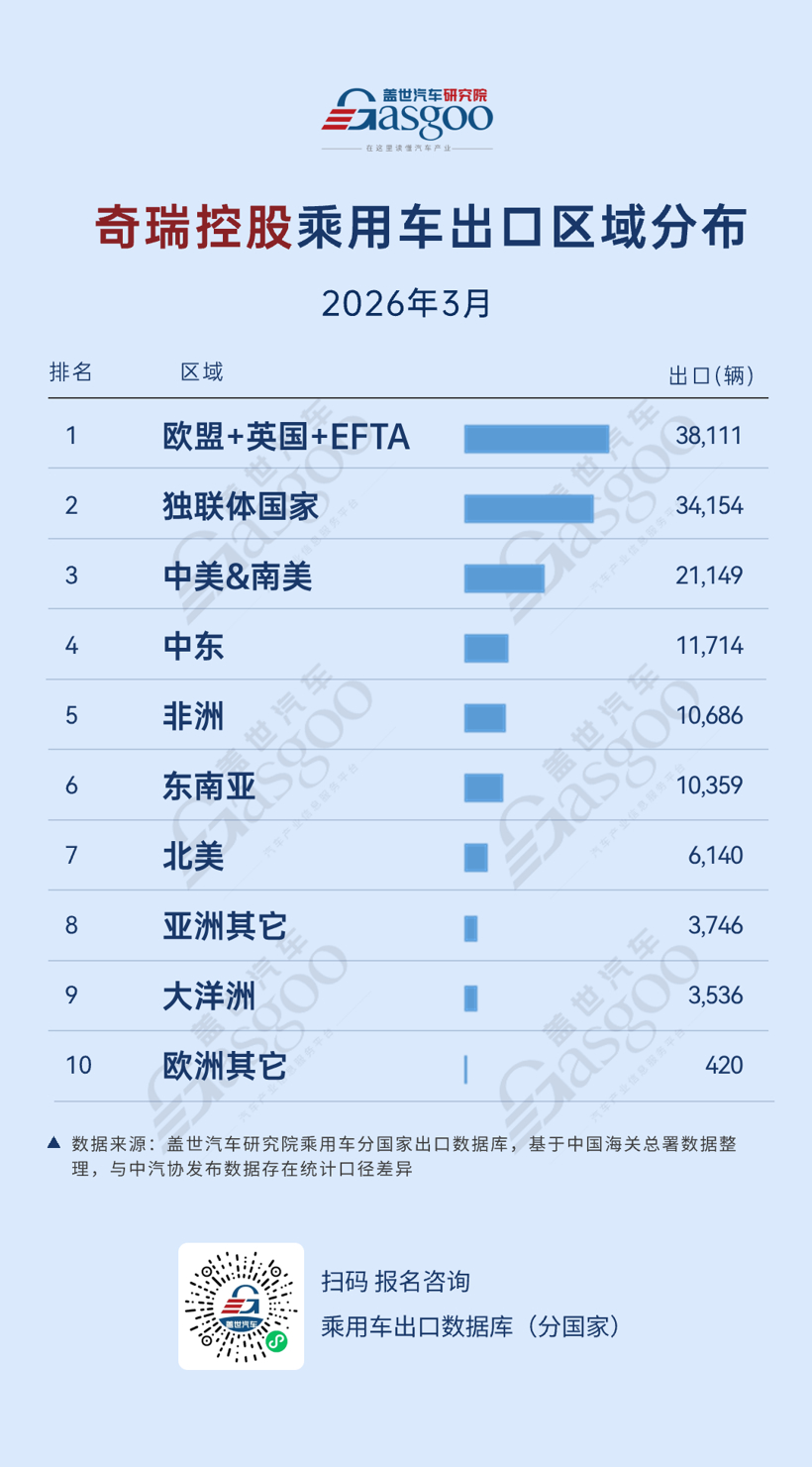
Chery Holdings’ exports present a pattern of “dual-core markets leading with multi-polar support,” featuring clear regional tiers and strong resilience. According to Gasgoo Institute data, Chery’s top five export destinations in March were: EU + UK + EFTA (38,111 units), CIS countries (34,154 units), Central & South America (21,149 units), Middle East (11,714 units), and Africa (10,686 units). The Institute believes that “this broad, multi-point export structure not only guarantees stable export volumes for Chery but also effectively hedges against risks from policy changes and exchange rate fluctuations in single markets, fully demonstrating the resilience of its global layout.”
Geely Holdings’ export landscape exhibits a typical “balanced multi-point” characteristic. Data shows Geely’s top five export markets in March were: CIS countries (17,037 units), Southeast Asia (11,353 units), EU + UK + EFTA (10,682 units), Central & South America (10,054 units), and Africa (7,863 units). The Institute notes: “With 17,037 units, the CIS region remains Geely’s core export market, reflecting the solid market barriers built through long-term product adaptation, channel construction, and localized operations in the area.”
Synthesizing the regional patterns of these three automakers, it is evident that Chinese passenger vehicle exports are shifting from “volume growth” to “structural deepening.” BYD is pivoting on Central & South America as a growth pole, Geely is leveraging a balanced push across the CIS and Southeast Asia, while Chery leads from the front with its dual-core strategy in Europe and the CIS. Each automaker is leveraging its strengths in different global regions, jointly outlining a competitive landscape where Chinese automotive globalization moves from “casting a wide net” to “intensive cultivation.”
In the global market, a structural window in Europe is opening wider. First, the China-EU electric vehicle case has achieved a “soft landing.” In January, both sides reached a significant consensus on the anti-subsidy investigation, allowing companies to sell pure electric vehicles at or above the minimum price set by the EU, potentially avoiding additional tariffs. Cui Dongshu, Secretary-General of the CPCA, projects that from 2026 to 2028, Chinese electric vehicle exports to the EU will maintain an annual growth rate of around 20%.
Second, demand for electric vehicles in Europe is recovering beyond expectations. Data from China Securities shows that EV sales in nine European countries reached 413,100 units in March, a 43% year-on-year surge, with a penetration rate of 32.9%—up 7.4 percentage points from last year. The institution has raised its 2026 European EV sales forecast to 5.42 million units, representing 35% growth.
Third, Chinese brands are rapidly gaining market share. Data from the European Automobile Manufacturers Association shows that BYD sold 37,600 vehicles in Europe (EU, UK, and EFTA) in March, soaring 147.6% year-on-year, with its first-quarter market share jumping from 0.9% to 2.1%. Chery exported over 90,000 units to Europe in the first quarter, up 170%, entering 18 European markets. In the UK, the Chery JAECOO 7 became the best-selling new car in March with 10,064 units sold—the first time a Chinese brand model has topped the monthly sales chart. SAIC MG sold over 90,000 units in Europe in the first quarter, while Leapmotor’s European EV sales reached 18,246 units, an 846% surge, capturing a 33.5% share of Italy’s pure electric market.
From “Product Export” to “Ecosystem Rooting”
It must be noted that the skyrocketing export figures do not equate to the full establishment of global competitiveness. Currently, Chinese automakers still face two core challenges: overseas operations that are “unprofitable or low-margin,” and the building of brand power.
Image Source: BYD
At present, the overseas operations of the vast majority of Chinese automakers remain in a state of low margins or even losses. Capital expenditures for building plants, developing channels, brand marketing, and establishing after-sales networks are enormous, while external costs such as tariffs, shipping, and exchange rate fluctuations continue to rise. The commissioning of overseas production capacity—such as BYD’s Hungary plant, Leapmotor’s Spain factory, and Chery’s Spanish base—means capital expenditure pressure will remain high for the next 2 to 3 years. Before achieving economies of scale and increased localization rates, the contribution of overseas business to consolidated profits will be very limited.
Regarding brand power, although Chinese brands are rapidly gaining share in markets like Europe, the perception of “Chinese cars” among most overseas consumers remains stuck at the “high specs, good price” value-for-money level. There is still a significant gap in brand premium capability compared to Volkswagen, Toyota, and even traditional German luxury brands.
“Forced by price constraints, the high-end transformation of Chinese automakers is in a critical stage of product upward movement, technological foundation building, and brand climbing,” Cui Dongshu, Secretary-General of the CPCA, said in a media interview. “While high-end price ranges and configuration levels have been achieved, brand premium, global recognition, and systemic capabilities remain insufficient, and a true high-end brand barrier has not yet been formed.”
He further pointed out that the future high-end breakthrough of Chinese brands overseas will focus on three directions: building irreplaceable core technology barriers such as 800V high-voltage systems, solid-state batteries, and high-level autonomous driving; shedding the value-for-money label to shape independent high-end brand images and win over global users; and perfecting compliance systems, localized supply chains, and service networks to upgrade from simple product export to full value chain globalization.
Recognizing these challenges, leading Chinese automakers are shifting their global strategy from a 1.0 era of “trade orientation” to a 2.0 era of “industrial rooting.” Localized production has become the prevailing narrative. BYD’s Hungary plant is scheduled for mass production in the second quarter of 2026, forming a manufacturing network covering Asia, Europe, and Latin America alongside its Thailand, Brazil, and Indonesia plants. Chery has launched its first overseas regional operations center and research institute in Barcelona, Spain, and initiated a localization project in South Africa. Through the “Leapmotor International” joint venture, Leapmotor is establishing about 900 sales outlets globally, with its Spain B10 plant planned for mass production in October 2026. The localization of supply chains and talent is proceeding in sync. Local employees account for 85% of Chery’s international talent, while Chinese supply chain companies in power batteries, thermal management, and smart cockpits are following automakers abroad, creating synergistic effects locally.
In summary, the export explosion in April was no accident. It is the inevitable result of years of technological accumulation and cost optimization in the Chinese automotive supply chain, as well as a historic window of opportunity spawned by shifts in the international geopolitical landscape. The China Association of Automobile Manufacturers (CAAM) estimates 2026 auto exports will reach approximately 7.4 million units, while the China EV 100 predicts a potential assault on the 8 million mark. However, in the long run, the true test of Chinese automotive globalization lies in the ability to build a global industrial system that is resilient to severe geopolitical disruptions, possesses sustainable profitability, and commands high-end brand recognition. This awaits further refinement by Chinese automakers in technology, capital, management, and strategy.
Search
RECENT PRESS RELEASES
Related Post