What’s at Stake for Trillionaire Elon Musk and SpaceX After Blockbuster IPO
June 12, 2026
Introducing TIME100 Sports 2026View More
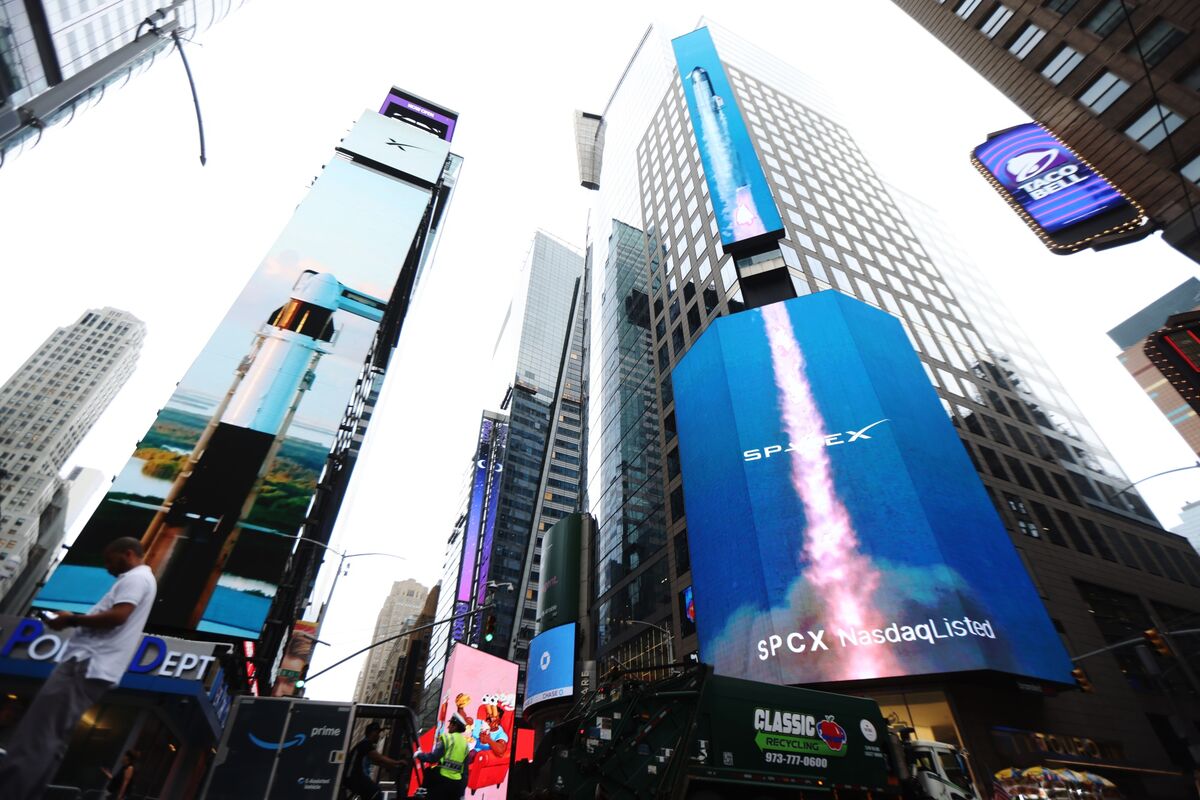
A crowd had already gathered outside the NASDAQ building at 42nd Street in New York’s Times Square before the market opened today. Some were dressed as astronauts; others wore T-shirts reading “Occupy Mars,” a slogan made popular by SpaceX founder and CEO Elon Musk. On the giant video screens that cover the curved facade of the building were scenes of rockets being launched, orbital data centers being built, and Musk describing humanity’s future in space.
All of this was in the run-up to SpaceX’s initial public offering, which was expected to move more than 555 million shares of SpaceX stock, raise $75 billion in fresh capital, put the company’s valuation at a staggering $1.77 trillion, and make Musk, who is also the CEO and founder of the electric car maker Tesla, the world’s first trillionaire, thanks to his stake in both companies.
After the market opened at 9:30 a.m. EDT, with Musk and SpaceX president and chief operating officer Gwynne Shotwell ringing the opening bell remotely—Shotwell in the NASDAQ building and Musk at SpaceX’s headquarters in Texas—the company didn’t disappoint. SpaceX set the IPO’s opening share price at $135; at just shy of 1:00 p.m. it was trading near $170, pushing the company’s valuation to close to $2.2 trillion, and putting Musk’s personal worth at $1.1 trillion, according to the Associated Press, citing Forbes.
Advertisement
That’s an awful lot of hype and an awful lot of cash for a company that lost $4.9 billion last year, and is net-negative—to the tune of $41.3 billion— since its founding in 2002. The company’s massive, 407-ft.-tall Starship rocket—on which SpaceX stakes the future of its long-term goals of getting humans back to the moon and later to Mars, not to mention launching data centers and satellite constellations into Earth orbit—has flown 12 times since 2023 with a mixed record of success. NASA is counting on Starship as much as SpaceX is, having cut the company checks totalling more than $4 billion to develop a modified version of the upper stage of the rocket as NASA’s Human Landing System (HLS) in the Artemis lunar exploration program. Artemis III is supposed to test the Starship HLS on a crewed mission in low-Earth orbit (LEO) toward the end of next year, with Artemis IV making a crewed lunar landing in 2028. Whether Starship will be fit and flight-ready by either of those deadlines remains a question mark.
Advertisement
But SpaceX has big wins in its portfolio too. Its reliable, affordable, Falcon 9 rocket has flown 648 times since its initial launch in 2010, with 165 flights just last year, representing nearly 51% of all launches by all companies or countries in that window. Its Starlink constellation has boomed to more than 10,000 satellites in LEO, with a goal of doubling that flock when Starship—with a massive cargo capacity—starts flying reliably. In February 2026, SpaceX merged with xAI, Musk’s artificial intelligence company, pushing the combined value of the sibling companies to $1.25 trillion—pre-IPO.
But challenges remain for Musk. The newly minted trillionaire saw investors dumping shares of Tesla, along with other tech companies, last week—paradoxically so that they could free up cash to buy into SpaceX, making at least some of today’s gains net-neutral for Musk.
On May 28, meantime, Blue Origin, the Jeff Bezos-owned rocket company and SpaceX rival, suffered a disastrous accident, when its massive New Glenn rocket exploded during an engine test, destroying the rocket and badly damaging the Cape Canaveral launch pad. A setback for a competitor ought to be a boon for SpaceX, but Blue Origin’s misfortune raises the pressure on SpaceX.
Advertisement
Bezos’s company is under contract to produce an HLS of its own for Artemis V and VI, and it was supposed to be test-flown on Artemis III along with the Starship lander. Many analysts see Blue’s HLS as the better of the two options.
The Apollo lunar module was 23 ft. tall with a low center of gravity and a four-legged stance. The Starship HLS, by contrast, is a tall, silvery silo, rising 171 ft. high, with a real risk of tipping if the ship lands on uneven ground. In 1971, the Apollo 15 lunar lander touched down in a shallow crater, leaving it leaning 6.9 degrees backward and 8.6 degrees to the left. A similar landing on even slightly more uneven terrain could prove catastrophic for a Starship crew. Blue Origin’s proposed HLS is more of a child of the Apollo era, standing just 52 ft. tall—less than a third of the height of Starship. With Blue Origin grounded until the source of the explosion can be determined, the pad can be repaired, and a new New Glenn can be readied for flight, NASA’s—and America’s—lunar dreams rest on the potentially wobbly shoulders of Starship.
Advertisement
Then too, there’s the voluble—sometimes volatile—Musk himself. During his tumultuous tenure as head of the Department of Government Efficience—or DOGE—in 2025, Musk pledged to cut $2 trillion from the federal budget by slashing jobs and cutting waste, fraud, and abuse. In the course of his 130 days on the job, however, he saved barely $32.5 billion according to an analysis by the BBC, while furloughing employees, slashing jobs, and infamously wielding a chainsaw during a public event to illustrate what he planned to do to the federal budget. He ended his tenure with a public feud with President Donald Trump—a one time bestie—during which he trolled Trump on X about his relationship with the disgraced and deceased Jeffrey Epstein. (Musk and the president have since patched things up, traveling to China together on Trump’s recent state visit.)
Tesla, a publicly held company, took a pounding due to Musk’s bad press resulting from both DOGE and the Trump dust-up, with share prices falling 36% from January to April 2025. SpaceX, privately held, was insulated from that PR tempest. Now SpaceX too will see any misbehavior in the CEO suite directly affecting performance on Wall Street. In February, Shotwell—who is often seen as the grownup in the room in the event of any enfant terrible displays by Musk—sidestepped TIME’s question about how she handles her boss.
Advertisement
“The most important part of my job is to keep my now-23,000 employees focused on the great work we do every day,” she said. “I feel like we put our heads down, we plow through our very difficult jobs. Maybe my best contribution…would be keeping everyone focused, not listening to the noise.”
Then too, there is the matter of appearances—the very existence of a single man with more than one trillion dollars in his pockets in a world of extreme wealth inequality. “Today, Elon Musk, a trillionaire, pays the same amount into Social Security as someone making $184,500,” posted Vermont Senator Bernie Sanders on the Musk-owned X. “If we end that absurdity and lift the cap on taxable income, we can make Social Security solvent for 75 years and expand benefits by $2,400.”
“Think Musk the Billionaire was bad?” wrote The Guardian. “Brace Yourself for Musk the Trillionaire.”
The Wall Street Journal, meantime, took the opposite view. In a commentary headlined “In Defense of Trillionaires,” contributor Novi Zhukovsky wrote, “Mr. Musk’s companies have kept America at the forefront of two of the defining industries of our era, employed tens of thousands of American workers, and—by going public, as Tesla did in 2010—given ordinary Americans the opportunity to share in their economic success.”
Advertisement
Maybe. Maybe the high public dudgeon is just envy masquerading as principle. Musk’s cars, after all, get you where you’re going, and his rockets do the same for satellites and astronauts. Either way, a fabulously wealthy man has just gotten fabulously wealthier, as has his fabulously huge company. Now let’s see if they’re both worth the money.
Search
RECENT PRESS RELEASES
Related Post