“End the Nightmare”—Coalition Hits DC for Cannabis Justice
May 18, 2026
A national coalition of 41 advocacy groups converged on Capitol Hill for the Cannabis Week of Unity, when a coordinated lobbying blitz pressed a gridlocked Congress to act on federal marijuana descheduling, criminal-legal reform and equitable access.
The mobilization, which ran from May 12-14, brought together labor unions, veterans, civil liberties advocates, legal experts, industry executives and directly impacted individuals around three core demands: federally legalizing cannabis, releasing federal cannabis prisoners, and expunging records to restore civil rights. The coalition spent three days navigating the halls of both congressional chambers to pitch a comprehensive package of 13 separate hemp and cannabis reform bills.
The legislative push comes at a critical juncture. While an overwhelming majority of states have legalized medical or adult-use cannabis in some form, federal law continues to classify the plant as a Schedule I controlled substance, creating a legal and economic paradox that advocates say can no longer be ignored.
Central to the coalition’s push is the Marijuana Opportunity Reinvestment and Expungement (MORE) Act, introduced as HR 5068. If passed, the MORE Act would completely remove cannabis from the Controlled Substances Act, effectively ending nearly a century of federal prohibition.
The bill’s provisions extend far beyond simple descheduling. It aims to eliminate all federal criminal penalties for marijuana activity, establish clear pathways for expungement and resentencing, and create community reinvestment from federal cannabis tax revenues. The bill also contains equity measures designed to lower barriers to entry for small, independent businesses attempting to navigate the highly capitalized legal market.
“It’s on Congress to pass a comprehensive legalization bill that centers the release of cannabis prisoners.”
“Cannabis reform is the most popular issue in American politics, and now that the president has signaled he is open to reform, it’s on Congress to pass a comprehensive legalization bill that centers the release of cannabis prisoners who should no longer be incarcerated,” Jason Ortiz, director of strategic initiatives for the Last Prisoner Project and cofounder of the Latino Cannabis Alliance, told Filter.
Ortiz emphasized that administrative gestures must be backed by concrete statutory moves. “LPP stands ready to work with the Cannabis Caucus co-chairs and the Cannabis Unity Coalition to pass a full descheduling bill like the MORE Act,” he continued, “to finally end the nightmare that has been cannabis prohibition, and create a path for everyone incarcerated for cannabis crimes to rejoin their families and become full members of society.”
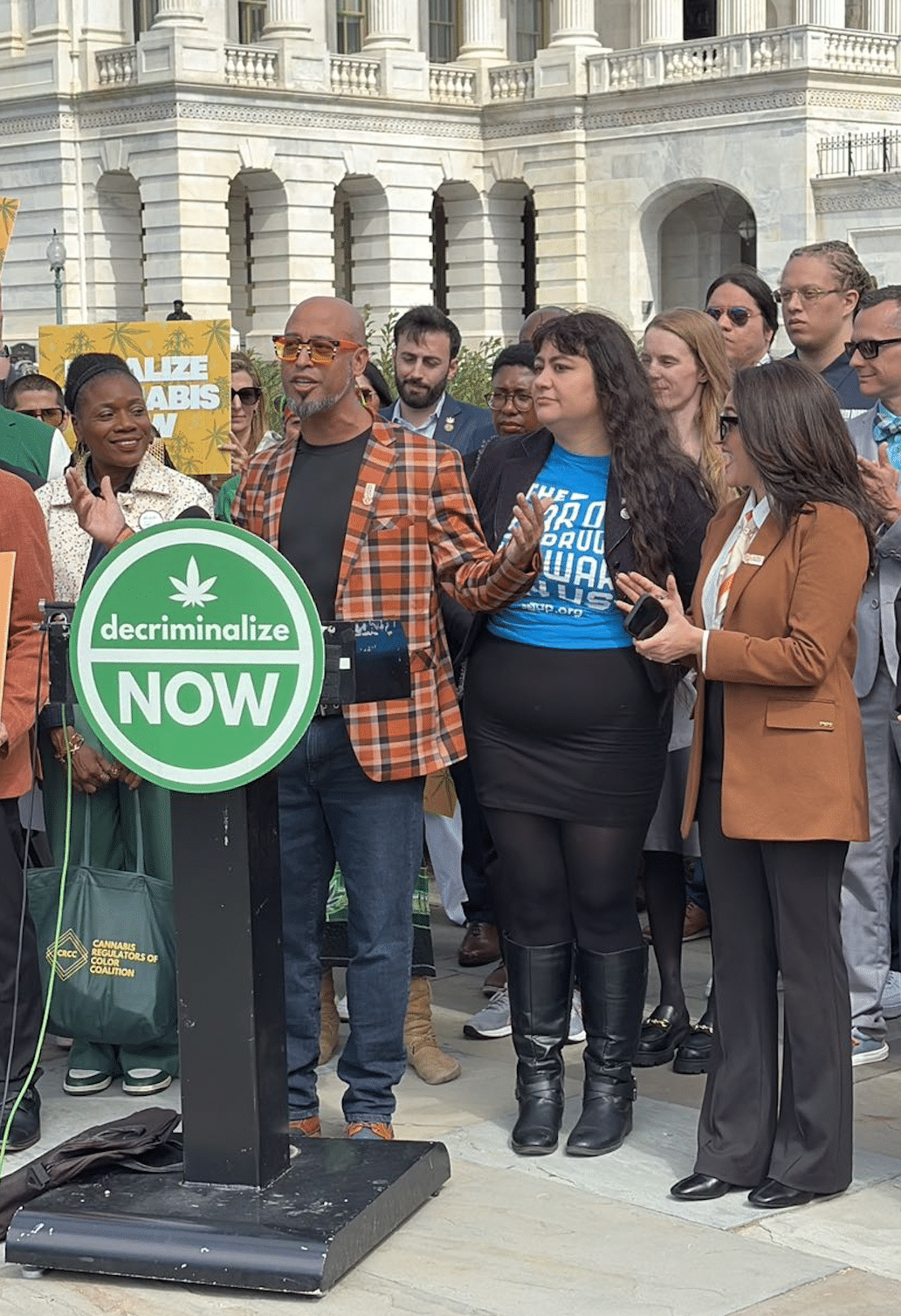
Jason Ortiz speaking
A driving theme of the Week of Unity was the disproportionate impact of federal prohibition on minority communities, specifically Latino populations. In a May 13 press conference outside the Senate wing of the Capitol, advocates drew a direct line from early 20th-century anti-immigrant rhetoric to modern-day deportation statistics.
“Buenos dias. My name is Jessica Gonzalez. I am an Ecuadorian immigrant, an attorney, and the president of the Latino Cannabis Alliance, a national coalition of Latino advocates, attorneys, organizers, researchers and storytellers fighting to move our communities from the margins of cannabis policy to the center of it,” Gonzalez told a crowd of reporters and lawmakers. “We are Harry Anslinger’s worst nightmare.”
“A system that fused cannabis prohibition and immigration enforcement into a deportation pipeline, and aimed it at our families.”
Anslinger, the first commissioner of the Federal Bureau of Narcotics, weaponized anti-Latino and anti-Black prejudice in the 1930s to secure the initial federal restriction of cannabis. Gonzalez noted that the structural machinery built during that era continues to function with devastating efficiency.
“We are here because Latinos are the largest immigrant group in the country, and the cannabis industry benefits tremendously from Latino consumers and workers while staying silent on the same policies that make participation for non-citizen Latinos dangerous,” Gonzalez said. “That is a contradiction we are here to say out loud. And here is a number we do not hear often enough: 70 percent. Over 70 percent of people sentenced federally for cannabis possession are classified as Hispanic. That is not a coincidence but the result of a system that fused cannabis prohibition and immigration enforcement into a deportation pipeline, and aimed it at our families.”
For non-citizens, even legal residents, a federal conviction or disclosure of cannabis possession can trigger mandatory deportation without judicial discretion. Gonzalez stated that the Latino Cannabis Alliance refuses to let the economic boom of state-sanctioned cannabis eclipse the human cost of federal inaction.
“But we have never been a people who accept the terms we are given,” Gonzalez said. “My family refused when they left everything they knew and built a life in a foreign country. Our communities refused when prohibition tried to turn our families into criminals and our neighborhoods into evidence. And today the Latino Cannabis Alliance refuses to let one more family be deported, one more worker be silenced, or one more community be erased from a movement we have always belonged to.”
She continued that, “decriminalization is the floor, not the ceiling. We will not forget the deported. We will not forget the detained. Our work spans borders, but it begins where this system was built. Prohibition began with a lie about our people. It will end with the truth from us.”
“In cannabis, Latinos still face limited access to capital, restrictive policies and exclusion from ownership.”
Business leaders also described the injustice and inequity of the current landscape.
“Cannabis Unity Week is not a celebration of victory—it is a call to action,” said Susie Plascencia, founder of Latinas in Cannabis and a representative for the National Hispanic Cannabis Council. “Thousands of people are still incarcerated for cannabis offenses, families are still living with the consequences of prohibition, and Latino communities remain disproportionately harmed and underrepresented in this industry.”
Today, Plascencia pointed out multi-state marijuana operators are generating billions of dollars on public stock exchanges, yet independent, minority-owned startups face severe capital constraints due to federal banking restrictions.
“Latino entrepreneurs are among the fastest-growing in the country, building businesses despite systemic barriers,” she said, “but in cannabis, many still face limited access to capital, restrictive policies and exclusion from ownership. We are building in spite of it all, but we should not have to build alone. We are here to demand federal action … Because equity is not just about repairing harm—it’s about investing in the future.”
The broader drug policy reform movement also lent its institutional weight to the coalition.
“As MAPS celebrates its 40th anniversary, we’re proud to join the Cannabis Unity Coalition in advancing the movement for compassionate, evidence-based drug policy,” said gina vensel, community partnerships manager for the Multidisciplinary Association for Psychedelic Studies (MAPS).
“This milestone is an opportunity to reflect on the progress made in challenging the War on Drugs while recognizing the crucial work that still lies ahead, especially around restorative justice,” vensel told Filter. “Together, we strive to dismantle stigma, educate our communities, and advocate for meaningful reform. The Cannabis Unity Coalition represents the power of collective action to drive lasting, positive change.”
Beyond the comprehensive framework of the MORE Act, advocates spent time on the Hill educating lawmakers on a variety of narrower measures designed to solve immediate, practical problems.
Among these is the STATES 2.0 Act (HR 2934), a bipartisan bill that would amend federal law to respect state-legal cannabis programs, shielding state-regulated businesses from federal interference and asset forfeiture. Advocates also pushed for the PREPARE Act (HR 2935 / S 3576), which would establish a federal commission tasked with designing a comprehensive regulatory framework for the eventual post-prohibition transition.
“I think there are a lot of people who smoke cannabis in Congress,” Rep. Omar said.
To counter decades of politically motivated restrictions on scientific inquiry, the coalition also advocated for the Evidence-Based Drug Policy Act (HR 3082), to remove barriers that prevent the Office of National Drug Control Policy from conducting objective research on the societal impacts of cannabis legalization.
The coalition additionally brought a heavy focus to “clean slate” initiatives, housing stability and agricultural guidelines. Key legislation on this front includes the Clean Slate Act, a bipartisan measure mandating the automatic sealing of certain federal records for nonviolent cannabis convictions, to help impacted people access employment and educational opportunities. Advocates are championing the Veterans Cannabis Use for Safe Healing Act and the Veterans Equal Access Act, too—complementary bills to prevent removal of Department of Veterans Affairs benefits if veterans participate in state-legal medical cannabis programs, and to allow VA physicians to recommend medical cannabis in states where it is legal.
Another item on the coalition’s agenda is the Marijuana in Federally Assisted Housing Parity Act, to protect people in federally assisted housing from eviction or denial of residency based solely on state-compliant cannabis use. Finally, organizers are seeking hemp regulatory clarifications through a suite of agricultural bills.
While the coalition faced an uphill battle given entrenched congressional leadership, several lawmakers emerged from their offices to signal solidarity. Following the press conference, Representative Ilhan Omar (D-MN), spoke candidly with TMZ about shifting currents inside the Capitol.
Omar noted that the immense financial drain of maintaining prohibition has fundamentally changed the conversation, making fiscal conservatives increasingly open to reform.
“I will say, advocacy for legalizing doesn’t necessarily mean that you are a user, so everybody can be an advocate … because we understand that it is not OK for us to spend the billions of dollars we do now on incarcerating people for smoking a joint,” Omar said.
Omar also suggested that policy positions on the Hill lag behind private reality. “I think there are a lot of people who smoke cannabis in Congress,” she said.
As the three-day mobilization concluded, organizers expressed optimism, saying that the sheer breadth of the 41-group alliance forces lawmakers to view cannabis not as a boutique drug policy issue, but as a critical intersection of labor rights, immigration justice, veteran health care and economic equity, among other issues.
Whether their unity can spur legislative movement in a highly polarized Congress remains to be seen, but advocates left Washington with a clear message: The floor of decriminalization has been established; the fight for the ceiling of full justice is underway.
Photographs by Jack Gorsline
Search
RECENT PRESS RELEASES
Related Post