Environmental Activist Robin Greenfield Brings Foraging Tour to Davis, Promotes Reconnection With Nature
June 14, 2026
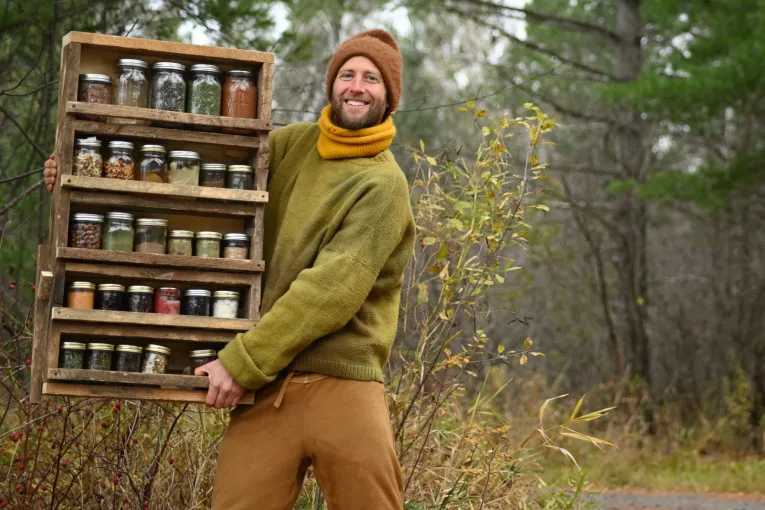
Robin Greenfield – courtesy photo
DAVIS, Calif. — Environmental activist Robin Greenfield, who is currently undertaking a yearlong experiment living entirely on foraged food and medicine, brought his message of environmental stewardship and community resilience to Davis last week as part of a West Coast tour focused on reconnecting people with the natural world.
Greenfield, known nationally for his environmental activism and unconventional lifestyle projects, is spending 2026 consuming only foods and medicines that he personally forages, avoiding grocery stores, restaurants and conventional food systems entirely. At the same time, he is advancing another ambitious effort: a campaign to help plant 1 million community fruit trees over the next decade.
During a stop in Davis, Greenfield hosted events aimed at teaching residents practical skills related to foraging while encouraging a broader conversation about sustainability, food systems and humanity’s relationship with nature.
Greenfield said his path toward environmental activism began more than a decade ago when he reassessed the lifestyle he was living.
“In 2011 I was living a fairly typical US American lifestyle. I was very focused on material possessions and financial wealth,” Greenfield said. “Life was good. I was sort of living the American dream and boy was I happy and healthy and I was running a marketing company and I had a goal of being a millionaire by the time I was 30 and I was on track.”
He said his perspective shifted after learning more about environmental degradation and the impacts of consumer lifestyles.
“I started to watch some documentaries and read some books and I learned that the way that I was living was just causing so much harm to the earth,” Greenfield said. “So I decided to change my life one step at a time.”
Today, Greenfield argues that modern industrial food production contributes significantly to environmental harm.
“Our current food system is designed in a way where every time we take a bite, we take a bite out of the planet,” he said. “The food that we’re growing in this global industrial food system just does a substantial amount of harm. It’s a system of exploitation and oppression and destruction.”
Rather than relying on large-scale industrial agriculture, Greenfield advocates for localized food systems that include small farms, regenerative agriculture, home gardening and foraging.
“For me, the solution is local food systems,” he said. “That includes small farms, regenerative agriculture, includes growing our own food and it includes foraging and all of those are wonderful practices.”
His current journey is intended both as a personal challenge and a public demonstration of what he believes is possible.
“Right now I’m on a West Coast foraging tour,” Greenfield said. “Traveling from San Diego to the Seattle area, leading plant walks, giving talks and hosting foraging schools all across the west coast.”
He described the experience as more than simply gathering food.
“As I’m immersed in my year of foraging all my food and medicine, I am taking others along on this journey,” he said. “This is a deep practice of living in a state of love and connection with the earth and I’m bringing that to people everywhere that I go.”
According to Greenfield, his diet this year has included approximately 200 different plant species as well as mushrooms, fish and venison. The effort has required extensive knowledge of ecosystems, seasonal food availability and preservation techniques.
“My diet has consisted of about 200 different plants as well as mushrooms, venison and fish,” Greenfield said. “So this is a really deeply immersive practice in getting to know the ecosystems in which I live.”
His pantry currently includes foods such as wild rice, acorns, hazelnuts, black walnuts, pecans, dried greens, preserved berries, fish and venison. He also relies on a variety of foraged herbs and medicinal teas.
Although some observers may view foraging as intimidating or inaccessible, Greenfield said newcomers often overestimate the amount of knowledge required to begin.
“A lot of people think they need to learn all the toxic plants in order to eat one plant, but that’s not the case,” he said. “You only need to know one plant to eat one plant.”
Greenfield encourages beginners to focus on familiar and easily identifiable species.
“We can start with dandelion or blackberries or apples, one plant at a time,” he said.
He added that incremental learning can quickly build confidence and familiarity with local ecosystems.
“If we learn one plant per month for a year, that’s 12 plants,” Greenfield said. “That takes you from muggle to Harry Potter in your community just in one year.”
Greenfield acknowledged that the project is demanding but said he has remained healthy throughout the experience.
“I know that I’m getting all the calories that I need,” he said. “I lost a few pounds, maybe five pounds, but that’s to be expected when you give up the pints of Ben and Jerry’s ice cream.”
The activist has spent years experimenting with alternative forms of transportation and low-impact living. He has previously walked from Canada to Los Angeles and bicycled across the United States three times. For the current tour, he is traveling with the assistance of a volunteer driver.
During his Davis appearance, Greenfield spoke to approximately 80 attendees at an event hosted by Davis Friends Meeting.
“It was great,” he said. “There was maybe 80 or so people that came out from Davis in the surrounding community and we got together and I shared about my story and shared about many tips for living in a closer connection with earth.”
He said attendees were eager to discuss environmental concerns and practical strategies for reducing dependence on industrial systems.
“I think a lot of people walked away from there with a lot to think about, a lot of critical thinking and a lot of inspiration as well,” Greenfield said.
Greenfield said the audiences he encounters throughout the country come from a wide variety of backgrounds but often share a common desire for stronger connections with nature and community.
“Most everybody who comes is they’re seeking a connection to the earth,” he said. “They’re seeking to some degree getting out of this broken global industrial food system.”
He added that many participants are looking for practical skills and relationships that can help them live more sustainably.
“Generally people are looking for community, for knowledge, for skills to really be able to live in a more harmonious way with this earth,” Greenfield said.
The environmental activist also addressed concerns about climate change and environmental degradation, acknowledging the seriousness of current ecological challenges while emphasizing resilience and action.
“Yes, right now we live in a time where the way that human beings are living is causing an incredible amount of destruction and you can see that everywhere that you go,” Greenfield said.
At the same time, he said he remains optimistic.
“I don’t let that get me down,” he said. “I also see that the world is an incredibly resilient place and that there’s still a lot of abundance and I’m here to share, to show that abundance and to share how we can respect and we can honor that abundance.”
Greenfield views his current project not only as a personal experiment but also as a means of drawing attention to broader environmental issues and possibilities.
“This is just a grand experiment and also a way to really create a story that grabs people’s attention,” he said.
Ultimately, Greenfield hopes his message encourages people to take small but meaningful steps toward reconnecting with local ecosystems and food sources.
“My recommendation to people is you don’t need to learn a lot in order to start foraging,” Greenfield said. “You really only need to learn one plant in order to forage one plant.”
He urged people to begin with familiar species that are easy to identify and unlikely to be confused with toxic plants.
“All you have to do is start with one plant,” Greenfield said. “My recommendation to people is to start there, start with the easy ones.”
Greenfield’s West Coast tour continues through Oregon and Washington before shifting to an upcoming East Coast and Midwest tour later this year. Information about future events and his ongoing foraging project is available through his public schedule and educational outreach efforts.
As Greenfield continues living entirely on foraged food, his message remains centered on the possibility of rebuilding relationships between people, food and the natural environment.
“Earth needs support, the plants and animals need support and humans need support,” Greenfield said. “And we can do that together.”
Follow the Vanguard on Social Media – X, Instagram and Facebook. Subscribe the Vanguard News letters. To make a tax-deductible donation, please visit davisvanguard.org/donate or give directly through ActBlue. Your support will ensure that the vital work of the Vanguard continues.
Categories:
Breaking News Environment State of California
Tags:
Climate Change Davis community Environmental Activism Foraging Robin Greenfield Sustainable Food Systems
Author

Search
RECENT PRESS RELEASES
Related Post