European Space Startups Jockey for ‘Infrastructure’ Financing
May 14, 2026
Europe has a growth-stage-capital problem.
The European space industry has blossomed in recent years, thanks to larger space and defense budgets, as well as a wider pool of space-focused VCs on the continent. But investment has largely been directed at early-stage companies.
Not a single growth-stage investment round in Europe was led by a European venture-capital firm last year, according to a report from the European Space Policy Institute. The situation has forced many European space scale-ups to look elsewhere for later-stage capital, by opening offices in the US or Asia in an attempt to attract more business—as well as VCs with deeper pockets.
However, there’s no shortage of funding in Europe for domestic infrastructure projects—whether through venture debt, or investment from typically risk-averse enterprises or family offices. Some space companies are trying to tap those funds by branding their businesses as critical European infrastructure.
“We look forward to [transitioning] from that venture-financing mode, to infrastructure financing,” Univity CEO Charles Delfieux told Payload. “We want to replicate the financing model of infrastructure for our own constellation [by] combining infrastructure funds and telecom operators that are not only our client, but also strategic investors.”
Positive signs: In some ways, reframing space as critical infrastructure is a response to the increasing appetite among public financiers to back space ventures.
In November, the European Investment Bank (EIB) launched a €500M financing program to help local space startups and mid-cap enterprises accelerate their growth. Based on their investments so far, it seems like the attempt to reframe space as infrastructure is gaining traction:
- In February, Luxembourg-based D2D satellite operator OQ Technology secured €25M in EIB venture debt financing, to support the launch of 20+ sats in the next two years.
- In April, Spanish launcher PLD Space landed a €30M EIB loan to complete the development of its MIURA 5 launcher.
The progress, however, has yet to move the needle within private-capital circles.
Easier said: Payload spoke with investors at three major European VCs—Seraphim Space, Alpine Space Ventures, and Primo Capital—who had the same response to the space infrastructure framing: give it time.
“If you’re expecting commercial, traditional infrastructure finance providers to provide finance to space as infrastructure—that will happen, but not yet,” Seraphim Chief Investment Officer James Bruegger told Payload. “From a risk-reward profile…we’re clearly not there yet in terms of the maturity of these businesses.”
Traditional infrastructure financiers typically back projects with demonstrated, predictable, recurring revenue—a far cry from many space businesses that are still in the technology build-out phase.
“Sure, a communication network in space would be infrastructure once it’s there, and once you have a predictable cash flow for the next 15 years,” Alpine Space Ventures Principal Sven Meyer-Brunswick told Payload. “But as a startup company today with 10 employees, you cannot expect…infrastructure investors to come in for new business models.”
The other problem is the pool of available late-stage financing is still too small and fragmented to support infrastructure-level projects in space.
Many European VCs get financing from sovereign wealth funds on the condition that a large percentage of the total fund is directed to local companies, explained Primo Capital GP Matteo Cascinari. For multiple startups to attract substantial growth rounds, national governments would need to become much more generous with their neighbors.
What do now? The VCs, unfortunately, don’t agree on what the future might hold.
- Cascinari told Payload that although capital remains constrained, things are moving in the right direction.
- Meyer-Brunswick argued that European-led growth rounds wouldn’t start flowing until European civil and defence procurement strategies adopt the US approach, with national—and in Europe’s case, intergovernmental—bodies deploying capital through multi-year contracts aiming to demonstrate predictable revenue.
- Bruegger fell somewhere in the middle—bearish on the idea of a pan-European investment awakening, but bullish on the region’s future.
“The very best companies will always be able to access money,” he said. “There isn’t so much market dislocation that if you’re absolutely killing it, you won’t be able to find money.”

Blacknight Space Labs will provide companies up to $100,000 each. In addition, accelerator companies will get startup 101 education, mentorship, assistance breaking into the defense space market—and help with everything from fundraising, to navigating the government contracting system, to finding customers.

B Capital led the round, which was co-led by Shield Capital and Cerberus Ventures.


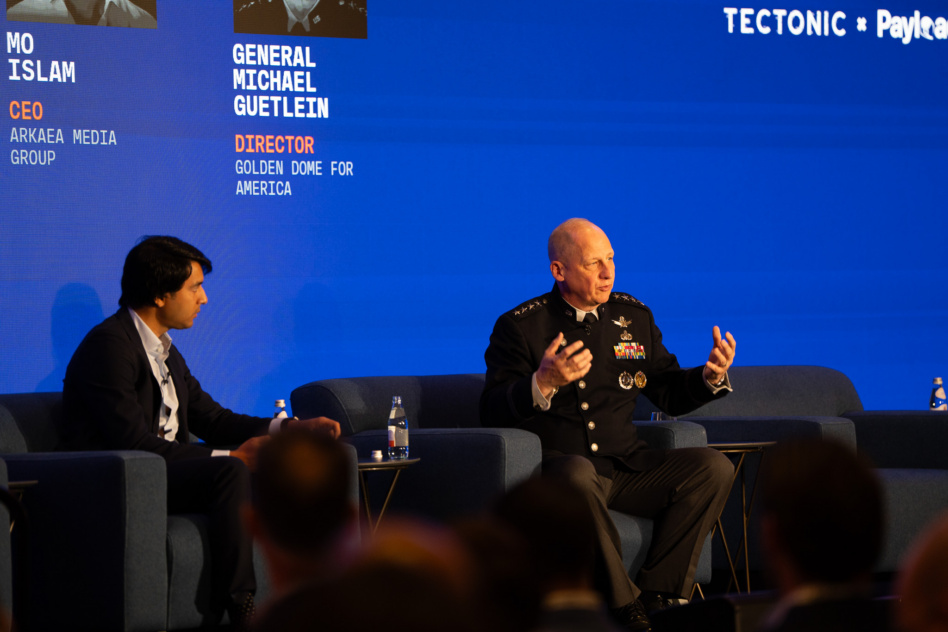
WASHINGTON—The head of the Golden Dome program said CBO’s $1.2T cost estimate for the missile-defense program is way off base.
“They’re not estimating what we’re building,” Gen. Michael Guetlein said Thursday at Inside the Dome, hosted by Payload and Tectonic. The CBO estimate is an order of magnitude higher than the $185B figure put forward by Guetlein in March.
By the numbers: Guetlein claimed that the CBO used the cost of decades-old tech, designed for a different type of fight, to create its estimate—but that Golden Dome is a new architecture to meet the current threat.
Search
RECENT PRESS RELEASES
Related Post