Fujifilm Will Offset 100% of its Electricity Usage in the US and Canada With Renewable Energy
April 21, 2026
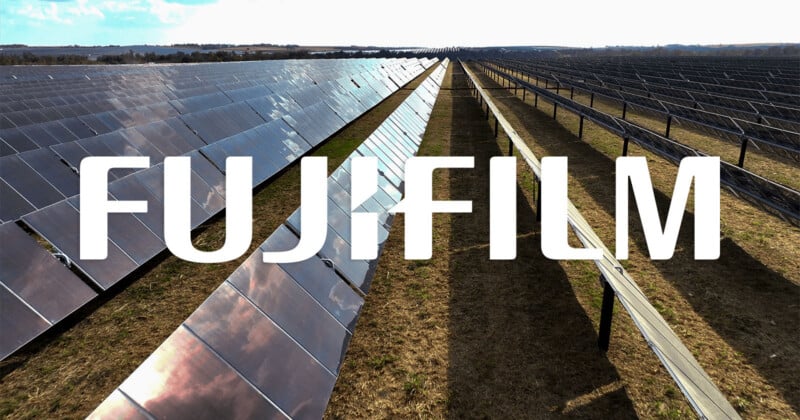
Fujifilm has announced that it will offset 100 percent of its group companies’ electricity usage in the United States and Canada using renewable energy certificates (RECs) from a new Texas-based solar energy project.
This builds upon an announcement Fujifilm made back in November 2023, when the company said it had signed a virtual power purchase agreement (VPPA) for 300,000 MWh of annual sustainable solar energy from the Blevins Solar Project.
Under this agreement, Fujifilm supports the development of 300,000 MWh of solar power at the Blevins Solar & Storage Project in Blevins, Texas. This project is operated by Geronimo Power, a Minnesota-based company.
“As this project comes online, it aligns with Fujifilm’s transition strategy, combining support for the development of new renewable electricity capacity with broader efforts to achieve measurable reductions in the environmental impacts of our operations over time,” says Chisato Yoshizawa, director, corporate vice president, and general manager of Environmental, Social & Governance (ESG) Division, Fujifilm Holdings Corporation.
Fujifilm’s VPPA corresponds to approximately 90,000 metric tons of CO2 emissions per year, which is about 10 percent of Fujifilm’s Group’s global annual CO2 emissions based on the company’s data ending the 2025 fiscal year.
Geronimo Power completed its 2,300-acre solar park in late 2025, and the site became fully operational last month. Under the VPPA, Fujifilm bought about 46 percent of the project’s nameplate capacity from Geronimo Power.
“The Blevins project reflects Geronimo’s commitment to building energy infrastructure that delivers real value to communities,” adds Gemma Smith, Vice President of Operations at Geronimo. “Working alongside partners such as Fujifilm and Bristol Myers Squibb, we’re delivering dependable power and meaningful economic investment while advancing our shared commitment to community-focused, responsibly built clean energy.”
Like many companies, Fujifilm is working toward specific targets and environmental initiatives that address climate change, including net-zero GHG emissions by fiscal year 2040 and reducing GHG emissions across the company’s entire product life cycle by 50 percent by fiscal year 2030.
“At Fujifilm, we have a proud history that spans nearly a century — leveraging our excellence in imaging to become a global leader across healthcare, life sciences, and advanced materials. Yet our purpose has always remained the same — to create and support technologies that improve lives and bring the world more smiles,” said Girish Menon, senior director, Environmental Health and Safety, Fujifilm Holdings America Corporation. “This power purchase agreement turns our purpose into action by supporting new, renewable electricity that advances our energy strategy and helps sustain Fujifilm’s broader decarbonization efforts across North America.”
Renewable energy certificates are a common way for companies to achieve higher rates of renewable energy use, particularly when they cannot generate renewable energy on-site. Essentially, a company uses a proportion of grid energy and balances that usage by purchasing certificates for a desired level of energy from renewable energy companies, like Geronimo Power in this case.
“Because the physical electricity we receive through the utility grid says nothing of its origin or how it was generated, RECs play an important role in accounting, tracking, and assigning ownership to renewable electricity generation and use. On a shared grid — whether the electricity comes from on-site or off-site resources — RECs are the instrument that electricity consumers must use to substantiate renewable electricity use claims,” the United States Environmental Protection Agency (EPA) explains.
Image credits: Fujifilm
Search
RECENT PRESS RELEASES
Related Post