Reducing oil demand through electric vehicle adoption could boost Japan’s energy security
June 1, 2026
Read the Japanese translation: EV普及による石油需要削減は日本のエネルギー安全保障の強化につながる
Following the closure of the Strait of Hormuz, Japan has sought to limit the impact of crude oil supply disruptions by releasing oil reserves, expanding imports from alternative suppliers, and offering subsidies to domestic oil wholesalers to reduce gasoline prices.
Such measures are necessary for Japan, a country heavily dependent on imported crude oil. In 2025, 94% of Japan’s oil imports were sourced from the Middle East, costing over JPY9 billion (USD57.7 million). Although Japan’s overall oil consumption has declined over the last two decades, the transportation sector remains highly reliant on gasoline and diesel, leaving it exposed to supply disruptions in the Persian Gulf.
Japan could strengthen its energy security by reducing domestic oil demand through accelerated transport electrification and increased electric vehicle (EV) adoption, rather than diversifying import sources away from the Middle East.
Japan’s oil consumption remains elevated among high-income economies
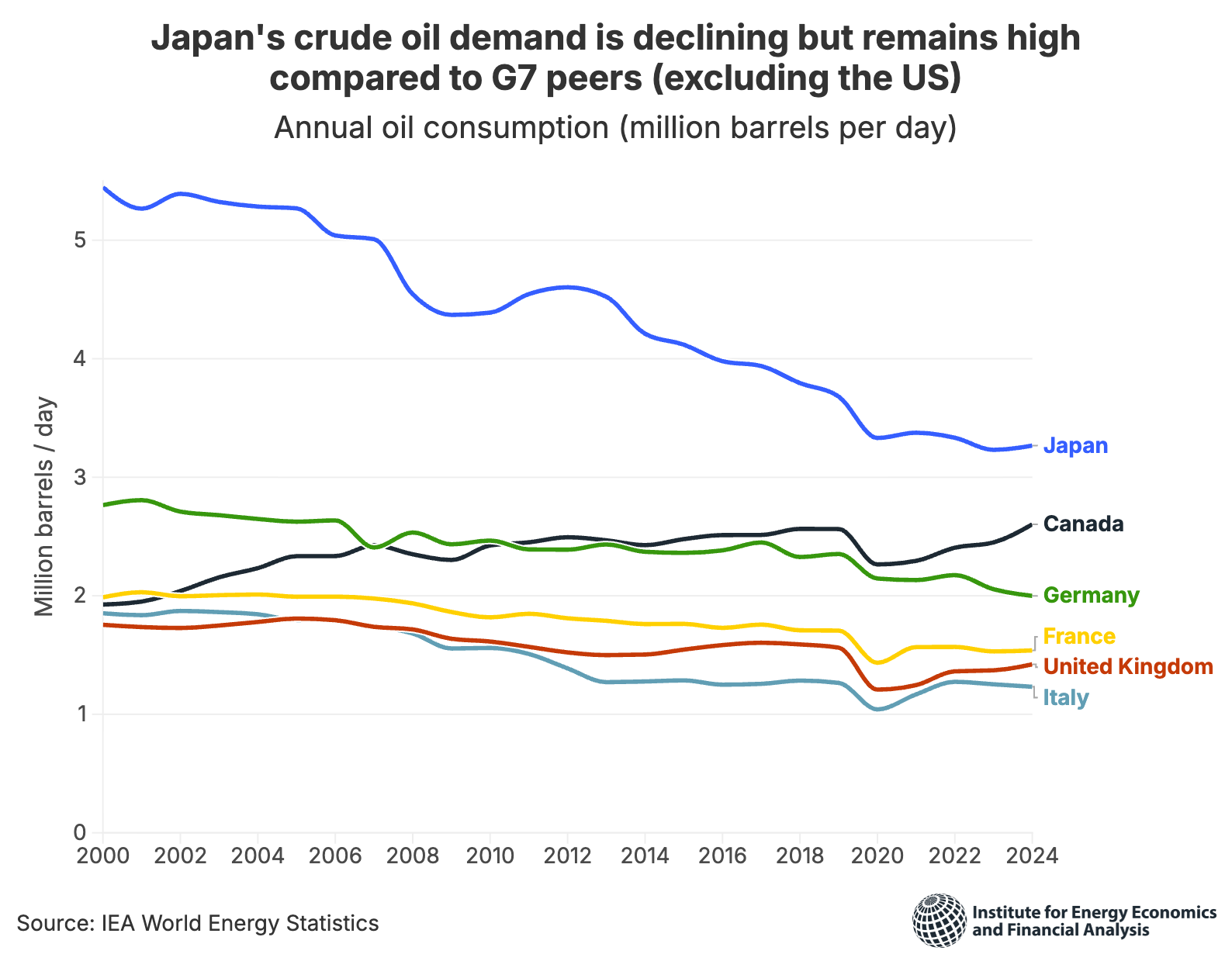
Japan’s annual crude oil consumption declined by 40% between 2000 and 2024, driven by slower economic growth, population decline, rising renewable energy and liquefied natural gas (LNG) power generation, and broader energy efficiency gains. Despite this drop, Japan’s crude oil consumption remains high compared with other Group of Seven (G7) countries. Crude oil also continued to account for the largest share of the country’s primary energy supply, at 34.5% in 2024.
A breakdown by petroleum product provides a clearer picture of Japan’s overall crude oil consumption decline. Fuel oil use fell by 69.3% between its peak in 1994 and 2023. Along with crude oil, fuel oil was primarily used for oil-fired power generation. Following the International Energy Agency’s (IEA) agreement in response to the first oil shock in 1973, Japan stopped building new baseload oil-fired power plants. Utilities have since shifted away from oil-fired generation, citing high costs, declining electricity demand due to energy conservation, and increased competition under Japan’s electricity market liberalization.
Kerosene consumption has also declined sharply by over 62% from its 2000 peak to 2023. Before the introduction of electric heating units in 1965, kerosene was commonly used for indoor heating in Japan. Since then, the adoption of electric heating units, improved building efficiency, and warmer winters have reduced demand, with kerosene consumption now concentrated in the colder Tohoku region.
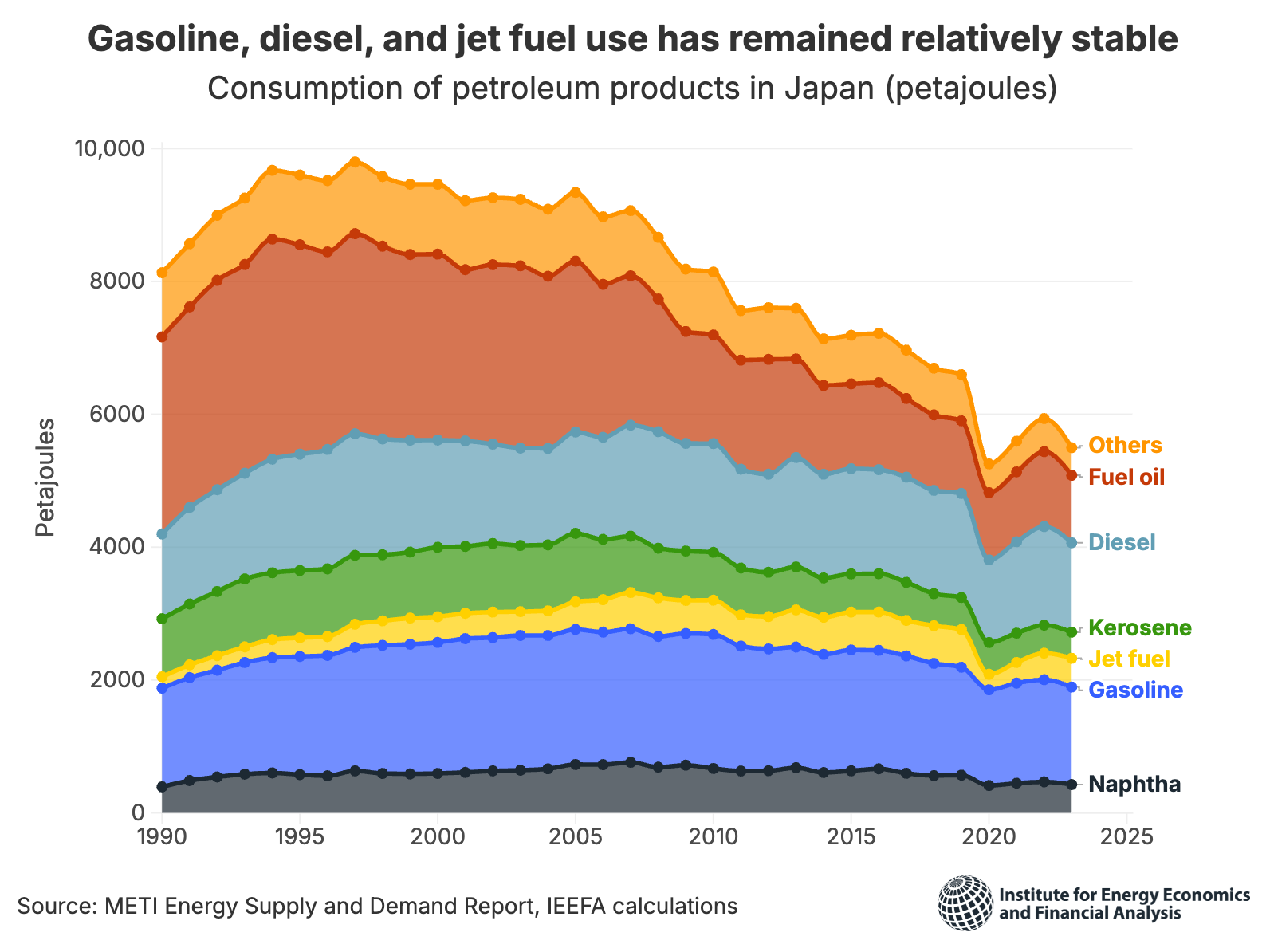
In contrast, demand for transportation fuels has declined gradually. In 2023, gasoline, diesel, and jet fuel accounted for 27%, 24%, and 8% of Japan’s petroleum product consumption, respectively. Gasoline consumption fell by 27.8% between its 2005 peak and 2023, while diesel consumption declined by 26.5% between its 1997 peak and 2023. These reductions reflect slower vehicle sales linked to Japan’s shrinking population, increased adoption of hybrid vehicles, and improved fuel efficiency. The government expects these trends to continue, projecting gasoline consumption to fall by 7.7% and diesel consumption by 3.8% between 2026 and 2030.
Japan seeks to expand crude oil import sources despite declining demand
Following the closure of the Strait of Hormuz, Japan has sought to expand alternative crude oil imports. In March 2026, Japanese Prime Minister Takaichi discussed plans to invest in oil production in Alaska. The following month, Japan agreed to import one million barrels of crude oil from Mexico.
However, given Japan’s declining oil demand, expanding import sources risks misallocating resources. The challenge is exacerbated by constrained production capacity in both Alaska and Mexico, limiting the volumes of oil Japan could realistically import. Oil production in Alaska dropped by 80% between 1988 and 2025. While new production is expected to come online, a significant increase is likely to take up to a decade to materialize. Similarly, Mexico’s crude production fell by more than 50% between 2004 and early 2024.
Accelerating transport electrification could reduce Japan’s oil demand and strengthen energy security
Even if Japan successfully replaces crude oil supplies disrupted by the closure of the Strait of Hormuz, it would remain exposed to price volatility in the global oil market. A more effective energy security strategy would be to accelerate the reduction of domestic oil demand.
Several factors driving the downward trend in oil demand are structural and likely to persist. However, well-designed policies could accelerate this trend further. As part of its February 2025 Plan for Global Warming Countermeasures, the Japanese government announced targets to electrify the transportation sector. These include installing 300,000 charging sites by 2030 and increasing the share of electrified vehicles — including battery electric, fuel cell, plug-in hybrid, and hybrid vehicles — to 100% of new passenger vehicle sales by 2035.
To achieve these goals, the Japanese government allocated JPY129 billion (USD825 million) in the fiscal year (FY) 2024 through its Clean Energy Vehicle subsidy program to support the purchase of battery EVs, plug-in hybrids, and fuel cell vehicles. It also earmarked JPY5.5 billion (USD35.2 million) in FY2024–FY2025 for subsidies to encourage households and businesses to install charging and discharging equipment that enable EVs to function as energy storage systems.
In 2025, the government allocated an additional JPY36.5 billion (USD232 million) in subsidies to support the installation of EV charging infrastructure in residential buildings. The market responded positively to these policies, with the number of EV charging sites across Japan increasing 41% year-on-year to 68,000 sites as of March 2025.
However, EV adoption subsidies remain modest compared to gasoline subsidies. Between 2022 and 2024, the government spent JPY6 trillion (USD38 billion) on gasoline subsidies, far exceeding the combined JPY171 billion (USD1.1 billion) allocated for EV purchases and charging infrastructure.
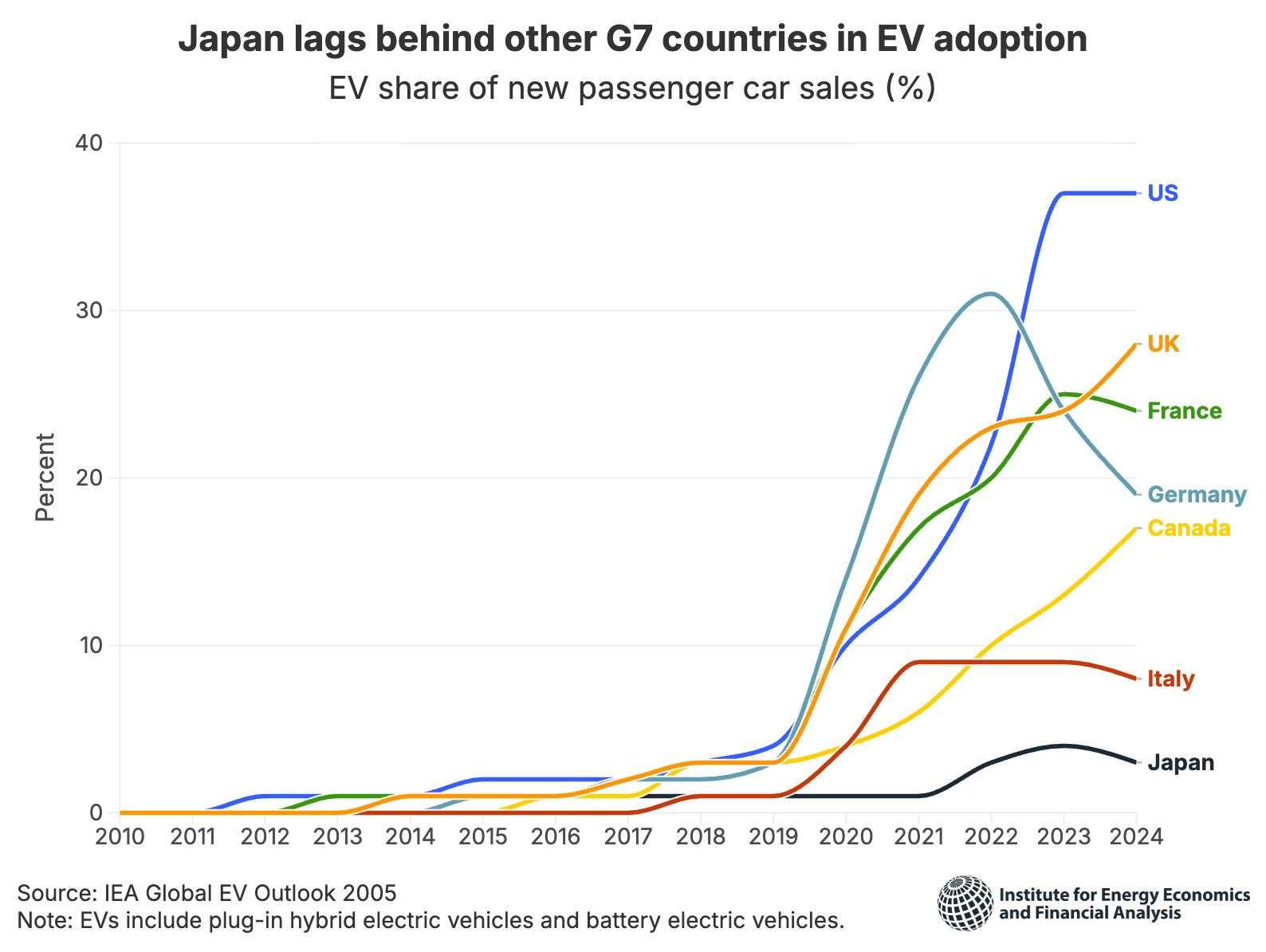
This disparity between gasoline and EV subsidies is likely to prolong Japan’s slow pace of EV adoption. Although compiling precise EV sales data in Japan is challenging due to its multiple vehicle categories, IEA data shows that EVs accounted for only 3–4% of new passenger vehicle sales between 2022 and 2024 — the lowest share among G7 countries.
The Japanese government should redirect a portion of its gasoline subsidy allocation toward EV purchases and charging infrastructure to stimulate demand and reduce the appeal of internal combustion vehicles. It should also introduce policies to lower the cost of new EVs by incentivizing domestic automotive manufacturers to mass-produce batteries for the local market.
Additionally, measures to develop the used EV market could further reduce Japan’s oil consumption. Current policies promoting EV adoption are focused on supporting new vehicle purchases, limiting used EV uptake. As a result, approximately 80% of Japan’s unsold used EVs are exported overseas. Implementing procedures and standards to accurately assess EV battery health would strengthen consumer confidence and expand demand for used EVs.
Energy security remains a top priority in Japan’s energy strategy, and reducing reliance on crude oil imports is an effective way to achieve it. Supporting local manufacturers to lower domestic EV prices, expanding EV uptake through subsidies and infrastructure investment, and developing the used EV market could directly strengthen Japan’s energy security.
Search
RECENT PRESS RELEASES
Related Post