Robot runner handily beats humans in half-marathon, setting new record
April 20, 2026
A humanoid robot’s record half-marathon run shows China’s speed in robotics.
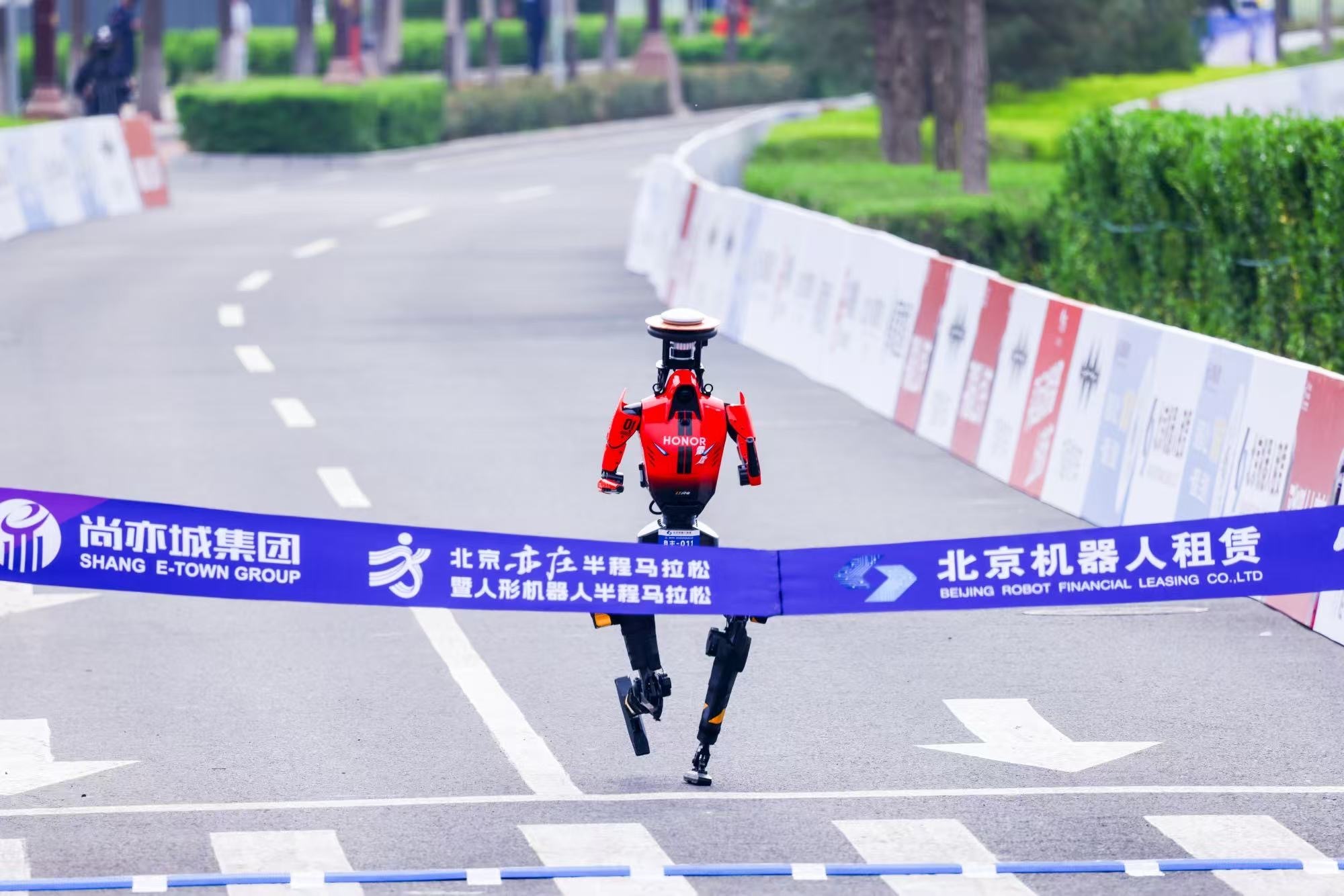
Humanoid robots outran the fastest human competitors while surpassing the human world record during a half-marathon event held in Beijing on April 19. The demonstration of fast-improving robotic speed and autonomy comes as China’s tech industry is rapidly scaling up mass production of humanoid robots to explore possible uses in the real world.
The fastest robot from Chinese smartphone-maker Honor notched a winning time of 50 minutes and 26 seconds while autonomously navigating the 13-mile (21-kilometer) route, according to the Global Times. That beat the human world record of 57 minutes and 20 seconds recently set by Ugandan long-distance runner Jacob Kiplimo during the Lisbon Half Marathon.
The winning robot design took inspiration from top human athletes by incorporating long legs measuring approximately 37 inches (95 centimeters) in length, said Du Xiaodi, a test development engineer for Honor, who spoke as a member of the winning team to The Associated Press and other publications. Xiaodi also described the robot as incorporating a custom liquid-cooling system—derived from similar cooling technology for consumer electronics—that could potentially be adapted for industrial applications.
All three top-ranked robot contestants incorporated Honor’s “Lightning” model to operate autonomously and beat the 12,000 human competitors who ran along a parallel track during the half-marathon event, according to Reuters. Last year’s inaugural half-marathon for robotic competitors saw the fastest robot record a race time of 2 hours and 40 minutes—still significantly slower than the human winner of the 2025 event. So a year’s difference has seen notable improvements for autonomous robot runners.
But overall, humanoid robots still have a long way to go in demonstrating their capability to operate in complex and sometimes chaotic environments. Autonomously navigating a half-marathon course does not necessarily lead to an immediate robotic application or spell assured success in other domains.
The bigger race for humanoid robots
The Beijing half-marathon event—which featured 300 robotic contestants fielded by about 100 primarily Chinese teams—coincides with the billions of dollars invested by Chinese and US tech industries to develop humanoid robots. Until now, industrial and domestic robot deployments have involved highly specialized robots designed to perform particular tasks. Companies are betting that humanoid robots powered by the latest AI models can eventually prove capable of stepping directly into workplaces designed for humans while flexibly tackling a wider range of tasks.
The US tech industry has seen established robotics companies such as Boston Dynamics competing with startups such as Figure AI and Agility Robotics to deploy and test humanoid robots in automotive factories and warehouses. Elon Musk’s company Tesla has also been shifting away from its traditional focus on electric cars to bet big on the development of an Optimus humanoid robot.
Meanwhile, as a sign of how fast things are moving in China’s tech industry, Honor only began expanding into robotics starting in 2025, according to the South China Morning Post. That made its half-marathon victory over more established Chinese robotics companies such as Unitree especially notable, standing out even within China’s fast-growing robotics industry with its substantial government backing.
“What appears to have changed this year is that some of China’s many humanoid companies have invested the engineering effort needed to make these systems robust enough for a long-duration race,” said Alan Fern, a robotics researcher at Oregon State University, in a New York Times interview. “That is genuinely impressive.”
The race to prove that humanoid robots are both useful and cost-effective is still more of a marathon than a sprint. Stanford University’s 2026 AI Index Report highlighted how the “strongest signals came from early stage industrial pilot projects and manufacturing-scale ambitions rather than widespread deployment.” The reports’ authors also cautioned that “it remains unclear whether the demand for humanoid robots will match the supply currently being built, who the customers will be at scale, and how quickly these platforms will move from structured factory pilot projects to unstructured environments.”
Still, that has not stopped humanoid robot makers from eyeing sprint speed records along the way. Chinese companies such as Unitree Robotics and MirrorMe Technology recently claimed their respective humanoid robots can reach speeds of 10 meters per second—approaching the average speed of 10.44 meters per second (more than 23 miles per hour) achieved by retired Jamaican runner Usain Bolt during his record-setting 100-meter sprint in 2009.
This story was updated on April 20, 2026 to reflect the fact that robots are not “taking away” records achieved by human athletes.
Search
RECENT PRESS RELEASES
Related Post