Wildfires in 2025
May 31, 2026
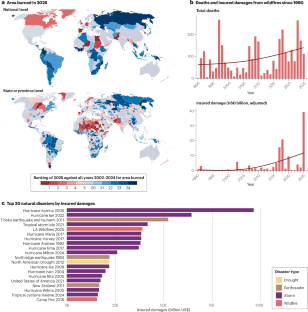
Globally, fires in 2025 burned the second-lowest area on record since 2002 and emitted the third-lowest CO2 total. Yet, a third successive year of extreme wildfire emissions prevailed in Canada, and catastrophic fires in Los Angeles, South Korea and Europe killed over 90 people and forced over 300,000 evacuations.
Key points
-
In Canada’s boreal forests, 2025 was the third successive year of extreme wildfire, with the total CO2 emissions during 2023–2025 exceeding the combined emissions of the preceding 15 years, highlighting the growing long-term effect of extreme burning in carbon-rich ecosystems.
-
January 2025 wildfires in Los Angeles killed 31 people, destroyed almost 12,000 homes, and forced over 150,000 evacuations, ranking among the top 5 costliest natural disasters in world history with an estimated US $140 billion in losses. Fast-moving fires of extreme intensity, particularly at fuel-rich wildland–urban interfaces, are hard to control, with deadly and costly consequences.
-
Repeated drought and heat extremes drove widespread and societally disruptive wildfires across Europe, causing 28 deaths and over 120,000 evacuations, prompting six countries to simultaneously request shared firefighting resources through the EU Civil Protection Mechanism, and producing the UK’s first ‘megafire’ that exceeded 10,000 ha.
This is a preview of subscription content, access via your institution
Access options
Access Nature and 54 other Nature Portfolio journals
Get Nature+, our best-value online-access subscription
$32.99 /Â 30Â days
cancel any time
Subscribe to this journal
Receive 12 digital issues and online access to articles
$119.00 per year
only $9.92 per issue
Buy this article
- Purchase on SpringerLink
- Instant access to the full article PDF.
USD 39.95
Prices may be subject to local taxes which are calculated during checkout
 The alternative text for this image may have been generated using AI.
Data availability
The authors declare that the main data discussed in this article are available in refs. 5,6 and at https://www.emdat.be/.
References
-
Jones, M. W. et al. Global rise in forest fire emissions linked to climate change in the extratropics. Science 386, eadl5889 (2024).
-
Cunningham, C. X., Williamson, G. J. & Bowman, D. M. J. S. Increasing frequency and intensity of the most extreme wildfires on Earth. Nat. Ecol. Evol. 8, 1420–1425 (2024).
-
Cunningham, C. X. et al. Climate-linked escalation of societally disastrous wildfires. Science 390, 53–58 (2025).
-
Teymoor Seydi, S. et al. Increasing global human exposure to wildland fires despite declining burned area. Science 389, 826–829 (2025).
-
Giglio, L., Boschetti, L., Roy, D. P., Humber, M. L. & Justice, C. O. The Collection 6 MODIS burned area mapping algorithm and product. Remote Sens. Environ. 217, 72–85 (2018).
-
van der Werf, G. R. et al. Landscape fire emissions from the 5th version of the Global Fire Emissions Database (GFED5). Sci Data 12, 1870 (2025).
-
Kelley, D. I. et al. State of wildfires 2024–2025. Earth Syst. Sci. Data 17, 5377–5488 (2025).
-
McNorton, J., Moreno, A., Turco, M., Keune, J. & Di Giuseppe, F. Hydroclimatic rebound drives extreme fire in California’s non�forested ecosystems. Glob. Change Biol. 31, e70481 (2025).
-
Otto, F. et al. Unequal Evidence and Impacts, Limits to Adaptation: Extreme Weather in 2025. https://doi.org/10.25560/126543 (2025).
-
Beltrán-Marcos, D., Calvo, L. & Fernández-Guisuraga, J. M. Environmental drivers of burned area and fire severity during the 2025 extreme fire season in the NW Iberian Peninsula. Fire Ecol. 22, 27 (2026).
Acknowledgements
M.W.J. was supported by the UK Natural Environment Research Council (NEV01417X1). C.A.K. was supported by the US Department of Agriculture National Institute of Food and Agriculture [award number 2022-67019-36435]. JTA was supported by NSF under award number OAI-2019762. PMF was supported by National Funds by FCT – Portuguese Foundation for Science and Technology, under the projects UID/04033/2025: Centre for the Research and Technology of Agro-Environmental and Biological Sciences and LA/P/0126/2020 (https://doi.org/10.54499/LA/P/0126/2020). The authors and their organizations remain neutral with regard to jurisdictional claims in published maps and institutional affiliations.
Author information
Authors and Affiliations
Corresponding author
Ethics declarations
Competing interests
The authors declare no competing interests.
Additional information
Publisher’s note Springer Nature remains neutral with regard to jurisdictional claims in published maps and institutional affiliations.
Rights and permissions
About this article
Cite this article
Jones, M.W., Abatzoglou, J.T., Burton, C. et al. Wildfires in 2025.
Nat Rev Earth Environ (2026). https://doi.org/10.1038/s43017-026-00793-z
-
Published:
-
Version of record:
-
DOI: https://doi.org/10.1038/s43017-026-00793-z
Search
RECENT PRESS RELEASES
Related Post